Showing posts with label Asa Thurston. Show all posts

Monday, February 9, 2015

New Things on the Horizon …


The ‘regular’ post will come later in the day; we have been working on a new website and new formatting of the posts and it’s making an early debut, today.

(There are still some indexing to finish and other stuff to fix, but the gist of it is ready to share … in a few of hours.)

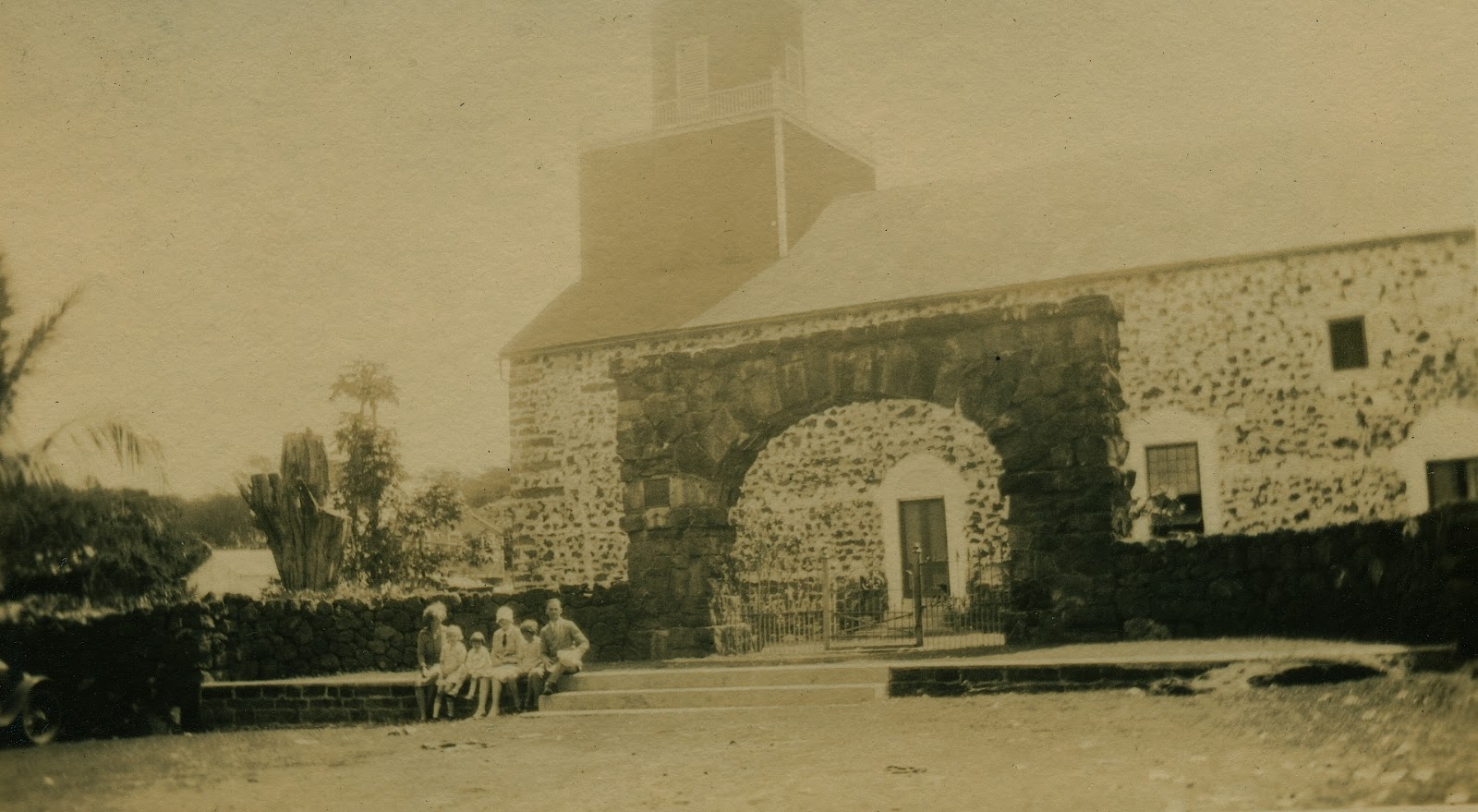
In the meantime, here’s a photo I haven’t shared yet.  The littlest girl near the middle is my mother; my grandparents are the couple on the right.

The others are noted as the “Scotts.” They were taking a tour around the Island of Hawaii, June 5-15, 1928.

They are sitting at the archway fronting Mokuʻaikaua Church in Kailua-Kona.  Construction of the church was started in 1835; it was dedicated in early-1837 (under the leadership of missionary Asa Thurston.)

The archway was built in 1910 to commemorate the 90th anniversary of the arrival of the first Protestant missionaries (1820.)

My grandfather was great grandson of Hiram and Sybil Bingham; Hiram was the leader of the Pioneer Company of missionaries to the Islands.

This year marks the 195th anniversary of the arrival of the Pioneer Company.  Plans are already underway for the celebration of the bicentennial of their arrival.  I am honored and proud to serve on the Board of the Hawaiian Mission Houses Historic Site and Archives.

If you haven’t recently visited the Mission Houses, I encourage you to visit – there are lots of things to see and learn there.

It’s on King and Kawaiahaʻo Streets (Diamond Head side of Kawaiahaʻo Church (designed by Hiram Bingham;) across King Street from the red brick Mission Memorial Building (dedicated in 1916 in anticipation of the centennial celebration.))

The Mission Memorial Building is on the site of the former Kawaiahaʻo Seminary; my great great aunt, Lydia Bingham, was principal of the seminary; her sister Lizzy later took over.

Kawaiahaʻo Seminary (for girls) and Mills School (for boys - started by Francis Damon) later merged and relocated to a site in Mānoa.  It’s now called Mid-Pacific Institute.

OK, back to the posts …

So, just to prepare you, the formatting of the posts will change – the full posts will be on the new website and short summaries will be posted in Facebook, Blogger, Google+ and LinkedIn – with links noted in the latter to get you directly to the website and the full posts.  (Special thanks to Jen Barrett for setting it up.)

An alternative (and preferred) way to get the posts is to subscribe on the website (no charge) – that way, you will receive an e-mail notice as soon as the post is made (with links to the full post.)  (Subscription sign-up is noted on the new website.)

Some other things are also in the works: ‘soon,’ podcasts, with imagery and reading of the full text, will be available.

Likewise, I am still looking for an economical way to get the posts noted on a web-based map – so you can see where these people, places and events took place.

I have a prototype on my computer … it is waaay cool and helps put a modern perspective (location) to the historical context.

Other ideas are in the works, as well.

So, stand by, the ‘regular’ post for today will be available soon.

© 2015 Hoʻokuleana LLC

Sunday, October 12, 2014

James Kahuhu


On October 23, 1819, the Pioneer Company of American Protestant missionaries from the northeast US set sail on the Thaddeus for the Sandwich Islands (now known as Hawai‘i.)  There were seven American couples sent by the ABCFM in this first company.

These included two Ordained Preachers, Hiram Bingham and his wife Sybil and Asa Thurston and his wife Lucy; two Teachers, Mr. Samuel Whitney and his wife Mercy and Samuel Ruggles and his wife Mary; a Doctor, Thomas Holman and his wife Lucia; a Printer, Elisha Loomis and his wife Maria; and a Farmer, Daniel Chamberlain, his wife and five children.

By the time the Pioneer Company arrived, Kamehameha I had died and the centuries-old kapu system had been abolished; through the actions of King Kamehameha II (Liholiho,) with encouragement by former Queens Kaʻahumanu and Keōpūolani (Liholiho’s mother,) the Hawaiian people had already dismantled their heiau and had rejected their religious beliefs.

One of the first things the missionaries did was begin to learn the Hawaiian language and create an alphabet for a written format of the language.   Their emphasis was on teaching and preaching.

The first mission station was at Kailua-Kona, where they first landed in the Islands, then the residence of the King (Liholiho, Kamehameha II;) Asa and Lucy Thurston manned the mission, there.

Liholiho was Asa Thurston's first pupil. His orders were that “none should be taught to read except those of high rank, those to whom he gave special permission, and the wives and children of white men.”

James Kahuhu and John ʻlʻi were two of his favorite courtiers, whom he placed under Mr. Thurston's instruction in order that he might judge whether the new learning was going to be of any value.  (Alexander, The Friend, December 1902)

In 1820, Missionary Lucy Thurston noted in her Journal, “The king (Liholiho, Kamehameha II) brought two young men to Mr. Thurston, and said: ‘Teach these, my favorites, (John Papa) Ii and (James) Kahuhu. It will be the same as teaching me. Through them I shall find out what learning is.’”

“To do his part to distinguish and make them respectable scholars, he dressed them in a civilized manner. They daily came forth from the king, entered the presence of their teacher, clad in white, while his majesty and court continued to sit in their girdles.”

“Although thus distinguished from their fellows, in all the beauty and strength of ripening manhood, with what humility they drank in instruction from the lips of their teacher, even as the dry earth drinks in water!”

“After an absence of some months, the king returned, and called at our dwelling to hear the two young men, his favorites, read. He was delighted with their improvement, and shook Mr. Thurston most cordially by the hand - pressed it between both his own - then kissed it.” (Lucy Thurston)

Kahuhu was among the earliest of those associated with the chiefs to learn both spoken and written words. Kahuhu then became a teacher to the chiefs.

In April or May 1821, the King and the chiefs gathered in Honolulu and selected teachers to assist Mr Bingham.  James Kahuhu, John ʻĪʻi, Haʻalilio, Prince Kauikeaouli were among those who learned English.  (Kamakau)

On October 7, 1829, it seems that Kauikeaouli (Kamehameha III) set up a legislative body and council of state when he prepared a definite and authoritative declaration to foreigners and each of them signed it.  (Frear – HHS)  Kahuhu was one of the participants.

King Kamehameha III issued a Proclamation "respecting the treatment of Foreigners within his Territories."  It was prepared in the name of the King and the Chiefs in Council:  Kauikeaouli, the King; Gov. Boki; Kaʻahumanu; Gov. Adams Kuakini; Manuia; Kekūanāoʻa; Hinau; ʻAikanaka; Paki; Kīnaʻu; John ʻIʻi and James Kahuhu.

In part, he states, "The Laws of my Country prohibit murder, theft, adultery, fornication, retailing ardent spirits at houses for selling spirits, amusements on the Sabbath Day, gambling and betting on the Sabbath Day, and at all times.  If any man shall transgress any of these Laws, he is liable to the penalty, - the same for every Foreigner and for the People of these Islands: whoever shall violate these Laws shall be punished."

It continues with, "This is our communication to you all, ye parents from the Countries whence originate the winds; have compassion on a Nation of little Children, very small and young, who are yet in mental darkness; and help us to do right and follow with us, that which will be for the best good of this our Country."

The Hawaiʻi State Archives is the repository of significant historic documents for Hawaiʻi; reportedly, the oldest Hawaiian language document in its possession is a letter written by James Kahuhu.

Writing to Chief John Adams Kuakini, Kahuhu’s letter was partially in English and partially Hawaiian (at that time, Kuakini was learning both English and written Hawaiian.)

Below is a transcription of Kahuhu's letter.  (HSA)

Oahu. Makaliʻi 12, 1822.
Kawaiahaʻo.
My Dear Chief Mr. John Adams Kuakini. I love you very much. This is my communication to you. Continue praying to Jehovah our God. Keep the Sabbath which is God’s holy day. Persevere in your learning the good Gospel of Jehovah. By and by perhaps we shall know the good word of Jesus Christ. Then we shall know the good word of God.

A few begin to understand the good word of God. I am very pleased with the good word of God which has been brought here to enlighten this dark land. Who will save our souls and take them up to heaven, the place of eternal life. I am presently teaching Nahiʻenaʻena. I am teaching seven of them. Nahienaena, Kauikeaouli, Halekiʻi, Ulumāheihei Waipa, Ulumāheihei a Kapalahaole, Nakapuai and Noaʻawa are the students I am teaching. I may have more in the future. You must obey your good teacher, Hopu. Persevere with him and don’t give up.

Keliʻiahonui has learned to write quite well, he sent a letter to Oahu. Tell Hopu that Keliʻiahonui misses him. The King is learning to write from Mr. Bingham. Kalanimōku, Kīnaʻu and Kekauōnohi are learning to write Hawaiian. Mr. Thurston is their teacher. Here is another word to you, if you see Kalapauwahiole tell him to come to Oahu as I would like very much for him to come to Oahu.
James Kahuhu

(Makaliʻi was the name of a month: December on Hawai‘i, April on Moloka'i, October on Oʻahu.  (Malo))

The image shows the first page of the Kahuhu letter to Kuakini (HSA.)    In addition, I have included other images in a folder of like name in the Photos section on my Facebook and Google+ pages.

Follow Peter T Young on Facebook  

Follow Peter T Young on Google+    

Follow Peter T Young on LinkedIn   

© 2014 Hoʻokuleana LLC

Sunday, May 11, 2014

Happy Mother’s Day!


The image shows my mother and grandmother in 1928 (my mother is the little girl sitting to the left, her mother is sitting nearby, wearing a hat.)

The scene is at Kailua-Kona at a site known as Pa O ʻUmi; over the years, most of this outcrop of land has been covered over with Aliʻi Drive – a small remnant remains extending beyond today’s seawall.

Here is where Chief ʻUmi-a-Liloa (who reigned about the same time Christopher Columbus was crossing the Atlantic) landed when he first came to Kailua by canoe, moving the Island’s Royal Center from Waipiʻo to Kailua.

On this point of rock ʻUmi ordered his attendant to dry his precious feather cloak (ʻahuʻula.)  (The site is also referred to as Ka Lae O ʻAhuʻula.)

My mother was the great-great grand-daughter of Hiram Bingham, leader of first missionaries to Hawaiʻi who first landed in the Islands, here at Kailua-Kona in 1820.  (Mokuaikaua Church, built by Bingham’s fellow missionary, Asa Thurston, is in the background, as well as Huliheʻe Palace (to the right.))

Follow Peter T Young on Facebook 

Follow Peter T Young on Google+ 

Follow Peter T Young on LinkedIn   

© 2014 Hoʻokuleana LLC

Thursday, April 4, 2013

Pioneer Company


The coming of Henry Obookiah (ʻŌpūkahaʻia) and other young Hawaiians to the continent had awakened a deep Christian sympathy in the churches and moved the American Board of Commissioners for Foreign Missions (ABCFM) to establish a mission in the Hawaiian Islands.

Among the other Hawaiian students at the Foreign Mission School were Thomas Hopu, William Kanui, John Honoliʻi and Prince Humehume (son of Kauaiʻi’s King Kaumuali‘i.)

When asked “Who will return with these boys to their native land to teach the truths of salvation?”  Hiram Bingham and his classmate, Asa Thurston, were the first to respond and offer their services to the Board.  (Congregational Quarterly)

Bingham and Thurston were ordained at Goshen, Ct on September 29, 1819; it was the first ordination of foreign missionaries in the State of Connecticut.

On October 23, 1819, the Pioneer Company of American Protestant missionaries from the northeast US set sail on the Thaddeus for the Sandwich Islands (now known as Hawai‘i.)

There were seven American couples sent by the ABCFM to convert the Hawaiians to Christianity in this first company.

These included two Ordained Preachers, Hiram Bingham and his wife Sybil and Asa Thurston and his wife Lucy; two Teachers, Mr. Samuel Whitney and his wife Mercy and Samuel Ruggles and his wife Mary; a Doctor, Thomas Holman and his wife Lucia; a Printer, Elisha Loomis and his wife Maria; and a Farmer, Daniel Chamberlain, his wife and five children.

Although a large part of the motivation for the Hawaiʻi missionary movement, Henry ʻŌpūkahaʻia unfortunately died of typhus fever in 1818 and didn’t return home to teach the gospel.  However, his book, “Memoirs of Henry Obookiah,” was the inspiration for this and subsequent Hawaiian missionary companies.

The Prudential Committee of the ABCFM in giving instructions to the pioneers of 1819 said: “Your mission is a mission of mercy, and your work is to be wholly a labor of love. … Your views are not to be limited to a low, narrow scale, but you are to open your hearts wide, and set your marks high. You are to aim at nothing short of covering these islands with fruitful fields, and pleasant dwellings and schools and churches, and of Christian civilization.”  (The Friend)

After 164-days at sea, on April 4, 1820, the Thaddeus arrived and anchored at Kailua-Kona on the Island of Hawaiʻi.  Hawai‘i’s “Plymouth Rock” is about where the Kailua pier is today.

By the time the Pioneer Company arrived, Kamehameha I had died and the centuries-old kapu system had been abolished; through the actions of King Kamehameha II (Liholiho,) with encouragement by former Queens Kaʻahumanu and Keōpūolani (Liholiho’s mother,) the Hawaiian people had already dismantled their heiau and had rejected their religious beliefs.

One of the first things Bingham and his fellow missionaries did was begin to learn the Hawaiian language and create an alphabet for a written format of the language.   Their emphasis was on teaching and preaching.

On July 14, 1826, the missionaries selected a 12-letter alphabet for the written Hawaiian language, using five vowels (a, e, i, o, and u) and seven consonants (h, k, l, m, n, p and w) in their "Report of the committee of health on the state of the Hawaiian language."   The report is signed by Hiram Bingham and Levi Chamberlain.

The arrival of the first company of American missionaries in Hawaiʻi marked the beginning of Hawaiʻi’s phenomenal rise to literacy. The chiefs became proponents for education and edicts were enacted by the King and the council of chiefs to stimulate the people to reading and writing.

By 1831, in just eleven years from the first arrival of the missionaries, Hawaiians had built 1,103 schoolhouses. This covered every district throughout the eight major islands and serviced an estimated 52,882 students.  (Laimana)

The proliferation of schoolhouses was augmented by the printing of 140,000 copies of the pīʻāpā (elementary Hawaiian spelling book) by 1829 and the staffing of the schools with 1,000-plus Hawaiian teachers.  (Laimana)

Interestingly, these same early missionaries taught their lessons in Hawaiian, rather than English.  In part, the mission did not want to create a separate caste and portion of the community as English-speaking Hawaiians.  In later years, the instruction, ultimately, was in English.

Within five years of the missionaries’ arrival, a dozen chiefs had sought Christian baptism and church membership, including the king’s regent Kaʻahumanu.  The Hawaiian people followed their native leaders, accepting the missionaries as their new priestly class.  The process culminated in Hawaiian King Kamehameha III’s adoption of Christianity and a Biblically-based constitution in 1840.  (Schulz)

Over the course of a little over 40-years (1820-1863) (the “Missionary Period”,) about 180-men and women in twelve Companies served in Hawaiʻi to carry out the mission of the ABCFM in the Hawaiian Islands.

Today, the Hawaiian Mission Children's Society, a nonprofit educational institution and genealogical society, exists to promote an understanding of the social history of nineteenth-century Hawai‘i and its critical role in the formation of modern Hawai‘i.

The Society operates the Hawaiian Mission Houses Historic Site and Archives, comprised of three historic houses and a research archives with reading room. The Society also compiles the genealogical records of the American Protestant missionaries in Hawai‘i and promotes the participation of missionary descendants in the Society's activities.

Through the Site and Archives, the Society collects and preserves the documents, artifacts and other records of the missionaries in Hawai‘i's history; makes these collections available for research and educational purposes; and interprets the historic site and collections to reflect the social history of nineteenth century Hawai‘i and America.

The image shows the early Mission house and Chapel in Honolulu (the precursor of today’s Kawaiahaʻo Church.)  More images are added to a folder of like name in the Photos section on my Facebook and Google+ pages.

Follow Peter T Young on Facebook  

Follow Peter T Young on Google+  

© 2013 Hoʻokuleana LLC

Sunday, March 17, 2013

Kamehameha III (Kauikeaouli)


Kauikeaouli appeared to be stillborn, but was revived.  He was the second son of Kamehameha I.   His birth site is at the head of Keauhou Bay (the Daughters of Hawaiʻi own and maintain the area.)

His exact birth date is not known; however, the generally accepted date is August 11, 1813.  Never-the-less, Kauikeaouli was apparently an admirer of Saint Patrick and chose to celebrate his birthday on March 17.

Kauikeaouli spent the first 5-years of his life with Chief Kaikioʻewa in the ‘O‘oma ahupuaʻa in Kona (the place where he first learned to be a king.)

Other early education the infant Prince received was at Kailua-Kona, from the Rev. Asa Thurston and Thomas Hopu, a native Hawaiian who had been educated on the continent and who came with the first missionaries to Hawaiʻi.  In Honolulu, the Prince was the pupil of Rev. Hiram Bingham.

The younger brother of Liholiho, he served as Hawai‘i’s King from 1825 to 1854 – the longest ruling monarch over the Hawaiian Kingdom.  Kauikeaouli was a pre-teen when he ascended to the throne; in the early years of his rule, he served under a regency with Kaʻahumanu, his father’s favorite queen, as joint ruler.

During the early- to mid-1800s timeframe, there were significant changes occurring that greatly affected the Hawaiian people:

  • his mother Keōpūolani  and Kaʻahumanu convinced Liholiho to effectively break the Kapu system
  • the health of many Hawaiians was weakened by exposure to new diseases, common cold, flu, measles, mumps, smallpox and venereal diseases
  • as more ships came in, many of those who came to Hawaiʻi chose to stay and settle
  • Hawaiʻi changed from a land of all Hawaiians to a place of mixed cultures, languages and races
  • many new plants and animals were brought to the islands, both on purpose and by accident
  • new products by foreign ships were traded
  • the economy and everyday life was changing from a subsistence way of life to a commodity-based economy that started with barter and trade, that eventually changed to a monetary system
  • there was growth of business centers, where people ended up living closer to one another, typically surrounding the best seaports for western ships (small towns soon grew into large cities)

There is scarcely in history, ancient or modem, any King to whom so many public reforms and benefits can be ascribed, as the achievements of his reign. Yet what King has had to contend with so many difficulties as King Kamehameha III? (The Polynesian, 1855)

“That the existence of the King, chiefs and the natives, can only be preserved by having a government efficient for the administration of enlightened justice, both to natives and the subjects of foreign powers residing in the islands, and that chiefly through missionary efforts the natives have made such progress in education and knowledge, as to justify the belief that by further training, they may be rendered capable of conducting efficiently the affairs of government; but that they are not at present so far advanced.”  (Kamehameha IV, In Obituary to the departed King)

In private life, Kamehameha III  was mild, kind, affable, generous and forgiving. He was never more happy than when free from the cares and trappings of state. He could enjoy himself sociably with his friends, who were much attached to him. (The Polynesian, 1855)

Having associated much, while a boy, with foreigners, he continued to the last to be fond of their company. Without his personal influence, the law to allow them to hold lands in fee simple could never have been enacted; neither could conflicting claims to land have been settled and registered by that most useful institution, the Board of Land Commissioners.  (The Polynesian, 1855)

It is hardly possible to conceive any King more generally beloved than was Kamehameha III; more universally obeyed, or more completely sovereign in the essential respect of independent sovereignty, that of governing his subjects free from any influence or control coming from beyond the limits of his own jurisdiction.  (The Polynesian, 1855)

Under his leadership, Hawaiʻi changed from an isolated island kingdom to a recognized member of the modem world. Many of the things he did as king still influence life in Hawaiʻi today.  (Kamehameha Schools Press)

The following are only some of the many accomplishments of Kamehameha III (Kauikeaouli:)

  • On June 6, 1825, Kauikeaouli was proclaimed king of Hawaiʻi. To the people he said, “Where are you, chiefs, guardians, commoners?  I greet you.  Hear what I say! My kingdom I give to God.  The righteous chief shall be my chief, the children of the commoners who do you right shall be my people, my kingdom shall be one of letters.”  (Kamakau - Kamehameha Schools Press)
  • June 7, 1839, he signed the Declaration of Rights (called Hawai‘i’s Magna Charta) that, in part, noted, "God hath made of one blood all nations of men to dwell on the earth, in unity and blessedness. God has also bestowed certain rights alike on all men and all chiefs, and all people of all lands.”
  • June 17, 1839 he issued the Edict of Toleration permitting religious freedom for Catholics in the same way as it had been granted to the Protestants.
  • June 28, 1839 he founded Chief’s Children’s School (The Royal School;) the main goal of this school was to groom the next generation of the highest ranking chiefs’ children of the realm and secure their positions for Hawaiʻi’s Kingdom.  (Missionaries Amos and Juliette Cooke were selected to teach the 16 royal children and run the school.)
  • October 8, 1840 (the King was about 27-years-old) he enacted the Constitution of 1840 that, in part, changed the government from one of an absolute monarchy to a constitutional monarchy. It provided for a separation of powers between three branches of government, with executive power in the hands of the king, the kuhina nui (similar to a prime minister) and four governors; a bicameral legislative body consisting of a house of nobles and a house of representatives, with the house of representatives elected by the people; and a judiciary system, including a supreme court.
  • April 27, 1846 he declared that “the forests and timber growing therein shall be considered government property, and under the special care of the Minister of the Interior ...;” effectively starting the process of protecting our mauka watersheds.
  • January 27, 1848 through March 7, 1848 he participated in what we refer to as the “Great Māhele” that was a reformation of the land system in Hawaiʻi and allowed private ownership
  • June 14, 1852 he enacted the Constitution of 1852 that expanded on the Declaration of Rights, granted universal (adult male) voting rights for the first time and changed the House of Nobles from a hereditary body to one where members served by appointment by the King. It also institutionalized the three branches of government and defined powers along the lines of the American Constitution.
  • Toward the end of Kauikeaouli’s reign there were 423 schools in Hawaiʻi with an enrollment of over twelve-thousand-students. Most of the schools were elementary schools using Hawaiian as the language of instruction.

Kauikeaouli (Kamehameha III) died December 15, 1854 (at the age of 41.)

Happy Birthday and Cheers to Kauikeaouli, Kamehameha III.  I think I'll have a Guinness (or two) tonight in his honor.  (Happy St Patrick’s Day.)

The image shows Kamehameha III (Kauikeaouli.)   In addition, I have included other related images in a folder of like name in the Photos section on my Facebook and Google+ pages.

Follow Peter T Young on Facebook  

Follow Peter T Young on Google+  

© 2013 Hoʻokuleana LLC

Thursday, December 6, 2012

Mokuʻaikaua Church


This stone and mortar building, completed in 1837, is the oldest surviving Christian church in the state of Hawaiʻi, started by the first Protestant missionaries to land in Hawaiʻi.

With the permission of Liholiho (Kamehameha II), the missionaries built a grass house for worship in 1823 and, later, a large thatched meeting house.

Missionary Asa Thurston directed the construction of the present Mokuʻaikaua Church, then the largest building in Kailua-Kona. Its massive size indicates the large Hawaiian population living in or near Kailua at that time.

Mokuʻaikaua, with its 112-foot-tall steeple, is a reminder of the enthusiasm and energy of the first American missionaries and their Hawaiian converts.

Built of stones taken from a nearby heiau and lime made of burned coral, it represents the new western architecture of early 19th-century Hawaiʻi and became an example that other missionaries would imitate.

The original thatch church which was built in 1823 but was destroyed by fire in 1835, the present structure was completed in 1837. Mokuʻaikaua takes its name from a forest area above Kailua from which timbers were cut and dragged by hand to construct the ceiling and interior.

Mokuʻaikaua Church is centered in a small level lot near the center of Kailua. Its high steeple stands out conspicuously and has become a landmark from both land and sea.

Huge corner stones, said to have been hewn by order of King ʻUmi in the 16th century for a heiau, were set in place and offers evidence of the heavy labor which contributed to the Church's construction.

The central core of the steeple is polygonal with alternating sections of wide and narrow clapboard.  The wider sections are articulated with louvered arches. The 48 by 120 feet lava rock and coral mortared church is capped with a gable roof.

Construction beams are made from ʻōhiʻa wood. Pieces of the wooden structure were joined with ʻōhiʻa pins.  The spanning beams are fifty feet long and are made from ʻōhiʻa timbers. Corner stones were set in place 20 to 30 feet above the ground.

Mokuʻaikaua Church is the first and one of the largest stone churches in Hawaiʻi, outstanding for its simple, well-proportioned mass and construction.

The interior open timber structure with high galleries is a fine architectural and engineering design. The architectural interest is further enhanced by the church's historical significance (it is on the Register of Historic Places.)

In 1910, a memorial arch was erected at the entrance to the church grounds to commemorate the arrival of the first missionaries.

Congregationalist missionaries from Boston crossed the Atlantic Ocean, rounded Cape Horn, aboard the Brig Thaddeus.   A replica of the Thaddeus is in Mokuʻaikaua Church.

On the morning of April 4, 1820, 163 days from Boston, the Congregational Protestant missionaries, led by Hiram Bingham, aboard the Thaddeus, came to anchor off the village of Kailua.

They came ashore at the “Plymouth Rock” of Hawaiʻi, where Kailua Pier now stands.  Christian worship has taken place near this site since 1820.  Mokuʻaikaua is known as the "First Christian Church of Hawaiʻi."

Inspired by the dream of Hawaiian Henry ʻŌpūkahaʻia, seven couples were sent by the American Board of Commissioners for Foreign Missions to convert the Hawaiians to Christianity.

Two Ordained Preachers Hiram Bingham and his wife Sybil and Asa Thurston and his wife Lucy; Two Teachers, Mr. Samuel Whitney and his wife Mercy and Samuel Ruggles and his wife Mary; A Doctor, Thomas Holman and his wife Lucia; A Printer, Elisha Loomis and his wife Maria; A Farmer, Daniel Chamberlain, his wife and five children.

The Thurstons remained in Kailua, while their fellow missionaries went to establish stations on other Hawaiian islands.

The photo was taken in 1928, it shows my grandparents and mother (on the right is my grandfather, the great grandson of Hiram Bingham; the little girl (shortest-near the middle) to the right of my grandmother is my mother, the great-great granddaughter of Hiram Bingham.)

In addition to this, I have included other images of Mokuʻaikaua Church in a folder of like name in the Photos section on my Facebook and Google+ pages.

http://www.facebook.com/peter.t.young.hawaii

http://plus.google.com/108947657421184863425

© 2012 Hoʻokuleana LLC

Monday, August 20, 2012

Ka Pā Nui o Kuakini (Great Wall of Kuakini)


Captain George Vancouver gave a few cattle to Kamehameha I in 1793; Vancouver strongly encouraged Kamehameha to place a kapu on them to allow the herd to grow.

In the decades that followed, cattle flourished and turned into a dangerous nuisance.  By 1846, 25,000 wild cattle roamed at will and an additional 10,000 semi‐domesticated cattle lived alongside humans.

John Adams Kuakini was an important adviser to Kamehameha I in the early stages of the Kingdom of Hawai‘i.

When the Kingdom's central government moved to Lāhaina in 1820, Kuakini’s influence expanded on Hawaiʻi Island, with his appointment as the Royal Governor of Hawaiʻi Island, serving from 1820 until his death in 1844.

During his tenure, Kuakini built many of the historical sites that dominate Kailua today.  The Great Wall of Kuakini, probably a major enhancement of an earlier wall, was one of these.

The Great Wall of Kuakini extends in a north-south direction for approximately 6 miles from Kailua to near Keauhou, and is generally 4 to 6-feet high and 4-feet wide.

Built between 1830 and 1840, the Great Wall of Kuakini separated the coastal lands from Kailua to Keauhou from the inland pasture lands.

The mortar-less lava-rock wall has had varying opinions regarding the purpose of its construction.

Speculation has ranged from military/defense to the confinement of grazing animals; however, most seem to agree it served as a cattle wall, keeping the troublesome cattle from wandering through the fields and houses of Kailua.

It is likely that the function of the wall changed over time, as the economic importance of cattle grew and the kinds and density of land use and settlement changed.

Kuakini was responsible for other changes and buildings in the Kona District during this era.

He gave land to Asa Thurston to build Moku‘aikaua Church.

He built Huliheʻe Palace in the American style out of native lava, coral lime mortar, koa and ‘ōhi‘a timbers.  Completed in 1838, he used the palace to entertain visiting Americans and Europeans with great feasts.

He made official visits to all ships that arrived on the island, offering them tours of sites, such as the Kīlauea volcano.

He was born about 1789 with the name Kaluaikonahale.  With the introduction of Christianity, Hawaiians were encouraged to take British or American names.

He chose the name John Adams after John Quincy Adams, the US president in office at the time.  He adopted the name, as well as other customs of the US and Europe.

Kuakini was the youngest of four important siblings: sisters Queen Kaʻahumanu, Kamehameha's favorite wife who later became the powerful Kuhina nui, Kalākua Kaheiheimālie and Namahana-o-Piʻia (also queens of Kamehameha) and brother George Cox Kahekili Keʻeaumoku.

He married Analeʻa (Ane or Annie) Keohokālole; they had no children.  (She later married Caesar Kapaʻakea.  That union produced several children (including the future King Kalākaua and Queen Liliʻuokalani.))

Hulihe‘e Palace is now a museum run the Daughters of Hawaiʻi, including some of his artifacts.

A highway is named "Kuakini Highway," which runs from the Hawaii Belt Road through the town of Kailua-Kona, to the Old Kona Airport Recreation Area.

He is also the namesake of Kuakini Street in Honolulu, which is in turn the namesake of the Kuakini Medical Center on it.

The image shows a portion of the Great Wall of Kuakini; in addition, I have added a few other images and maps of the wall n a folder of like name in the Photos section on my Facebook page.

http://www.facebook.com/peter.t.young.hawaii

© 2012 Hoʻokuleana LLC

Monday, May 14, 2012

Laniākea – Home of Missionaries Asa and Lucy Thurston


Reverend Asa and Lucy Thurston were in the first company of American Christian Missionaries to the Hawaiian Islands, arriving in Kailua-Kona on the Thaddeus in 1820.

They made their home in Kailua Village, in a home the Hawaiians named Laniākea.  Thurston received Laniākea, a 5.26 acre homestead parcel as a gift from Governor Kuakini.

As noted by Rev. Sereno Edwards Bishop, in his book “Reminiscences Of Old Hawaii” (1916:) “In the early (1830s,) Kailua was a large native village, of about 4,000 inhabitants rather closely packed along one hundred rods of shore, and averaging twenty rods inland.”

“It had been the chief residence of King Kamehameha, who in 1819 died there in a rudely built stone house whose walls are probably still standing on the west shore of the little bay. Nearby stood a better stone house occupied by the doughty Governor Kuakini.”

“All other buildings in Kailua were thatched, until Rev. Artemas Bishop built his two-story stone dwelling in 1831 and Rev. Asa Thurston in 1833 built his wooden two-story house at Laniakea, a quarter of a mile inland.”

“Most of the native huts were thatched with the stiff pili grass. The better ones were thatched with lau-hala (pandanus leaf) or with la-i.”

The following are excerpts from letters Lucy Thurston during her time in Hawaii, from "Life and Times of Mrs. Lucy G. Thurston" (1882;) her own words best describe the property (including its cave and pond:)

“Back of the village on that arid slope, a third of a mile from the shore, was an unoccupied, eligible site for a house and grounds. There we set about making such a home as circumstances would allow, and as the double responsibilities required, of molding heathen society, and of forming the characters of our children.

“Five acres were enclosed with a stone wall three feet wide and six feet high, with simply the front gate for entrance. A large thatched house was erected. Space was allowed for a yard twenty-five feet in breadth. Two close partition walls were built six feet high, running from the outer wall each side of the front gate, close up against the side of the house, each side of the front door.

“At the back side of the house is a hall which leads both from the dining room and study to a door, the only entrance into a retired yard of three acres. There stands another thatched house, built after the custom of the country. The frame is tied together with the very strong bark of a certain tree.

“Then from the ridge-pole to the ground, the frame is entirely covered with long slender poles, tied within a few inches of each other, over which the long lauhala leaves are laid, leaving the two ends to hang down on the outside.

“That house is the home of our children. There is our family sitting room, eighteen feet square, and there are our sleeping apartments. And inasmuch as I often wish to invite my native friends to that sitting room, we enclosed the further bed room in a yard sixty feet square, with a wall six feet high, coming up close to the house on both sides.

“In our kitchen yard, directly opposite and within a few feet of each other, are the two mouths of a large cave of volcanic formation.

“The larger opening gives us the novelty of a subterraneous walk one-fourth of a mile toward the sea, where we reach a pond of brackish water. Some of the rooms of this cave are quite spacious. The natives made it a place of concealment in times of war.

“The smaller mouth of the cave leads into a low cave which extends three miles up the mountain, where there is an opening, and when obliged to hide in the lower cave, the natives stole through the upper one to procure their food.

“The name of the cave is Laniakea, signifying the broad heavens. As it is enclosed in our premises, the natives were quick to give the name to our establishment, so that it has become universally known as Laniakea.

“Thatched houses are not durable, therefore, in the course of years, we had a succession of dwellings, but this was the general arrangement. In the 12th year of the Mission, a two-storied wooden house was erected in the children's yard, and the wall for their special enclosure removed, as the times no longer required such an accommodation.”

Hawaii Register of Historic Places, September 24, 2005 notes:
Laniākea: the Asa and Lucy Thurston House site is significant for its associations with Asa and Lucy Thurston and their profound involvement with the Protestant Missionary movement in Hawaii from 1820 to 1861.

With the permission of Liholiho (Kamehameha II), the missionaries built a grass house for worship in 1823 and, later, a large thatched meeting house.

Missionary Asa Thurston directed the construction of the present Mokuʻaikaua Church, then the largest building in Kailua. Its massive size indicates the large Hawaiian population living in or near Kailua at that time.

The image shows my Grandparents and my Mother in the Laniākea house ruins (in 1928) – (Great grandson and Great-great grand-daughter of Hiram Bingham, leader of missionaries to Hawai‘i, who came to Hawai‘i with Asa Thurston)

I have also added additional images of Laniākea in a folder of like name in the Photos section.  Included are two landscape scenes drawn by their daughter Persis Goodale Thurston Taylor, showing Kailua-Kona at 1836 (view up the hill noting Laniākea and a view down the hill to Kailua from Laniākea.)