Showing posts with label Keeaumoku. Show all posts

Saturday, February 15, 2014

Keaweaheulu


After a struggle of more than ten years, in 1791, Kamehameha succeeded in securing control over that island of Hawaiʻi (and later, the entire Hawaiian Islands chain.)

In getting there, he appointed Keʻeaumoku, Keaweaheulu, Kameʻeiamoku and Kamanawa to be his secret advisors (hoa kuka malu) and counselors (hoaʻahaʻolelo) in ruling the island. They alone were consulted about what would be for the good or the ill of the country.  (Kamakau)

Keaweaheulu Kaluaʻapana was a Hawaiian high chief and maternal great-grandfather of King Kalākaua and Queen Liliʻuokalani. He was among Kamehameha I's council of chiefs and was one of the “Kona Uncles.”  His father was the High Chief Heulu. He belonged to the ʻI, Mahikukulu and the Mahiʻololi families.  (Kamakau)

Late in 1790, Kamehameha sent an emissary to the famous kahuna (priest) Kapoukahi, to determine how Kamehameha could conquer all of the island of Hawaiʻi.  Kapoukahi prophesized that war would end if Kamehameha constructed a heiau dedicated to the war god Kū at Puʻukoholā.  (This was at about the same time that George Washington was serving as the US’s first president (1790.))

With Puʻukohola was completed in 1791, but, pending its formal consecration, Keaweaheulu and Kamanawa were dispatched to Kaʻū under a flag of truce, to invite Keōua to visit Kamehameha, with the view of arranging terms of peace.  (Kalākaua)

Kamehameha gave the order: "Go to Keōua Kuʻahuʻula and tell him that great is my desire to make friends (ike.) You are the best one to bear the message, for you are related to his mother, and he will heed your words sooner than anything I could say to him."  (Pratt)

By the time Keōua’s canoes arrived at Kawaihae, it was clear that Keōua expected Kamehameha’s warriors would try to kill him and all his supporters travelling with him in his canoe (“the wind clouds are gathering in the heavens for a storm.”

Just as Keōua was stepping from the canoe onto the beach at Kawaihae, Keʻeaumoku and other chiefs of Kamehameha's forces attacked and killed Keōua.

With Keōua dead, and his supporters captured or slain, Kamehameha became King of Hawaiʻi Island, an event that according to prophecy eventually led to the conquest and consolidation of the islands under the rule of Kamehameha I.

Keaweaheulu was at Kaʻawaloa at the time of Cook’s death; he assisted Kamehameha in his battles with Kiwalaʻo and Keōua on Hawaiʻi; he was at ʻIao in the Battle of Kepaniwai; he was at Molokaʻi when Kalola died and her granddaughter, Keōpūolani (Queen mother to Liholiho and Kauikeaouli) was given to Kamehameha.

Following the victories, Kamehameha made his Kona Uncles his governors (kuhina) and gave them large tracts of land from Hawaiʻi to Oʻahu in payment for their services; Kamehameha himself had no power to recover these lands. Keaweaheulu estates were the lands of Kapalilua, Kaʻawaloa and Kealakekua (South Kona.) (Kamakau)

Keaweaheulu was married to Ululani, one of the most renowned women of her day, being a chiefess of the Maui line and the outstanding poet of her generation.  She bore him two children who were to become equally famous.

They were Naihe, an accomplished Orator and athlete of Kona, and Keohohiwa.  It was through Keohohiwa that another legacy was founded in the Islands.

“My great-grandfather, Keawe-a-Heulu, the founder of the dynasty of the Kamehamehas, and Keōua (nui,) father of Kamehameha I, were own cousins (he was also brother of Mrs. Bishop's ancestress, Hakau), and my great-grandaunt was the celebrated Queen Kapiʻolani, one of the first converts to Christianity.”  (Liliʻuokalani)

“(Kapiʻolani) plucked the sacred berries from the borders of the volcano, descended to the boiling lava, and there, while singing Christian hymns, threw them into the lake of fire. This was the act which broke forever the power of Pele, the fire-goddess, over the hearts of her people.”  (Liliʻuokalani)

Since King Lunalilo did not nominate his successor, on his death an election of his successor was made by the legislature – Kalākaua became King by a count of 39 – 6 (over Queen Emma.)

“The contest for the succession which resulted in the elevation of my family - the Keawe-a-Heulu line – to royal honors is of course a matter of history.”  (Liliʻuokalani)

“The direct line of the “Kamehamehas” having become extinct, it was succeeded by the "Keawe-a-Heulu" line, its founder having been first cousin to the father of Kamehameha I.”  (Liliʻuokalani)

Kalākaua reigned from February 12, 1874 to January 20, 1891; his sister, Liliʻuokalani, reigned from January 29, 1891 to January 17, 1893.

Later, following the death of Liliʻuokalani, some lamented:
“Auwe, auwe, ua make kuu Aliʻi. Aole e hoi hou mai.”
(Alas, alas, dead is my chief. And no more will return.)

“Auwe, auwe, ua make kuu Aliʻi.”
(Alas, alas, gone is our chief, and now is the name no more.) (Hart)

The image shows genealogy for Keaweaheulu – to Kalākaua and Liliʻuokalani.

Follow Peter T Young on Facebook  

Follow Peter T Young on Google+    

© 2014 Hoʻokuleana LLC

Sunday, February 9, 2014

Battle of Kalaeʻiliʻili


In Europe, Great Britain defeated France in the Seven Years' War (1756-1763,) becoming the dominant power in Europe, North America and India.  The war cost a lot of money; to raise funds Britain decided to levy taxes on the Colonies on the American continent.

For instance, the passed Quartering Act (required the colonies to provide barracks and supplies to British troops;) Stamp Act (taxed newspapers, almanacs, pamphlets, broadsides, legal documents, dice and playing cards;) Sugar Act (increased duties on non-British goods shipped to the colonies) and Currency Act (prohibited American colonies from issuing their own currency.)

This marked the beginning of Colonial opposition to the British (1765) and Colonists cried out against ‘taxation without representation.’

Turmoil was in the Islands, as well – some folks on Maui were also feeling that they were not being treated fairly; in addition, a power struggle was emerging.

Wailuku was considered a Royal Center (politically, ceremonially and geographically important during traditional times) with many of the chiefs and much of the area’s population residing near or within portions of ‘Īao Valley and lower Wailuku.  (FWS)

The period immediately preceding contact with the Europeans was one of considerable upheaval and conflict.  (FWS)

After the death of Kamehamehanui (the late king of Maui,, which happened about 1765, Nāmāhana (the widow queen of Kamehamehanui) married Keʻeaumoku.  (Fornander)

Nāmāhana’s brother, Kahekili, then became King of Maui, was displeased that Nāmāhana had taken Keʻeaumoku for her husband, and he became Keʻeaumoku's enemy.

Nāmāhana and Keʻeaumoku lived at the large and fertile land of Waiheʻe.

Some people on Maui felt that the abundance of resources would have allowed all to be well fed; they felt they were not getting their share.

In particular, Kahanana (at the time, a lesser chief in Waiheʻe) was neglected by Keʻeaumoku and his court when the chief of Waiheʻe distributed fish, after fortunate catches, among the subordinates and warriors living on the land.  (Fornander)

Kalākaua writes that “Kahekili induced Kahanana … to embroil Keʻeaumoku in a difficulty with his own people.”

One evening Kahanana killed three of Keʻeaumoku’s men.  An insurrection arose and Kahekili, who was in the vicinity, took the side of Kahanana.

The resultant Battle of Kalaeʻiliʻili (c. 1765) was fought because the rich agricultural resources of the Waiheʻe River Valley and the offshore marine resources were being unevenly distributed by the chief Keʻeaumoku and other Molokaʻi chiefs.

A general fight ensued between the Kahanana party, being supported by Kahekili, and Keʻeaumoku.  Keʻeaumoku and his chiefs maintained their ground for some days, but were eventually overmatched, beaten and obliged to flee.  (Fornander)

The Battle reportedly marked the beginning of Kahekili’s reign and Keʻeaumoku and the Molokaʻi chiefs were driven out of Waiheʻe.

But the anger of Kahekili pursued the fugitives.  Invading Molokaʻi, he engaged Keʻeaumoku and his Molokaʻi allies in a sea-fight and Kahekili was again victorious. The naval engagement off Molokaʻi is called the battle of "Kalauonakukui."  (Fornander)

Keʻeaumoku fled to Hāna, where Mahihelelima, the governor under Kalaniʻōpuʻu, received him and his wife and entertained them at Kaʻuiki.  (Fornander)

At Kaʻuiki, Keʻeaumoku appears to have found a short repose in his turbulent career; he was not heard of again for some years. It is probable that he made his peace with Kalaniʻōpuʻu and was permitted to remain at Hāna.  (Fornander)

It was later, there at Kaʻuiki, Hāna, Maui, in about 1768, that Keʻeaumoku and his wife Nāmāhana had their first child, Kaʻahumanu, future and famous Queen of Kamehameha the Great.

Again, several years pass by with Kalaniʻōpuʻu still holding portions of the Hāna district on Maui and the great fort of Kaʻuiki; but about the year 1775, the war between Hawaiʻi and Maui broke out again.  (Fornander)

Kahekili successfully defended his capital in Wailuku throughout the 1770s, until his defeat at the hands of Kamehameha’s forces.  (FWS)  (Kamehameha went on to conquer the Islands of Hawaiʻi, Maui Nui and Oʻahu by 1795 (defeating Kalanikūpule, Kahekili’s son) and ultimately ruled the island chain in 1810.)

Back on the continent, the discontent between the Colonists and the British Crown led to the American boycott of taxed British tea and the Boston Tea Party in 1773, and ultimately the American Revolutionary War (1775–1783) and then the War of 1812.

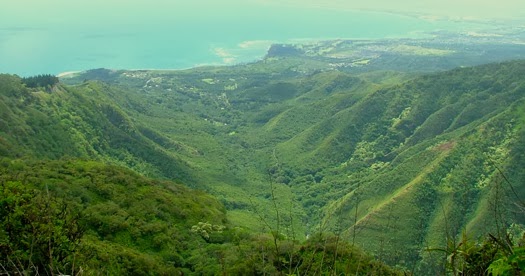
The image shows Waiheʻe Valley from Waiheʻe Ridge Trail.   In addition, I have included other related images in a folder of like name in the Photos section on my Facebook and Google+ pages.

Follow Peter T Young on Facebook  

Follow Peter T Young on Google+    

© 2014 Hoʻokuleana LLC
Wednesday, January 29, 2014

Solomon Lehuanui Kalaniomaiheuila Peleioholani


Solomon Lehuanui Kalaniomaiheuila Peleioholani (also called Peleioholani the 4th or Lehuanui, or simply, Peleioholani) (1843-1916) was the son of Peleioholani (uncle to the Kings Kamehameha IV and Kamehameha V) and Piikeakaluaonalani (mother.)

His great grandfather was the high chief Keʻeaumoku (father of Kaʻahumanu,) one of the ablest supporters of Kamehameha I.

Keʻeaumoku distinguished himself in the battle of Mokuʻōhai, (a fight between Kamehameha and Kiwalaʻo in July, 1782 in which Kamehameha won and put the island of Hawaiʻi under his control – this led to his ultimate control of all the islands.)

Keʻeaumoku killed Kiwalaʻo in a hand-to-hand combat; however, Keʻeaumoku’s mamo ʻahuʻula (feather cape) was bloodstained in that fight.  The cape, named “Eheukani” was later passed down through generations to Peleioholani.

Solomon LK Peleioholani, one of the highest surviving Hawaiian chiefs, was the man who stood before Lunalilo when he was crowned King of the Hawaiian Islands, wearing the famous cape, helmet and necklace, and also stood before Kalākaua at his coronation.  (Pacific Commercial Advertiser, January 22, 1902)

Unfortunately, “Eheukani” was later lost and presumed destroyed, along with other chiefly regalia and precious possessions belonging to Solomon LK Peleioholani, during the great Chinatown Fire of 1900.

As a boy, Peleioholani was the protégé of Kamehameha IV and his Queen Emma and the companion of their son Prince Albert (“Ka Haku O Hawaiʻi, “The Lord of Hawaiʻi.”)

During the short life of the little Prince, Peleioholani was his playmate, and both were treated with utmost respect by all they met. During this time, Peleioholani lived at the residence of Kekūanāo’a (hānai father of Bernice Pauahi Bishop.)  (Pacific Commercial Advertiser, January 22, 1902)

After the Prince’s death, Peleioholani traveled; for five years, he made voyages visiting the South Seas, Japan, Manila and the Indian Ocean.  (Pacific Commercial Advertiser, January 22, 1902)

One day, a steamer came into port and Peleioholani was given an opportunity to go with her to Australia. He remained there, became a British subject, drilled with the Australians who were to do service for the Queen in Africa, and he went in a transport to the eastern coast of South Africa, arriving there as a sub-officer.

He was a Hawaiian Chief who fought in Africa.

“Destiny seems to have called him to become a soldier as his ancestors were warriors in the service of Kamehameha I. The blood of brave men flowed through his veins and from his infancy he had heard almost daily the tales of the deeds done by his great grandfather”.  (Pacific Commercial Advertiser, January 22, 1902)

The blacks were on the shore that day, October 22, 1869, when the troops commenced to land. The ships opened fire upon them and attempted to land men in launches. Seven of the latter were disabled.

From one of them Peleioholani was forced to swim back to the ship, carrying nothing but his sword and belt.  He obtained another launch and thus from 2 until 5:30 o’clock in the afternoon the landing went on, the troops finally driving the enemy back.  (Pacific Commercial Advertiser, January 22, 1902)

When they went to England, Queen Victoria (Prince Albert's godmother) gave Peleioholani a service medal for bravery on the battlefields of Africa.

The Queen asked is nationality. “I told her I was Hawaiian. I told her my great grandfather had accompanied Kamehameha II to England. I told her Kamehameha V was my King.”  (Peleioholani, Pacific Commercial Advertiser, January 22, 1902)

In 1874, he returned to Hawaiʻi and was a well-respected genealogist.  For many, Peleioholani was considered an important Hawaiian antiquarian and the final word in Hawaiian genealogy, especially of the chiefs and royal families.

He also wrote of the Hawaiian history.  One work, ‘The Ancient History of Hookumu-ka-lani Hookumu-ka-honua,’ was a commentary of the ancient Hawaiian cosmogonies (creation theories.)

One of Peleioholani’s theories in that book notes, “The ancestors of the Hawaiian race came not from the islands the South Pacific – for the immigrants from that direction were late arrivals there – but from the northern direction (welau lani,) that is, from the land of Kalonakikeke, now known as Alaska.”

Peleioholani was a High Chief, and in many ways both the pinnacle and terminus of the old royal blood lines from Maui, Oʻahu, Hawaiʻi and Kauaʻi.

His grandparents were among those who sided with Kamehameha I to achieve unity of the islands. His father was an uncle to the Kings Kamehameha IV and Kamehameha V and he was himself one of the highest ranking chiefs in the Hawaiian Islands.  (kekoolani-org)

Besides being a direct lineal descendant of all the last independent ruling kings, he was also descended from what Hawaiian scholar Mary Pukui called the “chiefs of Pōkano,” chiefs of unblemished bloodline from remote times.  (kekoolani-org)

The image shows Solomon LK Peleioholani in 1903 in a holiday pageant costume.  (Lots of information here from Pacific Commercial Advertiser, January 22, 1902 and kekoolani-org.)

© 2014 Hoʻokuleana LLC

Saturday, September 28, 2013

Poʻolua


Poʻolua is literally broken down as Poʻo (head) and lua (two) and refers to a child who has two fathers (the child is sired by other than the husband, but he is accepted by both the husband and the sire.)

A child said to be poʻolua, “that is, a child of two fathers, was considered a great honor by chiefs of that period.” (Luomala)

Kamehameha has been referred to as poʻolua (shared, two-headed) son of Keōua and Kahekili by his mother Kekuʻiapoiwa.  (VanDyke)

Kamakau references Kamehameha was born at Kokoiki in Kohala.  His father was Keōua, younger brother of Kalaniʻōpuʻu, and his mother was Kekuʻiapoiwa, daughter of Kekela and Haʻae, both of whom belonged to families of chiefs.

Kamakau explains that it was the custom from ancient times among the chiefs of Hawaiʻi for the chief of one island to give a child to the chief of another island. This is the reason why Kahekili has often been called the father of Kamehameha, for chiefs of Hawaii and Maui were closely related.  (Kamakau)

Kamehameha, who had always thought that Chief Keōua of the island of Hawaiʻi was his natural father until a few years after he conquered all the islands but Kauaʻi.  Dibble notes that when Keōua, the father of Kamehameha, died, he commended his son to the care of Kalaniʻōpuʻu, who received him, and treated him as his own child.

Per Kamakau’s account, in 1802, Kamehameha, on hearing that Chief Kameʻeiamoku was dying at Lāhainā, went to him.  Kameʻeiamoku had attended Kamehameha since his boyhood and was one of his four Kona Uncles who had engineered his rise to power and made him king.  Kameʻeiamoku (on his deathbed) said to Kamehameha, "I have something to tell you: Kahekili was your father, you were not Keōua's son. Here are the tokens that you are the son of Kahekili."  (Kamakau)

Kamehameha responded, “Strange that you should live all this time and only when dying tell me that I am Kahekili's son! Had you told me this before, my brothers need not have died; they could have ruled Maui while I ruled Hawaii."    (Kamakau)

Kameʻeiamoku answered, “That is not a good thought; had they lived there would have been constant warfare between you, but with you alone as ruler the country is at peace.”    (Kamakau)

Kahekili’s age is not accurately known, but as by all native accounts he was the reputed father of Kamehameha I.  (Fornander)

“Kamehameha was the reputed son of Keōua otherwise called Kalanikupuapaikalaninui, a younger half-brother of Kalaniopuʻu, king of Hawaiʻi. It is said, however, that Kamehameha was the real son of Kahekili, king of Maui and that Kahekili gave him the name of his brother which was Kamehameha.”   (Dibble)

Kalākaua notes, “To this record of the tangled relationships of the chiefly families of the group at that period may be added … that Kahekili, the mōʻi of Maui, was the real father of Kamehameha; and in proof of the latter the acts and admissions of Kahekili are cited.”

When Kamehameha prepared an invasion in east Maui, Kahekili sent his younger brother, Alapaʻi, with the following orders: "Go, and bestow our kingdom upon our son; and if he will receive it, well; but if he does not recognize me as his father and will not respect the gift, but insists upon war; then, tell him that both he and his soldiers shall die in their youth, before the going down of the sun.”  (Dibble)

“If, indeed he shall listen to my request, then, say to him, 'Wait, till the black tapa, shall cover me and my funeral rites shall be performed, then, come and receive his kingdom, without the peril of war,' - for indeed, he is my son, and from me he received his name Kamehameha after that of my elder brother." (Dibble)  Receiving the message, Kamehameha delayed his invasion.

Some say that Kekuʻiapoiwa had a liaison with Kahekili (ruler of Maui) and from this union was born Kamehameha.  Though Kahekili was thought to be his biological father, he was raised by his parents (and was considered the son of Kekuʻiapoiwa and Keōua.)

After Kahekili died, Fornander had an interesting perspective related to the relationships of the parties.  Fornander notes, “Kameʻeiamoku and his twin-brother Kamanawa secretly took Kahekili's body away and hid it in one of the caves at Kaloko in North Kona, Hawaii.”

Kameʻeiamoku and Kamanawa were the children of Kekaulike of Maui, and thus half-brothers of Kahekili.  The twins (Kameʻeiamoku and Kamanawa) were Chiefs from the Kohala and North Kona districts and were uncles of and his counselors in the wars to unite the islands.

This relationship receives further confirmation from the native legends when they relate that, on learning the birth of Kamehameha, Kahekili sent these two sons of his father Kekaulike to Hawaiʻi to be and act as "Kahus" to Kamehameha.  (Fornander)

“In no other way can the otherwise singular fact be explained that two of Kamehameha's oldest and most prominent and trusted councilor chiefs, during a time of what may be called suspended hostilities, should have repaired from Hawaii to Oahu for the purpose of securing and safely hiding (Huna-kele) the bones of Kamehameha's political rival; nor the otherwise equally inexplicable fact that they should have been permitted by Kalanikūpule, Kahekili's son and successor, to carry their design into effect.”  (Fornander)

Under the social system of the old regime, and of time-hallowed custom, Kamehameha would have had no power to prevent those chiefs from executing their pious errand, and Kalanikūpule would have had no motive to mistrust their honesty when resigning to them his father's remains; and a breach of trust on their part would have consigned them to an infamy of which Hawaiian history had no precedent, and so deep, that the Hawaiian language would not have had a word detestable enough wherewith to express it.  (Fornander)

“He was the reputed and accepted son of Keōua, the half-brother of Kalaniʻōpuʻu, although it was believed by many that his real father was Kahekili, mōʻi of Maui. But, however this may have been, he was of royal blood, and was destined to become not only the king of Hawaiʻi, but the conqueror and sovereign of the group. This chief was Kamehameha.”  (Kalākaua)

Kamehameha, through the assistance of the Kona "Uncles" (Keʻeaumoku, Keaweaheulu, Kameʻeiamoku & Kamanawa (the latter two ended up on the Island’s coat of arms;)) succeeded, after a struggle of more than ten years, in securing to himself the supreme authority over that island (and later, the entire Hawaiian Islands chain.)

The image shows Kamehameha (drawn by Choris in 1816.)  In addition, I have added other related images in a folder of like name in the Photos section on my Facebook and Google+ pages.

Follow Peter T Young on Facebook  

Follow Peter T Young on Google+  

© 2013 Hoʻokuleana LLC

Saturday, September 21, 2013

The Prince-Slayer and Kingmaker


Keʻeaumoku Pāpaʻiaheahe (c. 1736-1804) was married to Namahanaʻi Kaleleokalani; they had several children, Kaʻahumanu (favorite wife of Kamehameha,) Kalākua Kaheiheimālie (wife of Kamehameha, later known as Hoapili Wahine,) Kahekili Keʻeaumoku II (Governor Cox of Maui,) Kuakini (John Adams Kuakini, Governor of Hawaiʻi and Oʻahu) and Namahana Piʻia (wife of Kamehameha.)  (kekoolani)

Before the conquest of Kamehameha, the several islands were ruled by independent kings, who were frequently at war with each other, but more often with their own subjects. As one chief acquired sufficient strength, he disputed the title of the reigning prince. If successful, his chance of permanent power was quite as precarious as that of his predecessor. In some instances the title established by force of arms remained in the same family for several generations, disturbed, however, by frequent rebellions … war being a chief occupation …”  (Jarves)

At the period of Captain Cook’s arrival (1778-1779), the Hawaiian Islands were divided into four kingdoms: (1) the island of Hawaiʻi under the rule of Kalaniʻōpuʻu, who also had possession of the Hāna district of east Maui; (2) Maui (except the Hāna district,) Molokaʻi, Lānaʻi and Kahoʻolawe, ruled by Kahekili; (3) Oʻahu, under the rule of Kahahana; and at (4) Kauaʻi and Niʻihau, Kamakahelei was ruler.

Keʻeaumoku became a staunch supporter and one of the great chiefs of the Kona district and the first among the war leaders of Kamehameha.

Following Kalaniʻōpuʻu’s death in 1782, the kingship was inherited by his son Kīwalaʻō; Kamehameha (Kīwalaʻō's cousin) was given guardianship of the Hawaiian god of war, Kūkaʻilimoku.)

Dissatisfied with subsequent redistricting of the lands by district chiefs, civil war ensued between Kīwalaʻō's forces and the various chiefs under the leadership of Kamehameha.

In the first major skirmish, Keʻeaumoku distinguished himself in the battle of Mokuʻōhai (a fight between Kamehameha and Kiwalaʻo in July, 1782 at Keʻei, south of Kealakekua Bay on the Island of Hawaiʻi.)

An ʻōlelo noʻeau notes, “Ka aku la kaʻu lāʻau i ka ʻaʻama kua lenalena.” (“My spear pierced the yellow-shelled crab.”) – a boast of a warrior who in the battle speared Keʻeaumoku (through his ʻahuʻula (cloak) - who survived.)

Keʻeaumoku killed Kiwalaʻo in a hand-to-hand combat; however, Keʻeaumoku’s mamo ʻahuʻula (feather cape – primarily of yellow feathers, named “Eheukani”) was bloodstained in that fight.

With the death of Kiwalaʻo, the victory made Kamehameha chief of the districts of Kona, Kohala and Hāmākua, while Keōua, the brother of Kiwalaʻo, held possession of Kaʻū and Puna, and Keawemauhili declared himself independent of both in Hilo.  (Kalākaua)

From the first of Kamehameha's battles Keʻeaumoku had not doubted the triumph of that chief over all adversaries in the end, and eagerly grasped at every circumstance calculated to strengthen the conviction. So believing, his way seemed to be clear.  (Kalākaua)

Keʻeaumoku never doubted the success of Kamehameha, and once, when Kamehameha was discomforted, Keʻeaumoku smiled as he said to his chief: “Thus far you have only skirmished with your enemies; you will win when you fight battles!”  (Kalākaua)

The remaining portion of Hāmākua, the district of Hilo, and a part of Puna, acknowledged Keawemauhili as their Moi; while the lower part of Puna and the district of Kaʻū, was under Keōua.  (Fornander)

Kamehameha, through the assistance of the Kona "Uncles" (Keʻeaumoku, Keaweaheulu, Kameʻeiamoku & Kamanawa (the latter two ended up on the Island’s coat of arms;)) succeeded, after a struggle of more than ten years, in securing to himself the supreme authority over that island.

A later battle at ʻIao saw the Maui troops completely annihilated by Kamehameha’s forces, and it is said that the corpses of the slain were so many as to choke up the waters of the stream of lao, and that hence one of the names of this battle was "Kepaniwai" (the damming of the waters).  (Fornander)

Then, a final battle of Kamehameha’s conquest took place on Oʻahu.  Kamehameha landed his fleet and disembarked his army on Oʻahu, extending from Waiʻalae to Waikīkī … he marched up the Nuʻuanu valley, where Kalanikūpule had posted his forces.  (Fornander)

In 1804, Kamehameha was preparing to invade Kauaʻi – with the goal of uniting the Islands under single control.  However, prior to the invasion, maʻi ‘ōkuʻu (believed to be cholera) struck the islands.  It affected Kamehameha and his planned invasion of Kauaʻi.

Keʻeaumoku, the slayer of princes and maker of kings, died peacefully as governor of the windward islands.  (Kalākaua)  It is believed maʻi ‘ōkuʻu was the cause of death of Keʻeaumoku, on March 21, 1804.

In the face of the threat of a further invasion, in 1810, at Pākākā on Oʻahu, negotiations between King Kaumuali‘i and Kamehameha I took place and Kaumualiʻi yielded Kauaʻi to Kamehameha.

The agreement marked the end of war and thoughts of war across the islands.  Although Kaumuali‘i had ceded Kaua‘i and Niʻihau to Kamehameha I, he generally maintained de facto independence and control of the island following his agreement with Kamehameha.

The image shows a drawing of Eheukani, Keʻeaumoku’s ʻahuʻula.  I have added other images to a folder of like name in the Photos section on my Facebook and Google+ pages.

Follow Peter T Young on Facebook  

Follow Peter T Young on Google+  

© 2013 Hoʻokuleana LLC

Saturday, July 27, 2013

Kalaniʻōpuʻū


At the time of Captain Cook’s arrival (1778-1779), the Hawaiian Islands were divided into four kingdoms: (1) the island of Hawaiʻi under the rule of Kalaniʻōpuʻu, who also had possession of the Hāna district of east Maui; (2) Maui (except the Hāna district,) Molokaʻi, Lānaʻi and Kahoʻolawe, ruled by Kahekili; (3) Oʻahu, under the rule of Kahahana; and (4) Kauaʻi and Niʻihau, Kamakahelei was ruler.

Kalaniʻōpuʻu was born about 1729, the son of Kalaninuiamamao and his wife Kamakaimoku. He died at Waioahukini, Kaʻū, in April 1782.  His brother was Keōua; his son was Kiwalaʻō; he was the grandfather of Keōpūolani.

When Keōua, the father of Kamehameha, died, he commended his son to the care of Kalaniʻōpuʻu, who received him, and treated him as his own child. (Dibble)

Kiwalaʻo, a real son of Kalaniʻōpuʻu, occasioned much trouble to his father, and in several instances proceeded so far as to engage in open revolt. Kamehameha seems always to have been obedient and to have possessed the good will of Kalaniʻōpuʻu.  (Dibble)

At the death of Alapaʻinui, about 1754, a bloody civil war followed, the result of which was that Alapaʻi’s son Keaweopala was killed, and Kalaniʻōpuʻu, descended from the old dynasty, became king of Hawaiʻi.  (Alexander)

Kalaniʻōpuʻu, from the very beginning of his reign, made repeated attempts to conquer the neighboring island of Maui.  He held portions of the Hāna district and the Kaʻuiki fort in 1775, when, in the war between Hawaiʻi and Maui, he commanded a raid in the Kaupō district.  (Thrum)

While Kalaniʻōpuʻu was at Hāna he sent his warriors to plunder the Kaupō people. Kahekili was king of Maui at that time, when Kahekili’s warriors met those of Kalaniʻōpuʻu at Kaupō, a battle developed between the two sides.  It was known as the Battle of Kalaeokaʻīlio; Kalaniʻōpuʻu’s army was routed and returned to Hāna.

Kalaniʻōpuʻu promised revenge and, in 1776, he again went to battle against Kahekili. This battle (known as the Battle of Sand Hills or Ahalau Ka Piʻipiʻi O Kakaniluʻa) was recorded as one of the most bloody.

Unfortunately, Kalaniʻōpuʻu was not aware of the alliance between Kahekili and the O‘ahu warriors under Kahahana, the young O‘ahu chief, and these numerous warriors were stationed at the sand dunes of Waikapū and also at a place close to those sand dunes seaward of Wailuku.

Kalaniʻōpuʻu’s army was annihilated as they entered the sand hills of Wailuku. In a desperate act to save what was left, Kalaniʻōpuʻu requested that his wife, Kalola, plead for peace from her brother Kahekili.

However, knowing that Kahekili would not look upon her with favor, Kalola suggested their son, Kiwalaʻo be sent instead. Kahekili welcomed Kiwala‘ō; for a time, after the great Sand Hills battle in Wailuku, peace and tranquility returned.

Although often defeated, Kalaniʻōpuʻu managed to hold the famous fort of Kaʻuiki in Hāna for more than twenty years.  (Alexander)

At the time of Captain Cook’s arrival (1778-1779), Kalaniʻōpuʻu was on the island of Maui.  Kalaniʻōpuʻu returned to Hawaiʻi and met with Cook on January 26, 1779, exchanging gifts, including an ʻahuʻula (feathered cloak) and mahiole (ceremonial feather helmet.)   Cook also received pieces of kapa, feathers, hogs and vegetables.

In return, Cook gave Kalaniʻōpuʻu a linen shirt and a sword; later on, Cook gave other presents to Kalaniʻōpuʻu, among which one of the journals mentions "a complete Tool Chest."

After the departure of the Resolution and Discovery, Kalaniʻōpuʻu left the bay and passed to Kaʻū, the southern district of Hawaiʻi, having in his charge the young Kaʻahumanu. (Bingham)

In about 1781, Kahekili was able, by a well-planned campaign, to regain possession of the Hāna district and this marked the beginning of the disintegration of Kalaniʻōpuʻu’s kingdom.  (Kuykendall)

Kalaniʻōpuʻu died shortly thereafter (1782.) Before his death, Kalaniʻōpuʻu gave an injunction to Kiwalaʻo and Kamehameha, and to all the chiefs, thus: “Boys, listen, both of you. The heir to the kingdom of Hawaii nei, comprising the three divisions of land, Kaʻū, Kona and Kohala, shall be the chief Kiwalaʻo. He is the heir to the lands.” (Fornander)

“As regarding you, Kamehameha, there is no land or property for you; but your land and your endowment shall be the god Kaili (Kūkaʻilimoku.) If, during life, your lord should molest you, take possession of the kingdom; but if the molestation be on your part, you will be deprived of the god.” These words of Kalaniʻōpuʻu were fulfilled in the days of their youth, and his injunction was realized.  (Fornander)

Following Kalaniʻōpuʻu’s death in 1782, and following his wishes, the kingship was inherited by his son Kīwalaʻō; Kamehameha (Kīwalaʻō's cousin) was given guardianship of the Hawaiian god of war, Kūkaʻilimoku.)

Kiwalaʻō and his chiefs were dissatisfied with subsequent redistricting of the lands; civil war ensued between Kīwalaʻō's forces and the various chiefs under the leadership of Kamehameha (his cousin.)

In the first major skirmish, in the battle of Mokuʻōhai (a fight between Kamehameha and Kiwalaʻo in July, 1782 at Keʻei, south of Kealakekua Bay on the Island of Hawaiʻi,) Kiwalaʻo was killed.

With the death of Kiwalaʻo, the victory made Kamehameha chief of the districts of Kona, Kohala and Hāmākua, while Keōua, the brother of Kiwalaʻo, controlled Kaʻū and Puna, and Keawemauhili declared himself independent of both in Hilo.  (Kalākaua)

Kamehameha, through the assistance of the Kona "Uncles" (Keʻeaumoku, Keaweaheulu, Kameʻeiamoku & Kamanawa (the latter two ended up on the Island’s coat of arms;)) succeeded, after a struggle of more than ten years, in securing to himself the supreme authority over that island (and later, the entire Hawaiian Islands chain.)

The image shows Kalaniʻōpuʻu welcoming Cook at Kealakekua, as depicted by Herb Kane.    In addition, I have included other images in a folder of like name in the Photos section on my Facebook and Google+ pages.

Follow Peter T Young on Facebook  

Follow Peter T Young on Google+  

© 2013 Hoʻokuleana LLC

Friday, April 19, 2013

Contact


"... at 5 o'clock we arrived there and saw a number of People, I believe between 2 and 300 ... we still continued advancing, keeping prepared against an attack tho' without intending to attack them ... they fired one or two shots, upon which our Men without any orders rushed in upon them, fired and put 'em to flight; several of them were killed".  (Diary of Lt. John Barker, Library of Congress)

On April 19, 1775, the Battles of Lexington and Concord were the first military engagements of the American Revolutionary War.  The battles marked the outbreak of open armed conflict between the Kingdom of Great Britain and its thirteen colonies of British North America.

The first shot (“the shot heard round the world”) was fired just as the sun was rising at Lexington. The American militia were outnumbered and fell back; and the British regulars proceeded on to Concord.

Following this, the Continental Congress adopted the Declaration of Independence and it was signed by 56-members of the Congress (1776.)

The next eight years (1775-1783) war was waging on the eastern side of the continent.  The main result was an American victory and European recognition of the independence of the United States.

The formal end of the war did not occur until the Treaty of Paris and the Treaties of Versailles were signed on September 3, 1783 and recognized the sovereignty of the United States over the territory bounded roughly by what is now Canada to the north, Florida to the south, and the Mississippi River to the west.

The last British troops left New York City on November 25, 1783, and the US Congress of the Confederation ratified the Paris treaty on January 14, 1784.

It was the turning point in the future of the continent and an everlasting change in the United States.

At this same time, there was a turning point in the future of the Islands.

In the dawn hours of January 18, 1778, on his third expedition, British explorer Captain James Cook on the HMS Resolution and Captain Charles Clerke of the HMS Discovery first sighted what Cook named the Sandwich Islands (that were later named the Hawaiian Islands.)

Hawaiian lives changed with sudden and lasting impact, when western contact changed the course of history for Hawai‘i.

Cook continued to sail along the coast searching for a suitable anchorage.  His two ships remained offshore, but a few Hawaiians were allowed to come on board on the morning of January 20, before Cook continued on in search of a safe harbor.

On the afternoon of January 20, 1778, Cook anchored his ships near the mouth of the Waimea River on Kauaʻi’s southwestern shore.  After a couple of weeks, there, they headed to the west coast of North America.

After the West Coast, Alaska and Bering Strait exploration, on October 24, 1778 the two ships headed back to the islands; they sighted Maui on November 26, circled the Island of Hawaiʻi and eventually anchored at Kealakekua Bay on January 17, 1779.

At the time of Cook’s arrival (1778-1779), the Hawaiian Islands were divided into four kingdoms: (1) the island of Hawaiʻi under the rule of Kalaniʻōpuʻu, who also had possession of the Hāna district of east Maui; (2) Maui (except the Hāna district,) Molokaʻi, Lānaʻi and Kahoʻolawe, ruled by Kahekili; (3) Oʻahu, under the rule of Kahahana; and at (4) Kauaʻi and Niʻihau, Kamakahelei was ruler.

At that time of Cook’s arrival, Kalaniʻōpuʻu was on the island to Maui to contend with Kahekili, king of Maui. The east side of Maui had fallen into the hands of Kalaniʻōpuʻu and Kahekili was fighting with him to gain control.

Kalaniʻōpuʻu returned to Hawaiʻi and met with Cook on January 26, 1779, exchanging gifts, including an ʻahuʻula (feathered cloak) and mahiole (ceremonial feather helmet.)   Cook also received pieces of kapa, feathers, hogs and vegetables.

In return, Cook gave Kalaniʻōpuʻu a linen shirt and a sword; later on, Cook gave other presents to Kalaniʻōpuʻu, among which one of the journals mentions "a complete Tool Chest."

Throughout their stay the ships were plentifully supplied with fresh provisions which were paid for mainly with iron, much of it in the form of long iron daggers made by the ships' blacksmiths on the pattern of the wooden pāhoa used by the Hawaiians.  The natives were permitted to watch the ships' blacksmiths at work and from their observations gained information of practical value about the working of iron. (Kuykendall)

After a month's stay, Cook got under sail again to resume his exploration of the Northern Pacific. Shortly after leaving Hawaiʻi Island, the foremast of the Resolution broke and the ships returned to Kealakekua Bay for repairs.

On February 14, 1779, at Kealakekua Bay, some Hawaiians took one of Cook's small boats. He attempted to take hostage the King of Hawaiʻi, Kalaniʻōpuʻu. The Hawaiians prevented this and Cook and some of his men were killed.  Clerke took over the expedition and they left.

After the departure of the Resolution and Discovery, Kalaniʻōpuʻu left the bay and passed to Kaʻū, the southern district of Hawaiʻi, having in his charge the young Kaʻahumanu. He died shortly thereafter.  (Bingham)

Following Kalaniʻōpuʻu’s death in 1782, the kingship was inherited by his son Kīwalaʻō; Kamehameha (Kīwalaʻō's cousin) was given guardianship of the Hawaiian god of war, Kukailimoku.

Dissatisfied with subsequent redistricting of the lands by district chiefs, civil war ensued between Kīwalaʻō's forces and the various chiefs under the leadership of Kamehameha. At the Battle of Mokuʻōhai (just south of Kealakekua) Kīwalaʻō was killed and Kamehameha attained control of half the Island of Hawaiʻi.

Kamehameha, through the assistance of the Kona "Uncles" (Keʻeaumoku, Kekūhaupiʻo, Keaweaheulu, Kameʻeiamoku & Kamanawa (the latter two ended up on the Island’s coat of arms;)), succeeded, after a struggle of more than ten years, in securing to himself the supreme authority over that island.

After further conquest Kamehameha took all of the islands, except Kauaʻi and Niʻihau – of which he gained control through negotiation in 1810.  (And, a little later, back on the continent, the US and Britain battled in the War of 1812.)

It’s interesting how dynamic changes (each involving Great Britain) were occurring at the same time, at relatively opposite ends of the globe.

The image shows Kalaniʻōpuʻu welcoming Cook at Kealakekua, as depicted by Herb Kane.    In addition, I have included other images in a folder of like name in the Photos section on my Facebook and Google+ pages.

Follow Peter T Young on Facebook  

Follow Peter T Young on Google+  

© 2013 Hoʻokuleana LLC