Showing posts with label Missionaries. Show all posts

Saturday, April 18, 2015

General Meeting


The missionaries were scattered across the Islands, each home was usually in a thickly inhabited village, so that the missionary and his wife could be close to their work among the people.

Very prominent in the old mission life was the annual “General Meeting” where all of the missionary families from across the Islands gathered at Honolulu from four to six weeks.  The primary object of this gathering was to hold a business; it was also social.

Click HERE for the full post and more images.

Tuesday, April 14, 2015

John Thomas Gulick


John Thomas Gulick did the first modern evolutionary study on Hawaiian land snails. He was a missionary and son of a Hawaiʻi missionary.   A collector of land snails since his teen years, he became a convert to evolutionary thinking even before reading On the Origin of Species (by Darwin.)

Gulick was among the first to recognize the critical role for geographical separation in the diversification of ecologically similar Hawaiian land snails. His ideas were discussed by Darwin, as well as leaders in the Modern Evolutionary Synthesis who saw an important role for geographical isolation in speciation.  Gulick extended his ideas to societal evolution in human beings.

Click HERE for the full post and more images.

Thursday, April 9, 2015

Wailuku Female Seminary


In 1835, at the general meeting of the Mission, a resolution was passed to promote boarding schools for Hawaiians; several male boarding schools and two female boarding schools were begun (Wailuku Female Seminary on the island of Maui and the Hilo School for Girls on the island of Hawai'i.)

Wailuku Female Seminary (or the Central Female Seminary, as it was first called) was the first female school begun by the missionaries. In 1837 the missionaries opened the Wailuku Female Seminary to educate girls to be “good Christian wives” for the graduates of Lahainaluna a school for boys at Lahaina. A boarding school, they thought, would have a deeper influence than day classes.

Click HERE for the full post and more images.

Saturday, April 4, 2015

Missionary Travel to the Islands


“What wonder that we so long for release from this little prison-house!”  From 1820 to 1847, there were 12-Companies of missionaries sent under the auspices of the American Board of Commissioners for Foreign Missions (ABCFM) to the Islands.  Every group of missionaries arrived by ship, sailing from New England, around Cape Horn and finally reaching the Hawaiian Islands, usually after a five-month sea voyage.

Travel wasn’t easy. "We were hardly able to stand even by holding on with both hands ….”  Sea sickness was a constant issue for these non-sailors.  Things were stored everywhere … The “day commenced (with) the study of the Owhyhee language. … This evening held our first singing school. It is greatly to be wished that we could all join with our hearts and voices too …”

Click HERE for the full post and more images.

Monday, March 9, 2015

‘Tennooe’ - William Kanui


 “He was born on the Island of Oʻahu, about the close of the last century.  His father belonging to the party of a defeated chief, fled with his son to Waimea, Kauai, while there (1809,) an American merchant vessel … touched for supplies.”   Kanui and his brother caught a ride on the ship and ended up in Boston.

He came back to the Islands with the Pioneer Company of missionaries.  Kanui was the first to return to the “old ways.”  He left the Islands and joined the California gold rush in 1848; he later returned to the Islands and established a school; “after wandering twenty years, has returned to his duty as a teacher.”  He died at Queen's Hospital, January 14, 1864 (about 66-years old.)

Click HERE for the full post and images.


Tuesday, March 3, 2015

A Day in the Life


“June 29th. A busy day.  - - - -” In part, the sole entry for that day in Sybil Bingham’s journal (1820) helps to describe what life was like for the families of the early missionaries in Hawaiʻi.  The day started at 4 am ... it continued into the night, with no breaks.  The mission children were up then, too; in the early morning, the parents taught their children.

“We had one tin whale-oil lamp between us, with a single wick…. Soon after five we had breakfast.”  By 9 am, after accomplishing all domestic duties and schooling of the children, the wives would begin the instruction of the Hawaiian children – and taught them for six solid hours, occasionally running into the house to see that all was straight.


Thursday, January 8, 2015

Harvey Rexford Hitchcock


Harvey Rexford Hitchcock, the oldest son of eleven children of David (a shoemaker and author of several books) and Sarah (Swan) Hitchcock, was born in Great Barrington, Massachusetts, March 13, 1800.

Hitchcock joined the Congregational church in Great Barrington, January 5, 1817. He entered Williams College as a Junior in 1826; he graduated on September 3, 1828.

After graduation, Hitchcock studied theology at Auburn Seminary, where he was graduated in 1831.  On August 26, 1831, he married Miss Rebecca Howard of Auburn, New York.

Within a couple of months, he sailed as a missionary with the Fifth Company of the American Board of Commissioners for Foreign Missions.  They sailed aboard the Averick, leaving New Bedford, November 26, 1831 and arriving in Honolulu, May 17, 1832.

Others in the Fifth Company included Rev. William P Alexander, Richard Armstrong, John S Emerson, Cochran Forbes, David B Lyman (Hitchcock’s college classmate,) Lorenzo Lyons, Ephraim Spaulding (their wives and others.)

He was assigned to Molokai and established the first permanent Mission Station on the Island at Kaluaʻaha in 1832.  Rebecca Hitchcock noted shortly after their arrival that there was not a foreigner on the island and no horses except for a lame one belonging to a chief.  (Curtis)

In 1834, the Hitchcocks received additional help with the arrival of Rev and Mrs Lowell Smith (Smith was a college mate of Hitchcock – who arrived on the Sixth Company in 1833.)

 The expanding mission was growing close to 500 members and two outstations, one in the east and one in the west, had been established.

Smith gave this description of the Island and its people: “The people reside mostly on the eastern part of the island, on the north and south sides; but the greater number are on the latter.” (The estimated Island population was about 6,000.)

“Their houses, many of them, are no more than five or six feet long by four wide and five feet from the ridge-pole to the ground; and these are not unfrequently the habitations of two, three, and sometimes more individuals of both sexes.”  Each is “But one apartment, no floor, no window, no chimney, except the humble door at which you enter.”

“The name of the elation is Kaluaʻaha; it is owned by the best and one of the most pious high chiefs on the islands, who desired us to take it as our station, assuring us at the same time, that she would act the part of a parent to us. We have fenced off about two acres of land as a door yard and garden, and might have extended our limits much farther had we chosen. “

“There is a delightful cluster of shade trees before our door, which was formerly a favorite resort of the chiefs; and under it, for several successive weeks, we met for the worship … On our arrival, there was no house of any importance, and few of any kind in the vicinity.”

“During the year, however, many comfortable houses have been built, with sleeping apartments, and other accommodations which give to them an air of neatness and comfort hitherto unknown on the island.” (Smith; Missionary Herald)

Hitchcock preached his first sermon in Hawaiian the last week of September 1832 in the open air. In the Molokai Station Report, Hitchcock wrote, “in about two months a meeting house was finished 30 feet by 120.” It was probably built of thatch.  (HABS)

“A spacious school-house is nearly completed, so that the station begins to assume the appearance of a small village.”  (Smith; Missionary Herald)

Nearby was Pukoʻo; it had a natural break in the reef with a perfect beach for landing canoes.  Hitchcock’s early church records often mentioned this location as the most convenient for travel to Lāhainā.  (Curtis)

In a January 1840 letter from Hitchcock, we get a glimpse of his daily life, “I hope to continue without interruption my present system of labors; that is, to hold a Bible class Sabbath morning of twenty-five girls, preach at ten o’clock, have an adult Sabbath-school at noon, and preach again at four.”

“My week-day labors are as follows, - a Bible class daily with the above-mentioned company of females, who are committing Matthew to memory at the rate of six verses a day. I spend some time with them in teaching singing.”

“On Tuesday and Thursday mornings I preach at sunrise, and preach regularly on Wednesday afternoon. Saturday evening I have a lecture for the church. Once in two weeks on Friday I address the men's benevolent society, or catechise them on the New Testament; and on Tuesday have a Bible class of adults.”

“I make it a point, as far as possible, to visit some parts of the parish daily, and hold direct religious conversation with the people. In these visits I am happy to say that I am received with respect, and listened to by the people. Rarely have I gone to one house and commenced conversation, without drawing around me others, particularly the aged.”

“My miscellaneous labors consist in conversing with those who resort to my study for the purpose, and giving out medicine for the sick. I am trying also to crowd in a weekly lecture on the most important points in theology, designed for several of the most pious and intelligent members of our church, in order to enable them to become more efficient helpers in the great work.”  (Hitchcock, Missionary Herald)

In the mid-1840s, they were working on building a new church; “Our main work the past year has been the erection of a permanent house of worship … Preparing most of the timber and getting it onto the ground from the distance of ten miles or more, procuring many of the stones for building …”

It was dedicated on April 3, 1844; “The house has been completed nearly two months. It is 100 feet long by 50 broad outside; walls 2-1/2 feet thick and 18 feet high. …. The thatching is pilimaoli. It leaks but little; has 4 doors three of which are 7 feet high and about as wide…”  (Hitchcock; HABS)  (Remnants of the church are still there; in 2009, a new roof was built inside the walls of the existing church.)

Hitchcock died August 29, 1855 … “for 23 years he has labored with unusual devotion, zeal and earnestness to enlighten, purify and elevate the people … He lived to see his labors crowned with wonderful success.”

“His great work was indeed the preaching of the gospel; yet in the infant state of the people, he had to superintend every thing, schools were to be created and managed; the sick, the aged and the destitute to be cared for; civil officers to be advised, the whole people clad and civilized and their souls saved.”

“He gave himself heartily to his work and made an unreserved consecration. … He did desire to live longer, not however for any selfish end, but that he might preach the gospel.”  (The Friend, September 29, 1855)  (His grandson was David Howard Hitchcock, the notable artist in Hawaiʻi.)

The image shows Harvey Rexford Hitchcock.  In addition, I have added other images in a folder of like name in the Photos section on my Facebook and Google+ pages.

Follow Peter T Young on Facebook  

Follow Peter T Young on Google+    

Follow Peter T Young on LinkedIn   

© 2015 Hoʻokuleana LLC

Sunday, November 9, 2014

Children of the Missionaries


The children of nineteenth-century American missionaries … Hawaiian nationality by birth, white by race and American by parental and educational design.  (Schultz)

There were seven American couples sent by the ABCFM to convert the Hawaiians to Christianity in this Pioneer Company.  These included two Ordained Preachers, Hiram Bingham and his wife Sybil and Asa Thurston and his wife Lucy.

Joining them were two Teachers, Mr. Samuel Whitney and his wife Mercy and Samuel Ruggles and his wife Mary; a Doctor, Thomas Holman and his wife Lucia; a Printer, Elisha Loomis and his wife Maria; and a Farmer, Daniel Chamberlain, his wife Jerusha and five children (Dexter, Nathan, Mary, Daniel and Nancy.)

On October 23, 1819, the Pioneer Company of American Protestant missionaries set sail on the Thaddeus for the Sandwich Islands (now known as Hawai‘i.)  For the most part, the couples were newlyweds; here is a listing of their wedding dates:

Hiram and Sybil Bingham were married October 11, 1819
Asa and Lucy Thurston were married October 12, 1819
Samuel and Mercy Whitney were married October 4, 1819
Samuel and Mary Ruggles were married September 22, 1819
Thomas and Lucia Holman were married September 26, 1819
Elisha and Maria Loomis were married September 27, 1819
(Daniel and Jerusha Chamberlain, with five children, were the only family in the Pioneer Company.)

After 164-days at sea, on April 4, 1820, the Thaddeus arrived and anchored at Kailua-Kona on the Island of Hawaiʻi.  Hawai‘i’s “Plymouth Rock” is about where the Kailua pier is today.

Starting a few short months after their arrival, the new missionary wives became mothers.

The first child was Levi Loomis, son of the Printer, Elisha and Maria Loomis; he was the first white child born in the Islands.  Here is the order of the early missionary births:

July 16, 1820 … Honolulu (Oʻahu) … Levi Loomis
October 19, 1820 … Waimea (Kauaʻi) … Maria Whitney
November 9, 1820 … Honolulu (Oʻahu) … Sophia Bingham
December 22, 1820 … Waimea (Kauaʻi) … Sarah Ruggles
March 2, 1821 … Waimea (Kauaʻi) … Lucia Holman
September 28, 1821 … Honolulu (Oʻahu) … Persis Thurston

More missionaries and more children came, later.

Over the course of a little over 40-years (1820-1863 - the “Missionary Period,”) about 180-men and women in twelve Companies served in Hawaiʻi to carry out the mission of the ABCFM in the Hawaiian Islands.

The missionaries established schools associated with their missions across the Islands. This marked the beginning of Hawaiʻi’s phenomenal rise to literacy. The chiefs became proponents for education and edicts were enacted by the King and the council of Chiefs to stimulate the people to reading and writing.

In 1820, missionary Lucy Thurston noted in her Journal, Liholiho’s desire to learn, “The king (Liholiho, Kamehameha II) brought two young men to Mr. Thurston, and said: "Teach these, my favorites, (John Papa) Ii and (James) Kahuhu. It will be the same as teaching me. Through them I shall find out what learning is."

Interestingly, as the early missionaries learned the Hawaiian language, they then taught their lessons in the mission schools in Hawaiian, rather than English. In part, the mission did not want to create a separate caste and portion of the community as English‐speaking Hawaiians.

By 1831, in just eleven years from the first arrival of the missionaries, Hawaiians had built over 1,100‐schoolhouses. This covered every district throughout the eight major islands and serviced an estimated 53,000‐students. (Laimana)

By 1853, nearly three-fourths of the native Hawaiian population over the age of sixteen years was literate in their own language. The short time span within which native Hawaiians achieved literacy is remarkable in light of the overall low literacy rates of the United States at that time. (Lucas)

This was fine for the Hawaiians who were beginning to learn to read and write, but the missionary families were looking for expanded education for their children.

“During the period from infancy to the age of ten or twelve years, children in the almost isolated family of a missionary could be well provided for and instructed in the rudiments of education without a regular school …  But after that period, difficulties in most cases multiplied.” (Hiram Bingham)

Missionaries were torn between preaching the gospel and teaching their kids.  “(M)ission parents were busy translating, preaching and teaching. Usually parents only had a couple of hours each day to spare with their children.”  (Schultz)

From 1826, until Punahou School opened in 1842, young missionary parents began to make a decision seemingly at odds with the idealizing of the family so prevalent in the 19th century; they weighed the possibility of sending them back to New England.  The trauma mostly affected families of the first two companies, and involving only 19 out of 250 Mission children.  (Zwiep)

“(I)t was the general opinion of the missionaries there that their children over eight or ten years of age, notwithstanding the trial that might be involved, ought to be sent or carried to the United States, if there were friends who would assume a proper guardianship over them”.  (Bingham)

“This was the darkest day in the life history of the mission child.  Peculiarly dependent upon the family life, at the age of eight to twelve years, they were suddenly torn from the only intimates they had ever known, and banished, lonely and homesick, to a mythical country on the other side of the world …”

“… where they could receive letters but once or twice a year; where they must remain isolated from friends and relatives for years and from which they might never return.”  (Bishop)

The parents in the first company demonstrate the range of options available: going home with all the children (as did the Chamberlains and Loomises;) keeping all the children to be educated by the mother (the Thurstons' choice;) or sending some or all of the children home, not knowing when or if they would be reunited (the course taken by the Binghams, Ruggleses and Whitneys.)

In 1829, Sophia Bingham was sent back to the continent.  Mail was so slow that her mother Sybil waited a year and a half for her first letter from Sophia. "This poor, waiting, anxious heart," she confessed, "has been made so glad by your long, crowded pages, that it would not be easy to tell you all its joy."  (Zwiep)

Sophia, the first white girl born on Oʻahu (November 9, 1820,) is my great great grandmother.  The image shows Sophia Bingham.

© 2014 Hoʻokuleana LLC

Monday, October 20, 2014

The Fever


“The first symptoms of the fever is a restless sensation - an excited state of the system - a wild expression of the eye - and a light and elastic tread. These symptoms are followed with a desire to obtain implements for digging and washing …” (Polynesian, July 15, 1848)

There are “fearful ravages of a terrible fever which has nearly depopulated all the seaport towns and caused general rush to the interior. It is not exactly the yellow fever, but a fever for a yellow substance, called gold.”

“An exceedingly rich gold mine has been discovered in the Sacramento Valley, and all class all sexes have deserted their occupation and rushed en masse to the mines to make their fortune.”

“The gold taken from this newly discovered mine is not gold ore, but pure virgin gold. It is procured by the simple process of digging and washing, and is obtained at the rate of from two to four ounces per day by each laborer.”  (Polynesian, June 24, 1848)

The great California gold rush began on January 24, 1848, when James W Marshall discovered a gold nugget in the American River while constructing a sawmill for John Sutter, a Sacramento agriculturalist. News of Marshall’s discovery brought thousands of immigrants to California from elsewhere in the United States and from other countries.

At first, there were only two routes. The first entailed a six-month sea voyage from New York around the tip of South America to San Diego or San Francisco. Rampant seasickness, bug-infested food, boredom, and high expense made this route unattractive for many would-be prospectors.

The second route brought travelers over the Oregon-California Trail in covered wagons—over rugged terrain and hostile territory. This journey also averaged six months' duration.

By 1850, the length and difficulty of both routes had inspired the construction of the Panama Railway, the world's first transcontinental railroad. Built across the isthmus of Panama by private American companies to speed travel to California, the railroad helped to shave months off of the long voyage around South America.

In addition to massive emigration from the eastern US, the California gold rush triggered a global emigration of ambitious fortune-seekers from China, Germany, Chile, Mexico, Ireland, Turkey, and France. The number of Chinese gold-seekers was particularly large, though many Chinese did not intend to settle in the United States, which they called “the Gold Mountain.”  (harvard-edu)

It is estimated that not less than two hundred foreigners have left the Sandwich Islands for the gold mines in California.— Others it is rumored will soon follow. At the latest intelligence from the gold region there was no falling off in the amount of gold that rewarded the labors of the miner …”  (the Friend, September 1, 1848)

“The rush, to that part of the world, flows in unabated. One hundred and eight vessels, are reported to have left the Atlantic States, for San Francisco, during the month of December. … The mines continue to yield the usual amount of gold, and no sign of being exhausted. The freshet and overflowings of the numerous streams and rivers, are reported to increase the amount of gold in the ‘diggings.’”  (The Friend, April 1, 1850)

And, they came from Hawaiʻi … hundreds of Hawaiians came to California to work in the mines.  Remaining place names, Kanaka Creek and Kanaka Bar remind us of their early presence in the gold country.

Others from Hawaiʻi, even some of the missionaries, joined in the quest for gold.

“Several other vessels left port some for California, which has become a very interesting quarter, since the reports have reached us of the gold mines.”  (August 1, 1848)  “Comore. Jones has gone to St. Francisco and it is said he will put a stop to the private operations in the gold district, and will claim the district & the gold for the U. S. government.”  (Levi Chamberlain, August 8, 1848)

“There is at present a great excitement here about digging gold in California. … Mr. Douglass and Mr. Lyman of whom you have heard as former assistants in our school are both there, also -- Mr. Ricord, the former attorney general. … Men, women, and children are all absorbed in it, the one great thing Gold.”  (Julia Cooke, September 21, 1848)

Reverend Damon of the Seamen’s Bethel Church and publisher of The Friend travelled the area – not as a miner, but an observer of the activities there.

“In travelling through the country I have met scores of seamen with whom I had become acquainted while at Honolulu.  I was cordially welcomed, although in more than a single instance they exclaimed ‘you are the last man that we expected to see at the mines.’ A few words of explanation were however sufficient to set the matter right.”  (Damon, The Friend, December 1, 1848)

Thomas Hopu and William Kanui, who returned to the islands with the Pioneer Company of missionaries in 1820, joined the gold rush.  Damon saw them in Sacramento on his journey through the area.

John Thomas Gulick, son of the Gulick missionary family, joined the rush after seeking his parents’ permission. By June 1849, his prospecting was reasonably successful, but after having his money stolen, he returned to Hawaii a few months later after having recovered his finances through various trading ventures.  (Bennett)

Likewise, the Reverend Lowell Smith, the first minister of Kaumakapili Church, sailed to San Francisco for a rest because of poor health.  He visited the California gold fields.

“Kamae went immediately to speak to the Hawaiians in other places to come so we might be together for the week. I witnessed their work in the gold fields …. They were not able to obtain much on account of the scarcity of water. Some made a dollar a day, others two dollars, and still others, nothing.”  (Smith; Kenn, HHS)

The California Gold Rush drawing Hawaiians to the continent was not its only effect on the Islands; the Hawaiian economy was affected in several ways – good and not-so-good.

Prior to the Gold Rush, supporting the Pacific whaling and trading fleets and trade between the West Coast and Hawaiʻi was the scale of the Hawaiʻi participation.  The scale of that significantly changed with the Gold Rush.

Hawaiʻi was only three to five weeks away, and with the growing population drawn to the gold fields, in addition to provisioning ships, Hawaiʻi farmers were feeding the gold seekers on the continent.

There were some down sides; this also brought a marked increase in the prices of consumer goods, especially food, caused by the great increase in agricultural exports to California, which offered very profitable new markets.  (Rawls)

Likewise, the exodus to the continent created a critical labor shortage in Hawaiʻi, where a sizeable number of sugar plantation workers migrated to the California gold fields.

The parting of workers from the plantations between 1848 and 1853 was so large, Hawaiʻi sugar producers began to seek Chinese immigrants to fill the gap.  (Rawls)  The image shows miners in the California gold fields.

Follow Peter T Young on Facebook  

Follow Peter T Young on Google+ 

Follow Peter T Young on LinkedIn   

© 2014 Hoʻokuleana LLC

Sunday, October 12, 2014

James Kahuhu


On October 23, 1819, the Pioneer Company of American Protestant missionaries from the northeast US set sail on the Thaddeus for the Sandwich Islands (now known as Hawai‘i.)  There were seven American couples sent by the ABCFM in this first company.

These included two Ordained Preachers, Hiram Bingham and his wife Sybil and Asa Thurston and his wife Lucy; two Teachers, Mr. Samuel Whitney and his wife Mercy and Samuel Ruggles and his wife Mary; a Doctor, Thomas Holman and his wife Lucia; a Printer, Elisha Loomis and his wife Maria; and a Farmer, Daniel Chamberlain, his wife and five children.

By the time the Pioneer Company arrived, Kamehameha I had died and the centuries-old kapu system had been abolished; through the actions of King Kamehameha II (Liholiho,) with encouragement by former Queens Kaʻahumanu and Keōpūolani (Liholiho’s mother,) the Hawaiian people had already dismantled their heiau and had rejected their religious beliefs.

One of the first things the missionaries did was begin to learn the Hawaiian language and create an alphabet for a written format of the language.   Their emphasis was on teaching and preaching.

The first mission station was at Kailua-Kona, where they first landed in the Islands, then the residence of the King (Liholiho, Kamehameha II;) Asa and Lucy Thurston manned the mission, there.

Liholiho was Asa Thurston's first pupil. His orders were that “none should be taught to read except those of high rank, those to whom he gave special permission, and the wives and children of white men.”

James Kahuhu and John ʻlʻi were two of his favorite courtiers, whom he placed under Mr. Thurston's instruction in order that he might judge whether the new learning was going to be of any value.  (Alexander, The Friend, December 1902)

In 1820, Missionary Lucy Thurston noted in her Journal, “The king (Liholiho, Kamehameha II) brought two young men to Mr. Thurston, and said: ‘Teach these, my favorites, (John Papa) Ii and (James) Kahuhu. It will be the same as teaching me. Through them I shall find out what learning is.’”

“To do his part to distinguish and make them respectable scholars, he dressed them in a civilized manner. They daily came forth from the king, entered the presence of their teacher, clad in white, while his majesty and court continued to sit in their girdles.”

“Although thus distinguished from their fellows, in all the beauty and strength of ripening manhood, with what humility they drank in instruction from the lips of their teacher, even as the dry earth drinks in water!”

“After an absence of some months, the king returned, and called at our dwelling to hear the two young men, his favorites, read. He was delighted with their improvement, and shook Mr. Thurston most cordially by the hand - pressed it between both his own - then kissed it.” (Lucy Thurston)

Kahuhu was among the earliest of those associated with the chiefs to learn both spoken and written words. Kahuhu then became a teacher to the chiefs.

In April or May 1821, the King and the chiefs gathered in Honolulu and selected teachers to assist Mr Bingham.  James Kahuhu, John ʻĪʻi, Haʻalilio, Prince Kauikeaouli were among those who learned English.  (Kamakau)

On October 7, 1829, it seems that Kauikeaouli (Kamehameha III) set up a legislative body and council of state when he prepared a definite and authoritative declaration to foreigners and each of them signed it.  (Frear – HHS)  Kahuhu was one of the participants.

King Kamehameha III issued a Proclamation "respecting the treatment of Foreigners within his Territories."  It was prepared in the name of the King and the Chiefs in Council:  Kauikeaouli, the King; Gov. Boki; Kaʻahumanu; Gov. Adams Kuakini; Manuia; Kekūanāoʻa; Hinau; ʻAikanaka; Paki; Kīnaʻu; John ʻIʻi and James Kahuhu.

In part, he states, "The Laws of my Country prohibit murder, theft, adultery, fornication, retailing ardent spirits at houses for selling spirits, amusements on the Sabbath Day, gambling and betting on the Sabbath Day, and at all times.  If any man shall transgress any of these Laws, he is liable to the penalty, - the same for every Foreigner and for the People of these Islands: whoever shall violate these Laws shall be punished."

It continues with, "This is our communication to you all, ye parents from the Countries whence originate the winds; have compassion on a Nation of little Children, very small and young, who are yet in mental darkness; and help us to do right and follow with us, that which will be for the best good of this our Country."

The Hawaiʻi State Archives is the repository of significant historic documents for Hawaiʻi; reportedly, the oldest Hawaiian language document in its possession is a letter written by James Kahuhu.

Writing to Chief John Adams Kuakini, Kahuhu’s letter was partially in English and partially Hawaiian (at that time, Kuakini was learning both English and written Hawaiian.)

Below is a transcription of Kahuhu's letter.  (HSA)

Oahu. Makaliʻi 12, 1822.
Kawaiahaʻo.
My Dear Chief Mr. John Adams Kuakini. I love you very much. This is my communication to you. Continue praying to Jehovah our God. Keep the Sabbath which is God’s holy day. Persevere in your learning the good Gospel of Jehovah. By and by perhaps we shall know the good word of Jesus Christ. Then we shall know the good word of God.

A few begin to understand the good word of God. I am very pleased with the good word of God which has been brought here to enlighten this dark land. Who will save our souls and take them up to heaven, the place of eternal life. I am presently teaching Nahiʻenaʻena. I am teaching seven of them. Nahienaena, Kauikeaouli, Halekiʻi, Ulumāheihei Waipa, Ulumāheihei a Kapalahaole, Nakapuai and Noaʻawa are the students I am teaching. I may have more in the future. You must obey your good teacher, Hopu. Persevere with him and don’t give up.

Keliʻiahonui has learned to write quite well, he sent a letter to Oahu. Tell Hopu that Keliʻiahonui misses him. The King is learning to write from Mr. Bingham. Kalanimōku, Kīnaʻu and Kekauōnohi are learning to write Hawaiian. Mr. Thurston is their teacher. Here is another word to you, if you see Kalapauwahiole tell him to come to Oahu as I would like very much for him to come to Oahu.
James Kahuhu

(Makaliʻi was the name of a month: December on Hawai‘i, April on Moloka'i, October on Oʻahu.  (Malo))

The image shows the first page of the Kahuhu letter to Kuakini (HSA.)    In addition, I have included other images in a folder of like name in the Photos section on my Facebook and Google+ pages.

Follow Peter T Young on Facebook  

Follow Peter T Young on Google+    

Follow Peter T Young on LinkedIn   

© 2014 Hoʻokuleana LLC

Thursday, October 2, 2014

Prefab Construction in Hawaiʻi


The 1821 Frame House at Mission Houses Historic Site and Archives was one of Hawaiʻi’s early prefab houses.  They precut the lumber on the continent, then delivered it to Hawaiʻi and erected the house.  It's still there.

The timbers of Maine white pine were cut and fitted in Boston in 1819 and came around the Horn on the brig Thaddeus with the Pioneer Company in April 1820, arriving first in Kona.  The frame of the house arrived in Honolulu on Christmas morning of that year on board the ship Tartar.

Construction of the house wasn’t necessarily smooth - it was some weeks before the King would permit its erection.  Construction did not begin until April, and the frame had by that time been injured by exposure to the tropical sun.

The boards for the roof could not be found, and it was concluded that they were never put aboard ship. Other lumber had been damaged enroute, and some was stolen after arrival at Honolulu. The balance had to be eked out by boards purchased locally.

During the shingling, the scaffolding collapsed, injuring one of the men. The siding of rough feather-edged boards proved leaky, and attempts were made to stop the cracks with rags soaked in tar.  (Mission Houses; Peterson)

The Frame House was used as a communal home by many missionary families who shared it with island visitors and boarders.  It is the oldest wood frame structure still standing in the Hawaiian Islands.

It wasn’t until the California Gold Rush (1848) that prefab housing started to really catch on, on the West coast of the continent and elsewhere.

As news spread of the discovery, thousands of prospective gold miners traveled by sea or over land to San Francisco and the surrounding area; by the end of 1849, the non-native population of the California territory was some 100,000 (compared with the pre-1848 figure of less than 1,000.)  They needed places to stay.

Ralph Waldo Emerson noted the gold seekers brought ‘framed houses’ with them, “Suddenly the Californian soil is spangled with a little gold-dust here and there in a mill … the news flies here and there, to New York, to Maine, to London, and an army of a hundred thousand picked volunteers”.

“(T)he ablest and keenest and boldest that could be collected, instantly organize and embark for this desart, bringing tools, instruments, books, and framed houses, with them.  Such a well-appointed colony as never was planted before arrive with the speed of sail and steam on these remote shores, bringing with them the necessity that the government”.  (Emerson, 1849)

Framed houses were also an early article of overseas trade, and before long the American colonies, in their turn, were making and shipping houses to the Caribbean sugar islands. After that both Europe and our Eastern Seaboard produced them for the settlement of Australia and California.

At the height of the Gold Rush in 1849 port cities around the world were sending large numbers of buildings to San Francisco. Hawaiʻi  - and especially Honolulu - was soon to share them.  (Peterson)

The Polynesian notes, “A New Article in Commerce. From all parts of the world we hear that HOUSES, in perfect order to be set up in a short time, are being constructed for California. From the humble wooden tenement of a single room, to immense iron and framed buildings of three stories”.

“Belgium, France, England, the British Colonies the South American States and China, are all sending their quota … from New York and immediate vicinity alone, 5,000 houses have been … shipped for El Dorado.”  (Polynesian, March 2, 1850)

A century later, the Islands saw the proliferation of ‘pre-designed’ homes built by Harold Hicks.  In 1949, Hicks brought his family to the Islands and started his own residential construction company in the laundry room of his house.

Hicks designed and built homes for the ‘First Time Buyer,’ as well as for subdivision developers. He wanted to offer affordable homes to the working families of the islands and would build one home or 100 at a time.  (BIA)

One dozen efficient model home designs offered the homeowners a range of flexibility in bedrooms and bathrooms. Sizes ranged from a one-bedroom 576-SF model to a four-bedroom 1,208-SF home.

Consistent features in a Hicks’ home include clear heart redwood interior and exterior single walls, oak flooring and jalousie windows … and the white roof (no matter the model or square footage, the roof was always white.)

Hicks wanted his customers to be able to “select a home model just as a shopper could select items in a department store”.  Since 1950, 17,000 Hicks homes have been built in the islands and the working families of Hawaiʻi have experienced their homes for generations. (BIA)

The image shows the 1821 Frame House at the Mission Houses Historic Site and Archives.  (1907)  In addition, I have included other related images in a folder of like name in the Photos section on my Facebook and Google+ pages.

Follow Peter T Young on Facebook  

Follow Peter T Young on Google+ 

Follow Peter T Young on LinkedIn   

© 2014 Hoʻokuleana LLC

Wednesday, September 17, 2014

Early Sugar Use … Rum


The early Polynesian settlers to Hawaiʻi brought sugar cane with them and demonstrated that it could be grown successfully.  In 1802, sugar was first made in the islands on the island of Lānaʻi by a native of China.

He came here in one of the vessels trading for sandalwood, and brought a stone mill and boilers and, after grinding off one small crop and making it into sugar, went back the next year with his fixtures, to China.

But it wasn’t development of a sweetener that was one of the first popular uses of the canoe crop (that later ended up changing the landscape and social make-up of the Islands.)

“In short it might be well worth the attention of Government to make the experiment and settle these islands by planters from the West Indies, men of humanity, industry and experienced abilities in the exercise of their art would here in a short time be enabled to manufacture sugar and rum from luxuriant fields of cane equal if not superior to the produce of our West India plantations.”  (Menzies, 1793)

Rum is a beverage that seems to have had its origins on the 17th century Caribbean sugarcane plantations and by the 18th century its popularity had spread throughout world.  Rum is a distilled alcoholic beverage made from sugarcane byproducts by a process of fermentation and distillation.

The origin of the word ‘rum’ is generally unclear. In an 1824 essay about the word's origin, Samuel Morewood suggested the word ‘rum’ might be from the British slang term for ‘the best,’ as in “having a rum time.  … it would be called rum, to denote its excellence or superior quality.” (Samuel Morewood, 1824)

According to Kamakau, “The first taste that Kamehameha and his people had of rum was at Kailua in 1791 or perhaps a little earlier, brought in by Captain Maxwell. Kamehameha went out to the ship with (John) Young and (Isaac) Davis when it was sighted off Keāhole Point and there they all drank rum.”

“Then nothing would do but Kalanimōku must get some of this sparkling water, and he was the first chief to buy rum.”

Shortly thereafter, while in Waikīkī, after having tasted the “dancing water,” Kamehameha I gained the apparent honor of having spread the making of rum from Oʻahu to Hawaiʻi island. (Kanahele)

After he saw a foreigner make rum in Honolulu, he set up his own still. Spurred by his own appetite for rum, he soon made rum drinking common among chiefs and chiefesses as well as commoners. (Kanahele)  Many of the subsequent royalty and chiefs also drank alcoholic beverages (several overindulged.)

Within a decade or so, Island residents were producing liquor on a commercial basis. "It was while Kamehameha was on Oʻahu that rum was first distilled in the Hawaiian group," wrote Kamakau.

“In 1809 rum was being distilled by the well-known foreigner, Oliver Holmes, at Kewalo, and later he and David Laho-loa distilled rum at Makaho.”  Several small distilleries were in operation by the 1820s.

By November 1822, Honolulu had seventeen grog shops operated by foreigners.  Drinking places were one of the earliest types of retail business established in the Islands.

“For some years after the arrival of missionaries at the islands it was not uncommon in going to the enclosure of the king, or some other place of resort, to find after a previous night’s revelry, exhausted cases of ardent spirits standing exposed and the emptied bottles strewn about in confusion.” (Dibble)

In 1825 an English agriculturist named John Wilkinson, who in his younger years had been a planter in the West Indies, arrived at Honolulu on the frigate Blonde. He had made some arrangement with Governor Boki, while the latter was in England, to go out and engage in cultivating sugar cane and coffee and in making sugar and, probably, rum.  (Kuykendall)

A plantation was established in the upper part of Mānoa valley. Six months after beginning operations Wilkinson had about seven acres of cane growing, Untimely rains raised the stream and destroyed a dam under construction at the mill site. (Kuykendall)  His partners constructed a still and began to make rum from molasses.  (Daws)

Boki’s trade in entertaining the visiting ships and distilling liquor ran him afoul of the missionaries and Kaʻahumanu.   Kaʻahumanu had him fined in 1827 for misconduct, intemperance, fornication and adultery, apparently in connection with his brothels and grog-shops.  (Nogelmeier)

Kaʻahumanu ordered the sugar cane on his Mānoa plantation to be torn up when she found it was to be used for rum.  When Boki could no longer provide the cane for distilling and Kaʻahumanu had the sugar crop destroyed, Boki turned to distilling ti-root.    (Nogelmeier)

But the missionaries apparently also shared in the libations.  As late as 1827, the Honolulu missionaries ran in effect a liquor store for its members. From May 15, 1826 to May 2, 1827, Hiram Bingham bought on his personal account 7 ½ gal of wine, 6 ¾ gal, 1 pt and a bottle of rum, 4 gal of brandy, 1 doz bottles of porter and 4 bottles of port.  (Mission Account Book, Greer)

The Binghams were not the only missionaries to imbibe. Elisha Loomis bought 8 gal, 1 pt of wine, 1 gal of rum, and 1 ½ gal of brandy.  Abraham Blatchley bought 4 gal of brandy, 2 gal of rum, and 2 gal of gin. Joseph Goodrich bought 2 ½ gal of wine and 1 qt of rum. Samuel Ruggles bought 1 ¼ gal of brandy and 2 ¼ gal of wine. Levi Chamberlain bought 3 qts of wine and 2 qts of brandy. The Medical Department drew 4 gal of rum. (Mission Account Book, Greer)

In March 1838, the first liquor license law was enacted, which prohibited all selling of liquors without a license under a fine of fifty dollars for the first offense, to be increased by the addition of fifty dollars for every repetition of the offense.  (The Friend, December 1887)

All houses for the sale of liquor were to be closed at ten o’clock at night, and from Saturday night until Monday morning.  Drunkenness was prohibited in the licensed houses under a heavy fine to the drinker, and the loss of his license to the seller.  (The Friend, December 1887)

In 1843, the seamen’s chaplain, Samuel C. Damon, started ‘The Temperance Advocate and Seamen's Friend;’ he soon changed its name to simply “The Friend.”   Through it, he offered ‘Six Hints to seamen visiting Honolulu’ (the Friend, October 8, 1852,) his first 'Hint,' "Keep away from the grog shops."

However, that was pretty wishful thinking, given the number and distribution of establishments in the early-years of the fledgling city and port on Honolulu.

In 1874, a legislative act was passed that allowed distillation of rum on sugar plantations.  According to a report in ‘The Friend,’ “the only planter in the Legislature voted three times against the passage of the Act.”  The first export of Hawaiian rum was made on May 15, 1875 – the product of Heʻeia Plantation.  (Today, others are making a comeback.)

The sweetener production focus of sugar caught hold. The first commercially-viable sugar plantation, Ladd and Co., was started at Kōloa on Kaua‘i.  On July 29, 1835 (187 years ago, today,) Ladd & Company obtained a 50-year lease on nearly 1,000-acres of land and established a plantation and mill site in Kōloa.

Hawai‘i’s economy turned toward sugar in the decades between 1860 and 1880; these twenty years were pivotal in building the plantation system.  A century after Captain Cook's arrival in Hawaiʻi, sugar plantations started to dominate the landscape.

At the industry's peak in the 1930s, Hawaii's sugar plantations employed more than 50,000 workers and produced more than 1-million tons of sugar a year; over 254,500-acres were planted in sugar.  That plummeted to 492,000 tons in 1995.

With statehood in 1959 and the almost simultaneous introduction of passenger jet airplanes, the tourist industry began to grow rapidly.  A majority of the plantations closed in the 1990s.  As sugar declined, tourism took its place - and far surpassed it.  Like many other societies, Hawaii underwent a profound transformation from an agrarian to a service economy.

Follow Peter T Young on Facebook  

Follow Peter T Young on Google+    

Follow Peter T Young on LinkedIn   

© 2014 Hoʻokuleana LLC

Tuesday, August 19, 2014

Early Brew Crew


Beer is produced by the saccharification (breaking into sugars) of starch and fermentation of the resulting sugar.  There are eight basic steps to the standard commercial brewing process: milling, mashing, wort separation, boiling, chilling, fermenting, conditioning and packaging.  (Barth)

Journal entries show Captain James Cook was the first to make beer in the Islands.  On December 7, 1778 he notes, “Having procured a quantity of sugar cane; and having, upon a trial, made but a few days before, found that a strong decoction of it produced a very palatable beer, I ordered some more to be brewed, for our general use.”

“A few hops, of which we had some on board, improved it much. It has the taste of new malt beer; and I believe no one will doubt of its being very wholesome. And yet my inconsiderate crew alleged that it was injurious to their health.”  (Cook)

While the crew “would (not) even so much as taste it”, Cook “gave orders that no grog should be served ... (he) and the officers, continued to make use of this sugarcane beer, whenever (they) could get materials for brewing it.”  (Cook)

I realize some purists might suggest beer needs cereal grain to be brewed, and sugar is not a grain.  However, beer, ultimately, is the fermentation of sugar.  (BTW, starch is a primary product of photosynthesis, and is found in sugarcane stalks.  (Figueira))

Other early beer references show experiences with the brew.  On June 29, 1807, Iselin notes, “Went on shore with some Englishmen, etc., who took us to their houses, where they displayed beer and a kind of gin, a spirituous liquor distilled of the tea root (ʻōkolehao,) said to be drank freely in the Isles.”  (Isaac Iselin)

For early indications of new plants and production from those plants in the Islands, most attention turn to Don Francisco de Paula Marin.  Marin was a Spaniard who arrived in the Hawaiian Islands in 1793 or 1794 (at about the age of 20.)

His knowledge of Western military weapons brought him to the attention of Kamehameha, who was engaged in the conquest of O‘ahu.  Marin almost immediately became a trusted advisor to Kamehameha I.

Marin was responsible for introducing and cultivating many of the plants commonly associated with the Islands.  And, he is reportedly the first Island resident to brew beer. His journal entry for February 2, 1812 recorded the making of "a barrel of beer."  On December 7, 1815, he wrote, “This day I made a little oil and a barrel of beer for Captain Tela (Tyler.)”  (Schmitt)

We even see some references to beer (brewing and drinking) in missionary journals.  On November 19-20, 1824, missionary Elisha Loomis notes, “Yesterday and today I have been engaged in making beer and vinegar from a root called tee, which grows plentifully in these islands. It is the most sweet of any vegetable I ever tasted. The juice is nearly as sweet as molasses.”

On October 31, 1832, Clarissa Armstrong (wife of Reverend Richard Armstrong) noted, “Capt. Brayton has given me a little beer cask - it holds 6 quarts - Nothing could have been more acceptable.  I wanted to ask you for one, but did not like to. O how kind providence has been & is to us, in supplying our wants. The board have sent out hops - & I have some beer now a working. I should like to give you a drink.”

On July 24, 1836, Clarissa Armstrong notes (during an illness:) “We had a bottle of wine of which I drank … All the nourishment I took after leaving Honolulu til we reached Wailuku was two biscuit about the size of small crackers, & a bit of dried beef. Drinks were my nourishment. Limes grow at Oahu & I obtained some for the voyage, which furnished me pleasant drink. Also a little beer which I had made.”

Hawaiʻi’s first full-scale brewery appeared in 1854. From April 15 to October 21, 1854, The Polynesian carried a weekly one-column advertisement headed “Honolulu Brewery.-Genuine Beer.”  (Schmitt)

The copy continued: “Brewry in Honolulu, Fort street, opposite the French Hotel, are now prepared to supply families, hotels, boarding houses and bar rooms, in bottles or in kegs.  This Beer is made of barley and hops only, contains no alcohol, nor any ingredient whatever injurious to health, can be recommended to the public as the best and most wholesome beverage ever made on these islands, and we hope, therefore, to obtain the favor of public patronage. All orders will be punctually attended to. Captains and passengers will be accommodated at the shortest notice. JJ Bischoff L Co (Polynesian, September 30, 1854)

They later changed the ad, and dropped the “no alcohol” reference, “Honolulu Brewery Malt Beer. The undersigned having established a Brewery in Honolulu, Fort St., opposite the French Hotel, are now prepared to supply families, hotels, boarding houses and bar rooms, in kegs or in bottles. All orders will be punctually attended to. Captains and passengers will be accommodated at the shortest notice.  JJ Bischoff & Co. (Polynesian, August 4, 1855)

Willard Francis and Thos. Warren started Hawaiian Brewery in March 1865; apparently the partnership didn’t last long.  On February 10, 1866, Francis was advertising the brewery for sale, noting that he intended to leave the Islands.  At the same time, Warren was advertising for “a No. 1 Brewer” for the Oʻahu Brewery.  (PCA, Feb. 10, 1866)

Other breweries followed this initial effort. Gilbert Waller National Brewery Co. in Kalihi produced steam beer from January 1888 until 1893 or thereabouts.  (Schmitt)

Then came one of Hawaiʻi’s notable beers, Primo, that started production on February 13, 1901.  “The Honolulu Brewing and Malting Co Ltd will deliver their Primo lager either in kegs or bottled by July 1st. Orders received will be promptly filled.”  (Hawaiian Star, June 27, 1901)

Another paper that day noted an early ‘Buy Local’ marketing theme, “The building up of home industries made the United States what it is today. The Honolulu Brewing and Malting Co have a home production ‘Primo Lager Beer’ why not order some when it is the equal of any beer brewed?”  (Honolulu Republican, June 27, 1901)

Primo also touted the apparent health benefits of drinking beer, “Every doctor knows how beer benefits. If you need more strength or vitality, he will prescribe it. For run-down, nervous people, there is no better tonic and nutrient than a glass of good Primo Beer with meals. Primo Beer, the best tonic.”  The brewery was later renamed Hawaiʻi Brewing Co.

The first American beer to be marketed in an aluminum can was Primo, in October 1958. The 11-ounce “Shiny Steiny,” developed by the Hawaiʻi Brewing Corp with the help of Kaiser, was heavily promoted but failed to achieve popularity, and it was eventually withdrawn.  (Schmitt)

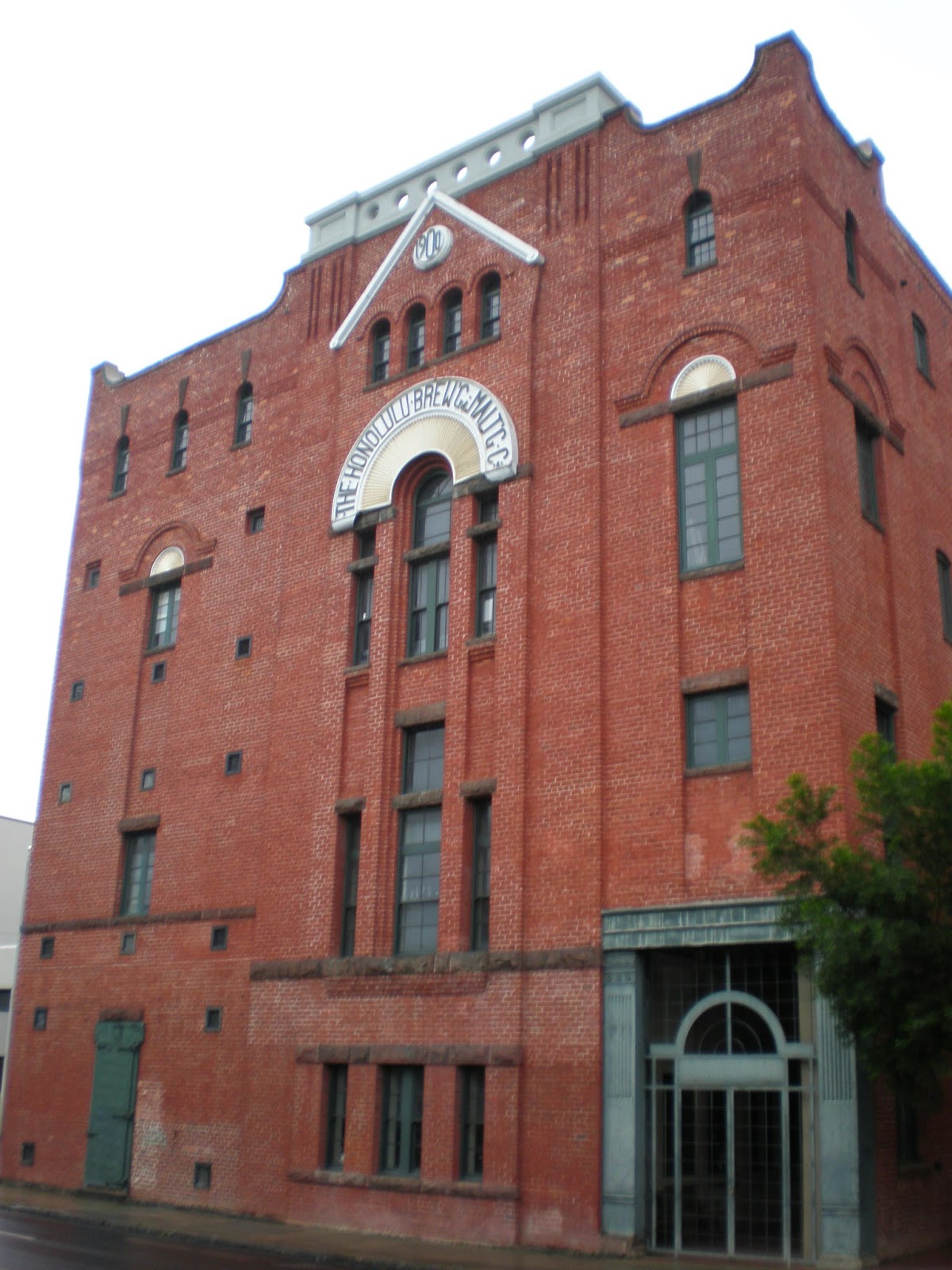
A lasting legacy of the early brew crew is the Royal Brewery on Queen Street.  It was built in 1899 to the specifications of the Honolulu Brewing and Malting Company.  It was constructed from materials shipped in from San Francisco and New York in 1899-1900 and was the original home of Primo.  (They stopped brewing beer there in 1960.)

The image shows The Royal Brewery – former home to Honolulu Brewing and Malting Co Ltd (later Hawaiʻi Brewing Co) and initial home to Primo. In addition, I have added some other images in a folder of like name in the Photos section on my Facebook and Google+ pages.

Follow Peter T Young on Facebook  

Follow Peter T Young on Google+    

Follow Peter T Young on LinkedIn   

© 2014 Hoʻokuleana LLC

Sunday, August 17, 2014

“Love Always For Hawaiʻi”


When the Hawaiian Music Hall of Fame honored ‘Hawaiʻi Aloha’ as one of five traditional songs as a ‘Famous Song’ (1998,) they noted, “For more than 100 years, love of the land and its natural beauty has been the poetry Hawaiian composers have used to speak of love. Hawaiian songs also speak to people's passion for their homeland and their beliefs.”

The Hawaiian Music Hall of Fame further noted, Hawaiʻi Aloha is “widely regarded as Hawaiʻi’s second anthem”.  (Hawaiian Music Museum)

“It is performed at important government and social functions to bring people together in unity, and at the closing of Hawaiʻi Legislative sessions. Today, people automatically stand when this song is played extolling the virtues of ‘beloved Hawaiʻi.’”

Hawaiʻi Aloha was written by a Protestant missionary, Lorenzo Lyons.

“In 1998, The Advisory Board honored these traditional songs for their beauty and their messages, which have made them popular, with concert performers and recording artists, as well as the public.”

Hawaiʻi Aloha has three verses, but most typically sing the first verse and repeat portions of the chorus:

E Hawaiʻi e kuʻu one hānau e
Kuʻu home kulaiwi nei
ʻOli nō au i nā pono lani ou
E Hawaiʻi, aloha ē

Hui:
E hauʻoli nā ʻōpio o Hawai`i nei
ʻOli ē! ʻOli ē!
Mai nā aheahe makani e pā mai nei
Mau ke aloha, no Hawaiʻi

Reverend Lorenzo Lyons was fluent in the Hawaiian language and composed many poems and hymns; his best known and beloved work is the hymn “Hawaiʻi Aloha” sung to the tune of “I Left It All With Jesus.”  He wrote it in about 1852.

Here’s the English translation:

O Hawaiʻi, o sands of my birth
My native home
I rejoice in the blessings of heaven
O Hawaiʻi, aloha

Chorus:
Happy youth of Hawai`i
Rejoice! Rejoice!
Gentle breezes blow
Love always for Hawaiʻi

Click HERE for a link to Hawaiʻi Aloha – sung by Ledward Kaʻapana, Dennis Kamakahi & Nathan Aweau – written by a missionary.

Collaboration between native Hawaiians and the American Protestant missionaries resulted in, among other things, the introduction of Christianity, the creation of the Hawaiian written language, widespread literacy, the promulgation of the concept of constitutional government, making Western medicine available and the evolution of a new and distinctive musical tradition.

Oli and mele were already a part of the Hawaiian tradition. “As the Hawaiian songs were unwritten, and adapted to chanting rather than metrical music, a line was measured by the breath; their hopuna, answering to our line, was as many words as could be easily cantilated at one breath.” (Bingham)

Some songs were translations of Western songs into Hawaiian; some were original verse and melody.  Hawaiʻi Aloha is an example of the music left as a lasting legacy by the missionaries in the Islands.

Missionaries used songs as a part of the celebration, as well as learning process. “At this period, the same style of sermons, prayers, songs, interrogations, and exhortations, which proves effectual in promoting revivals of religion, conversion, or growth in grace among a plain people in the United States, was undoubtedly adapted to be useful at the Sandwich Islands. … some of the people who sat in darkness were beginning to turn their eyes to the light”. (Bingham)

“The king (Kamehameha III) being desirous to use his good voice in singing, we sang together at my house, not war songs, but sacred songs of praise to the God of peace.” (Bingham)

Hawaiʻi Aloha was not the only popular song written by the missionaries.

One of the unique verses (sung to an old melody) was Hoʻonani Hole ‐ Hoʻonani I Ka Makua Mau.  Missionary Hiram Bingham wrote/translated it to Hawaiian and people sang it to a melody that dates back to the 1600s – today, it is known as the Hawaiian Doxology.

“In 1872, (Lyons) published Buke Himeni Hawaiʻi containing over 600 hymns, two thirds his own composition. Some years later he prepared the Sabbath School Hymn and Tune Book Lei Aliʻi.””

“The Hawaiians owe entirely to his exertions their introduction to modern enlivening styles of popular sacred music.”  (Hawaiian Gazette, October 19, 1886)  The image shows the Hawaiʻi music and lyrics.

Follow Peter T Young on Facebook

Follow Peter T Young on Google+    

Follow Peter T Young on LinkedIn   

© 2014 Hoʻokuleana LLC

Saturday, April 12, 2014

Instructions from the ABCFM


“It is for no private end, for no earthly object that you go. It is wholly for the good of others, and for the glory of God our Saviour.”

“You will never forget Opukahaia.  You will never forget his fervent love, his affectionate counsels, his many prayers and tears for you, and for his and your nation.”

“You saw him die; saw how the Christian could triumph over death and the grave; saw the radient glory in which he left this world for heaven. You will remember it always, and you will tell it to your kindred and countrymen who are dying without hope.”

On October 23, 1819, a group of northeast missionaries, led by Hiram Bingham, set sail on the Thaddeus for the Sandwich Islands (now known as Hawai‘i.)  With the missionaries were four Hawaiian students from the Foreign Mission School, Thomas Hopu, William Kanui, John Honoliʻi and Prince Humehume (son of Kauaʻi’s King Kaumuali‘i.)

The Prudential Committee of the American Board of Commissioners for Foreign Missions (ABCFM) in giving instructions to the pioneers of 1819 said:”

“Your mission is a mission of mercy, and your work is to be wholly a labor of love. … Your views are not to be limited to a low, narrow scale, but you are to open your hearts wide, and set your marks high.”

“You are to aim at nothing short of covering these islands with fruitful fields, and pleasant dwellings and schools and churches, and of Christian civilization.”  (The Friend)

The points of especial and essential importance to all missionaries, and all persons engaged in the missionary work are four:
Devotedness to Christ;
Subordination to rightful direction;
Unity one with another; and
Benevolence towards the objects of their mission

To this high and holy service you are solemnly designated; to this arduous and momentous work you are henceforth to hold yourselves sacredly devoted. You go to the Sandwich Islands as the messengers of the churches and the glory of Christ.

But it is an arduous enterprise, a great and difficult work. To obtain an adequate knowledge of the language of the people; to make them acquainted with letters; to give them the Bible with skill to read it; to turn them from their barbarous courses and habits; to introduce the arts; above all, to convert them from their idolatries and superstitions and vices, to the living and redeeming God, his truth, his laws, his ways of life, of virtue, and of glory.

To effect all this must be the work of an invincible and indefectible spirit of benevolence - a spirit which is not to be turned from its purpose, by any ingratitude, or perverseness, or maltreatment, or difficulties, or dangers; which, in the true sense of the first missionary, will become all things unto all men; which will give earnest heed to the counsels of, wisdom, and be studious in devising the best means and methods of promoting its great object; and which, most especially, and as its grand reliance, will, humbly and thankfully avail itself of the graciously proffered aid of Him in whom all fulness dwells.

Beloved members of the mission, male and female, this christian community is moved for you, and for your enterprise.  The offerings, and prayers, and tears, and benedictions, and vows of the churches are before the throne of everlasting mercy. They must not be violated; they must not, cannot be lost.

But how can you sustain the responsibility? A Nation to be enlightened and renovated; and added to the civilized world, and to the kingdom of the world's Redeemer and rightful sovereign! In his name only, and by his power, can the enterprise be achieved. In him be all your trust. To Him, most affectionately and devoutly, and to the word of His grace, we commend you.

In the Islands, the kapu system was the common structure, the rule of order, and religious and political code.  This social and political structure gave leaders absolute rule and authority.

By the time the Pioneer Company arrived, Kamehameha I had died and the crown was passed to his son, Liholiho, who would rule as Kamehameha II.  Kaʻahumanu recruited Liholiho’s mother, Keōpūolani, to join her in convincing Liholiho to break the kapu system which had been the rigid code of Hawaiians for centuries.

When the Pioneer Company of missionaries arrived, the kapu system had been abolished; the Hawaiian people had already dismantled their heiau and had rejected their religious beliefs - and effectively weakened belief in the power of the gods and the inevitability of divine punishment for those who opposed them.

Christianity and the western law brought order and were the only answers to keeping order with a growing foreign population and dying race.  Kamehameha III incorporated traditional customary practices within the western laws - by maintaining the "land division of his father with his uncles" - which secured the heirship of lands and succession of the throne, as best he could outside of "politics, trade and commerce." (Yardley)

Over the course of a little over 40-years (1820-1863) (the “Missionary Period”,) about 180-men and women in twelve Companies served in Hawaiʻi to carry out the mission of the ABCFM in the Hawaiian Islands.  (The information here is mostly from the initial instructions given to the missionaries in the Pioneer Company – those were included in 15-pages of instructions, summarized into about a page, here.)

The Annual Meeting of the Hawaiian Mission Children's Society begins at 10 am, today (April 12;) at about 11 am, there is the “Cousins” Annual Roll Call (a competitive counting of the descendents of the respective missionary families who were called to serve in the Islands.) From 1 - 4 pm, there is a free open house at the Hawaiian Mission Houses Historic Site and Archives.

The image shows the Mission Houses in a drawing by James P. Chamberlain (LOC) ca 1860.  In addition, I have added other images in a folder of like name in the Photos section on my Facebook and Google+ pages.

Follow Peter T Young on Facebook  

Follow Peter T Young on Google+    

Follow Peter T Young on LinkedIn   

© 2014 Hoʻokuleana LLC

Wednesday, January 15, 2014

ʻŌpūkahaʻia Leaves Hawaiʻi


Hostilities of Kamehameha’s conquest on Hawai‘i Island supposedly ended with the death of Keōua at Kawaihae Harbor in early-1792 and the placement of the vanquished chief’s body at Puʻukoholā Heiau at Kawaihae.

The island was under the rule of Kamehameha.  However, after a short time, another chief entered into a power dispute with Kamehameha; his name was Nāmakehā.

In 1795, Kamehameha asked Nāmakehā, who lived in Kaʻū, Hawai‘i, for help in fighting Kalanikūpule and his Maui forces on O‘ahu, but Nāmakehā ignored the invitation. Instead, he opted to rebel against Kamehameha by tending to his enemies in Kaʻū, Puna and Hilo on Hawai‘i Island.

Hostilities erupted between the two. The battle took place at Hilo.  Kamehameha defeated Nāmakehā; his warriors next turned their rage upon the villages and families of the vanquished. The alarm was given of their approach.

A family, who had supported Nāmakehā, the father (Ke‘au) taking his wife (Kamohoʻula) and two children fled to the mountains. There he concealed himself for several days with his family in a cave.  (Brumaghim)  The warriors found the family and killed the adults.

A survivor, a son, ʻŌpūkahaʻia, was at the age of ten or twelve; both his parents were slain before his eyes.  The only surviving member of the family, besides himself, was an infant brother he hoped to save from the fate of his parents, and carried him on his back and fled from the enemy.

But he was pursued, and his little brother, while on his back, was killed by a spear from the enemy. Taken prisoner, because he was not young enough to give them trouble, nor old enough to excite their fears, ʻŌpūkahaʻia was not killed.

He was later turned over to his uncle, Pahua, who took him into his own family and treated him as his child. Pahua was a kahuna at Hikiʻau Heiau in Kealakekua Bay.

When Captain Vancouver visited the islands in the 1790s, he provided the following description of Hikiʻau:
“Adjoining one side of the Square was the great Morai (heiau,) where there stood a kind of steeple (‘anu‘u) that ran up to the height of 60 or 70 feet, it was in square form, narrowing gradually towards the top where it was square and flat; it is built of very slight twigs & laths, placed horizontally and closely, and each lath hung with narrow pieces of white Cloth.”

“… next to this was a House occupied by the Priests, where they performed their religious ceremonies and the whole was enclosed by a high railing on which in many parts were stuck skulls of those people, who had fallen victims to the Wrath of their Deity. …. In the center of the Morai stood a preposterous figure carved out of wood larger than life representing the … supreme deity… .”

John Papa ʻI‘i wrote that in ca. 1812-1813, shortly after Kamehameha’s return to Hawai‘i, the king celebrated the Makahiki and in the course of doing so he rededicated Hikiʻau, “the most important heiau in the district of Kona”.

This is the same place where Captain Cook landed on the Island of Hawaiʻi, across the bay from Hikiʻau Heiau is where Cook was later killed.

ʻŌpūkahaʻia’s uncle, wanting his nephew to follow him as a kahuna, taught ʻŌpūkahaʻia long prayers and trained him to the task of repeating them daily in the temple of the idol. This ceremony he sometimes commenced before sunrise in the morning, and at other times was employed in it during the whole or the greater part of the night.

ʻŌpūkahaʻia was not destined to be a kahuna.

He made a life-changing decision – not only which affected his life, but had a profound effect on the future of the Hawaiian Islands.

“I began to think about leaving that country, to go to some other part of the globe. I did not care where I shall go to. I thought to myself that if I should get away, and go to some other country, probably I may find some comfort, more than to live there, without father and mother.”  (ʻŌpūkahaʻia)

In 1807, he boarded an American a ship in Kealakekua Bay, the Triumph, under the command of Captain Brintnal; also on Board was Thomas Hopu.  They set sail for New York, stopping first in China (selling seal-skins and loading the ship with Chinese goods.)

Also on Board was Russell Hubbard, a son of Gen. Hubbard of New Haven, Connecticut.  “This Mr. Hubbard was a member of Yale College. He was a friend of Christ. Christ was with him when I saw him, but I knew it not.  ‘Happy is the man that put his trust in God!’  Mr. Hubbard was very kind to me on our passage, and taught me the letters in English spelling-book.”  (ʻŌpūkahaʻia)

In 1809, they landed at New York and remained there until the Captain sold out all the Chinese goods.   Then, they made their way to New England.

“In this place I become acquainted with many students belonging to the College. By these pious students I was told more about God than what I had heard before … Many times I wished to hear more about God, but find no body to interpret it to me. I attended many meetings on the sabbath, but find difficulty to understand the minister. I could understand or speak, but very little of the English language. Friend Thomas (Hopu) went to school to one of the students in the College before I thought of going to school.”  (ʻŌpūkahaʻia)

ʻŌpūkahaʻia’s life in New England was greatly influenced by many young men with proven sincerity and religious fervor that were active in the Second Great Awakening and the establishment of the missionary movement.  These men had a major impact on ʻŌpūkahaʻia’s enlightenment in Christianity and his vision to return to Hawaiʻi as a Christian missionary.

He was taken into the family of the Rev. Dr. Dwight, President of Yale College, for a season; where he was treated with kindness, and taught the first principles of Christianity.  At length, Mr. Samuel J. Mills, took him under his particular patronage, and sent him to live with his father, the Rev. Mr. Mills of Torringford.

By 1817, a dozen students, six of them Hawaiians, were training at the Foreign Mission School to become missionaries to teach the Christian faith to people around the world.

ʻŌpūkahaʻia improved his English by writing; the story of his life was later assembled into a book called “Memoirs of Henry Obookiah” (the spelling of his name based on its sound, prior to establishment of the formal Hawaiian alphabet.)  ʻŌpūkahaʻia, inspired by many young men with proven sincerity and religious fervor of the missionary movement, had wanted to spread the word of Christianity back home in Hawaiʻi; his book inspired 14-missionaries to volunteer to carry his message to the Sandwich Islands (now known as Hawaiʻi.)

On October 23, 1819, the Pioneer Company of missionaries from the American Board of Commissioners for Foreign Missions (ABCFM) from the northeast United States, set sail on the Thaddeus for the Sandwich Islands (now known as Hawai‘i.)

There were seven couples sent to convert the Hawaiians to Christianity.   These included two Ordained Preachers, Hiram Bingham and his wife Sybil and Asa Thurston and his wife Lucy; two Teachers, Mr. Samuel Whitney and his wife Mercy and Samuel Ruggles and his wife Mary; a Doctor, Thomas Holman and his wife Lucia; a Printer, Elisha Loomis and his wife Maria; a Farmer, Daniel Chamberlain, his wife and five children.

Along with them were four Hawaiian youths who had been students at the Foreign Mission School at Cornwall Connecticut, Thomas Hopu (his friend on board the ship when he first left the Islands,) William Kanui, John Honoliʻi and Prince Humehume (son of Kauaiʻi’s King Kaumuali‘i and also known as Prince George Kaumuali‘i.)

Unfortunately, ʻŌpūkahaʻia died suddenly of typhus fever in 1818 and did not fulfill his dream of returning to the islands to preach the gospel.  (The bulk of the information here is from ʻŌpūkahaʻia’s “Memoirs of Henry Obookiah” and Papaʻula, 1867 in Brumaghim)

The image shows ʻŌpūkahaʻia. In addition, I have added some other images in a folder of like name in the Photos section on my Facebook and Google+ pages.

Follow Peter T Young on Facebook  

Follow Peter T Young on Google+    

© 2014 Hoʻokuleana LLC

Sunday, December 8, 2013

Hula – How the Missionaries Felt


"Hula is the language of the heart, and therefore the heartbeat of the Hawaiian people."  (attributed to Kalākaua)

"Their dances ... are prefaced with a slow, solemn song, in which all the party join, moving their legs, and gently striking their breasts, in a manner, and with attitudes, that are perfectly easy and graceful ... ."  (Captain Cook Journal, 1779)

“Hula is not just a dance, but a way of life, an ancient art that tells of Hawaiʻi's rich history and spirituality.” (attributed to many)

As hula is the dance that accompanies Hawaiian mele, the function of hula is therefore an extension of the function of mele in Hawaiian society. While it was the mele that was the essential part of the story, hula served to animate the words, giving physical life to the moʻolelo (stories.)  (Bishop Museum)

Hula combines dance and chant or song to tell stories, recount past events and provide entertainment for its audience.  With a clear link between dancer’s actions and the chant or song, the dancer uses rhythmic lower body movements, mimetic or depictive hand gestures and facial expression, as part of this performance. (ksbe-edu)

So what did the missionaries really think?

As Hiram Bingham once noted, they “were wasting their time in learning, practising, or witnessing the hula, or heathen song and dance.”  (Remember, heathen simply means ‘without religion, as in without God.’)

I think some might be surprised on how some missionaries viewed hula.

"The hula was a religious service, in which poetry, music, pantomime, and the dance lent themselves, under the forms of dramatic art, to the refreshment of men's minds. Its view of life was idyllic, and it gave itself to the celebration of those mythical times when gods and goddesses moved on the earth as men and women and when men and women were as gods."  (Emerson, son of missionaries)

"(W)hen it comes to the hula and the whole train of feelings and sentiments that made their entrances and exits in the halau (the hall of the hula) one perceives that in this he has found the door to the heart of the people."  (Emerson, son of Missionaries)

In describing a hula danced before Keōpūolani and her daughter Nāhiʻenaʻena, in Lāhainā in 1823, Missionary CS Stewart wrote:  "The motions of the dance were slow and graceful, and, in this instance, free from indelicacy of action; and the song, or rather recitative, accompanied by much gesticulation, was dignified and harmonious in its numbers. The theme of the whole, was the character and praises of the queen and princess, who were compared to everything sublime in nature, exalted as gods." (Missionary Stewart)

In describing the challenges between commitment to hula, as well as their studies, Sybil Bingham, wife of Hiram noted, "… most of them (are) indeed in earnest to receive instruction as the conduct of each day testifies.  Three of them are obliged to attend the hula hula every afternoon. At the close of the school this forenoon, and also last Saturday, they proposed going quickly to eat and return immediately that they might not lose the privilege of the bible lesson. … We were gratified after the vigorous effort made for the hula hula to see our scholars both at public worship and sabbath school."  (Sybil Bingham)

And how did Hiram Bingham feel (the one most often accused of a Hula ban?)

“This was intended, in part at least, as an honor and gratification to the king, especially at Honolulu, at his expected reception there, on his removal from Kailua.  Apparently, not all hula was viewed as bad or indecent.”  (Missionary Hiram Bingham)

“In the hula, the dancers are often fantastically decorated with figured or colored kapa, green leaves, fresh flowers, braided hair, and sometimes with a gaiter on the ancle, set with hundreds of dog's teeth, so as to be considerably heavy, and to rattle against each other in the motion of the feet.”  (Hiram Bingham)

“They had been interwoven too with their superstitions, and made subservient to the honor of their gods, and their rulers, either living or departed and deified.” (Hiram Bingham)

The missionaries most often opposed nudity, drinking and ‘wasting’ time.  Even today, laws forbid nudity in public; frown on excessive drinking and, likewise, we tend to encourage people to be productive members of their community (kind of like the concerns expressed by the early missionaries, including Bingham.)

So what happened?  Was hula ever effectively banned?  Did hula stop?

“Missionary influence, while strong, never wiped out the hula as a functional part of the Hawaiian society. Faced with this undeniable fact, the authorities sought to curb performances by regulation.”  (Barrere, Pukui & Kelly)

While not effectively stopping it completely, it does appear the missionaries did play a role on the Sabbath.  "The king Kaumualiʻi appears exceedingly interested in what he now learns from the bible through the interpretation of Honolii. The Capt. of the schooner informed us that last week the king sent out his crier, prohibiting dancing and work in the "Kalo patches" on the Sabbath. Honolii gives us some account of this in his letter to Mr. B.”

“After giving many of the particulars relative to the king's desire to hear the word of the Great Jehovah he says "I, John, told the king 'your people have hula hula on the Sabbath day? The king say, yes' Then I ask him, 'Can you wait hula hula on this day? Your people may hula hula on Monday, this day it is holy. Then king say we may stop hula hula on another Sabbath day.'"  (Sybil Bingham)

In 1830, Kaʻahumanu issued an oral proclamation in which she instructed the people, in part: “The hula is forbidden, the chant (olioli), the song of pleasure (mele), foul speech, and bathing by women in public places.” (Kamakau)  Although it was apparently never formally rescinded, the law was so widely ignored, especially after Kaʻahumanu died in 1832, that it virtually ceased to exist.

Kaʻahumanu was not the only Aliʻi who sought to ban hula: “A hula in the village today at the house formerly occupied by Kaomi. It was commenced at an early hour and continued until noon and was broken up only by the appearance of Kinau to put a stop to it. The notice that a hula was going on reached her and she sent word by Kalaaulana to Kaomi to put a stop to it & shut up the house”.  (Missionary Levi Chamberlain)

There are many references to King Kamehameha III regularly watching the hula.  “The young king (Kamehameha III,) … has been induced, however, to coincide with the other chiefs in all public acts.  His conduct, therefore, as a private person, though far from correct, has had but little influence. But recently, he has asserted more openly his independence; & he has done it by pursuing a course, which he knew was altogether opposed to the wishes of nearly all the high chiefs. He has revived the hula, or native dance”.   (EW Clark)

He was not alone.  “Unquestionably many christian Hawaiians considered hula immoral, and attempted to extirpate it. A series of letters from the Hawaiian journal Nupepa Kukoa in 1864-66 complains about hula schools operating in Maui, Oʻahu and Kauaʻi. These letters are interesting because they show that hula continued to flourish … ‘the “power and influence” of the national dance was never threatened ... hula remained the favorite entertainment of Hawaiians of all classes.’”  (kaimi-org)

In 1836, it was reported the French consul for Manila visited Honolulu, and attended a state banquet hosted by the King. Part of the festivities was a formal hula performance.  In 1850, the Penal Code required a license for “any theater, circus, Hawaiian hula, public show or other exhibition, not of an immoral character” for which admission was charged.

“No license for a Hawaiian hula shall be granted for any other place than Honolulu.”  (The law did not regulate hula in private, so the dance continued to be practiced and enjoyed throughout the islands.)

King David Kalākaua’s 1883 coronation included three days of hula performances and his 1886 jubilee celebrations had performances of ancient and newly created dances.

Hula was never effectively banned; it is a common misconception that one would suggest that the American missionaries banned hula.  They could not have banned hula, they did not have the authority.

The image shows an early drawing of Hula (1816.)  In addition, I have added other related images in a folder of like name in the Photos section on my Facebook and Google+ pages.

Follow Peter T Young on Facebook  

Follow Peter T Young on Google+    

© 2013 Hoʻokuleana LLC