Wednesday, August 7, 2013

Robert Crichton Wyllie


Robert Crichton Wyllie was born October 13, 1798 in an area called Hazelbank in Dunlop parish of East Ayrshire, Scotland. His father was Alexander Wyllie and his mother was Janet Crichton.

He earned a medical diploma by the time he was 20.  In 1844, he arrived in Hawaiʻi and stayed in the Hawaiian Islands for the rest of his life.

Wyllie first worked as acting British Consul. During this time he compiled in-depth reports on the conditions in the islands. Attracted by Wyllie’s devotion to the affairs of Hawaiʻi, on March 26, 1845, King Kamehameha III appointed him the Minister of Foreign Affairs.

Kamehameha IV reappointed all the ministers who were in office when Kamehameha III died, including Robert C. Wyllie as Minister of Foreign Relations.  Wyllie served as Minister of Foreign Relations from 1845 until his death in 1865, serving under Kamehameha III, Kamehameha IV and Kamehameha V.

Within five years after taking the helm of the office he had negotiated treaties with Denmark, England, France and the United States whereby Hawaiʻi’s status as an independent state was agreed.

Wyllie eventually gave up his allegiance to Queen Victoria and became a naturalized Hawaiian subject.

In 1847, Wyllie started collecting documents to form the Archives of Hawaii.  He requested the commander of the fort in Honolulu and all the chiefs to send in any papers they might have.  Two of the oldest documents included the 1790 letter of Captain Simon Metcalf and a letter by Captain George Vancouver dated 1792.

The foundation of the Archives of Hawaiʻi today are based almost entirely upon the vast, voluminous collections of letters and documents prepared and stored away by Wyllie.

Wyllie built a house in Nuʻuanu Valley he called Rosebank. He entertained foreign visitors at the house, and the area today still has several consular buildings.

In his role in foreign affairs, Wyllie was seen as a counter to the American influence.  Wyllie wrote in the early part of 1857, "There are two grand principles that we aspire to; the first is that all nations should agree to respect our independence and consider the Archipelago strictly neutral in all wars that may arise - and the second is, to have one identical Treaty with all nations."  (Kuykendall)

Of these two principles, the second was auxiliary to the first. Wyllie's great ambition was to set up some permanent barrier against any possible threat to Hawaii's national independence. He had a clear idea as to the direction from which danger was most likely to come.  (Kuykendall)

In the latter part of 1857 he wrote, "If we be left to struggle for political life, under our own weakness and inability to keep up an adequate military and naval force, in the natural course of things, the Islands must sooner or later be engulfed into the Great American Union, in which case, in time of war, the United States would be able to sweep the whole Northern Pacific.”  (Kuykendall)

Wyllie, above all other men in Hawaiʻi, succeeded in compelling the powers to maintain an attitude of “hands off”, leaving the kingdom in the list of independent nations.  (Taylor)

In March 1853, he bought a plantation on Hanalei Bay on the north shore of the island of Kauaʻi. In 1860, he hosted his friends King Kamehameha IV, Queen Emma and their two-year-old son, Prince Albert, at his estate for several weeks. In honor of the child, Wyllie named the plantation the "Barony de Princeville", the City of the Prince (Princeville.)

Originally the land was planted with coffee; eventually it was planted with sugarcane.  Princeville became a ranch in 1895, when missionary son Albert S Wilcox bought the plantation.

A bachelor all his life, Wyllie died October 19, 1865 at the age of 67; Kamehameha V and the chiefs ordered the casket containing his remains be buried at Mauna ʻAla, the Royal Mausoleum, adjacent to those of the sovereigns and chiefs of Hawaiʻi.

Members of Queen Emma’s family are also interred in the crypt with Mr. Wyllie: Queen Emma’s mother, Kekelaokalani; her hānai parents, Grace Kamaikui and Dr. Thomas Charles Byde Rooke; her uncles, Bennett Namakeha and Keoni Ana John Young II; her aunt, Jane Lahilahi; and her two cousins, Prince Albert Edward Kunuiakea and Peter Kekuaokalani.

The image shows Robert Crichton Wyllie. In addition, I have added other related images in a folder of like name in the Photos section on my Facebook and Google+ pages.

Follow Peter T Young on Facebook  

Follow Peter T Young on Google+  

© 2013 Hoʻokuleana LLC

Tuesday, August 6, 2013

Hawaiʻi And The Selma Voting Rights March


"They oughta be comin' pretty soon now," somebody said, looking west and into the sun where the two-lane highway curves to the right. "They oughta be here any time."  (Saturday Evening Post)

Folks lined the 54-miles of roadway between Selma and Montgomery, Alabama.  Thousands of others joined the march.

There were actually three marches, collectively called the Voting Rights March from Selma to Montgomery.  A catalyst was the killing of Jimmie Lee Jackson, who, while attempting to protect his mother from the troopers' billy clubs while attending a voting rights rally, was shot point blank by two of the troopers. Seven days later, on February 25, 1965, Jackson died from his gunshot wounds.

The first march (March 7) was known as "Bloody Sunday," as a result of the beatings upon marchers by state troopers and the local posse on horseback.  The second march, the following Tuesday, resulted in 2,500 protesters being turned back after attempting to cross the Edmund Pettus Bridge ("Turnaround Tuesday.")

The third march started after receiving a court order granting them the right to protest without police interference, and with protection from federalized National Guard troops.

The marchers arrived in Montgomery on March 24; that night, a "Stars for Freedom" rally was held. Singers Harry Belafonte; Peter, Paul and Mary; Tony Bennett; and comedian Sammy Davis Jr. entertained the marchers.

At the final leg of the march, 25,000 people gathered at the steps of the Alabama State Capitol Building, on Thursday, March 25, 1965.

The marchers were protesting the hostile conditions, discrimination, and unequal rights to vote, adequate housing and education.  One of the leaders said this was not a show, but a war against the social structure of America.

They came from everywhere. Charles Campbell, a Negro high-school teacher, came from Hawaiʻi where, he said, there is proof that the races can live together.  (Saturday Evening Post)

Campbell and other Hawaiʻi marchers were not this event's only ties to Hawaiʻi.

Lead marcher in the third march was Dr Martin Luther King.  A photo and caption of the event noted, "During part of the famous Selma to Montgomery Freedom March in 1965, Martin Luther King and fellow civil rights leaders wore the Hawaiian necklace of flowers - the lei - to symbolize their peaceful intentions."  (AkakaFoundation)

The lei were gifts from Rev Abraham Akaka as noted in this excerpt from Jet Magazine, “... Pastor emeritus of a Honolulu Church (Kawaiahaʻo,) Rev Abraham Akaka, 74, gained worldwide attention when he sent flower leis used by Dr Martin Luther King in the Selma march …”  (Jet, June 3, 1991)

This wasn't King's only tie to Hawaiʻi.

King came to Hawaiʻi a month after statehood and on Thursday, September 17, 1959 delivered a speech to the Hawaiʻi House of Representatives at its 1959 First Special Session.  His remarks included the following.

"As I think of the struggle that we are engaged in in the South land, we look to you for inspiration and as a noble example, where you have already accomplished in the area of racial harmony and racial justice, what we are struggling to accomplish in other sections of the country, and you can never know what it means to those of us caught for the moment in the tragic and often dark midnight of man’s inhumanity to man, to come to a place where we see the glowing daybreak of freedom and dignity and racial justice."

"And these are the things that we must be concerned about – we must be concerned about because we love America and we are out to free not only the Negro. This is not our struggle today to free 17,000,000 Negroes. It’s bigger than that. We are seeking to free the soul of America. Segregation debilitates the white man as well as the Negro."

"We are to free all men, all races and all groups. This is our responsibility and this is our challenge, and we look to this great new state in our Union as the example and as the inspiration. As we move on in this realm, let us move on with the faith that this problem can be solved, and that it will be solved, believing firmly that all reality hinges on moral foundations, and we are struggling for what is right, and we are destined to win."

At Selma, King delivered the speech "How Long, Not Long." "The end we seek," King told the crowd, "is a society at peace with itself, a society that can live with its conscience. ... I know you are asking today, How long will it take? I come to say to you this afternoon however difficult the moment, however frustrating the hour, it will not be long."

The Selma to Montgomery March effected great change; it led to the passage of the Voting Rights Act, signed by President Lyndon B Johnson on August 6, 1965.

The image shows Martin Luther King and others in the Selma to Montgomery march wearing lei, gifts from Abraham Akaka.  In addition, I have added other related images in a folder of like name in the Photos section on my Facebook and Google+ pages.

Follow Peter T Young on Facebook  

Follow Peter T Young on Google+  

© 2013 Hoʻokuleana LLC

Monday, August 5, 2013

Elephant Cage


It doesn’t exist anymore (and was relatively short-lived,) and contrary to its nickname, it didn’t house pachyderms.  It was actually an antenna array, constructed near Wahiawa, Oʻahu, and used during the Cold War.

More formally known as the AN/FRD-10 Circularly Disposed Antenna Array (CDAA) at NCTAMS (Facility 314,) it was a part of the efforts to gather foreign intelligence information.

Along with fourteen other FRD-10 CDAAs worldwide, it was a part of the Naval Security Group's Classic Bullseye network, a program for strategic signals intelligence (SIGINT) collection and transmitter locating.

This technology was a radical improvement in the performance of high-frequency direction finding. Its design, with uniformly spaced outside the rings of reflector screens, was able to intercept and detect the direction of high-frequency radio transmissions covering 360 degrees. (NPS)

Early work on CDAA systems had been undertaken by the German navy's signal intelligence research and development center early in World War II.  At that time, it was given the name, Wullenweber, or Wullenweber Antenna (named after Jürgen Wullenweber who was the mayor of Lubeck, Germany from 1533 to 1537. He was an opponent of injustice and a supporter of the Protestant cause who became a legendary figure.)

In addition to the nickname noted above, it was referenced by some as a “Dinosaur Cage;“ the names came from the nature of its construction.

The structure had concentric circles of posts and wires; the innermost ring was an antenna reflector screen made up of 80-vertical wood poles 94-feet high that were spaced evenly about 28'-6" apart in a circle about 732-feet in diameter.

Moving outward, another circle of 40-poles, 58-feet high, spaced evenly a little over 61-feet apart formed a ring 776-feet in diameter.  A third ring, 847-feet in diameter consisted of 120 wood poles, 25-feet in height, spaced 22-feet apart.  The outer-most ring had 120-poles, 22-feet in height forming a circle with an 873-foot diameter.

With poles, wire and netting, it looked like a cage to control some big animals, thus its nicknames.

But it served a greater purpose; throughout the post-World War II years, advancing technology helped to shift the means of intelligence gathering by the US, from networks of agents operating on the ground in foreign lands to electronic and over flying systems that could gather data from much greater distances.

Remember, in the 1950s technology was still in its relative infancy; it was only in 1957 that the Soviets launched the first earth-orbiting satellite (Sputnik I.)

The Wahiawa facility was positioned to pick up all radio signals from Asia and the Pacific region, but the antenna was so sensitive that it could also pick up signals from around the world.  Its sub-antennas in a complete circle also let operators inside know the direction from which the signal was coming.

Although human intelligence gathering efforts continued, technology played a greater role in the collection of information. The 1950s saw a greater capability of aerial reconnaissance in intercepting voice, radiotelephone, facsimile or Morse code communication, either transmitted in the clear or encrypted.

In addition, electronics were beginning to be able to pick up non-communications signals, such as the releases from foreign radar, and signals sent back from missiles or satellites that indicate performance and operation during a flight.

Supporting this aerial surveillance, during the 1950s and 1960s, work on ways of improving the capabilities and performance of high-frequency direction-finding equipment was improving – part of that research was the refinement of circular arrays, the CDAAs.

Besides the Wahiawa facility (built between 1962 and 1964,) CDAA were operational at Agana, Guam; Homestead AFB, FL; Imperial Beach, CA; Marietta, WA; Howard AFB, Panama Canal Zone; Sebana Seca, PR; Skaggs Island, CA; Sugar Grove, WV; Winter Harbor, ME; Canada: CFB Gander, NF; CFB Masset, BC; Europe: Brawdy, UK; Edzell, UK; Keflavik, Iceland; NAS Rota, Spain; and Asia: Hanza, Japan.

The worldwide network, known collectively as "Iron Horse", could detect and locate Soviet submarines and other high frequency communications almost anywhere on the planet.

The system was wound down at the end of the Cold War; in the mid-1990s, the network of facilities were started to be torn down.  On October 4, 1998, the Wahiawa facility ceased operations and was dismantled in 2005.

In September 2007, it was completely removed to make way for new buildings of the Hawaiʻi Regional Special Operations Center (HRSOC;) the military relocated its state-of-the-art intelligence and data gathering and analysis facility, related to security operations in the Pacific, out to the Kunia Tunnel.

The image shows AN/FRD-10 Circularly Disposed Antenna Array (CDAA) at NCTAMS (Facility 314,) the “Elephant Cage,” that used to be at Wahiawa.   In addition, I have included other related images in a folder of like name in the Photos section on my Facebook and Google+ pages.

Follow Peter T Young on Facebook  

Follow Peter T Young on Google+  

© 2013 Hoʻokuleana LLC

Sunday, August 4, 2013

Kālia


In traditional times, Pi‘inaio Stream was the dominant feature of the eastern area of Waikīkī.

It entered the ocean as a wide, ribboned kahawai (wide delta,) bringing fresh waters from the mountain valleys and creating an area of abundance. The early-Hawaiians found this plentiful land and marine resources as an excellent place to settle (the early settlers arrived around 600 AD.).

The Stream played a vital role in the geography, and cultural usage, of the ‘ili of Kālia. The meaning of Pi‘inaio is uncertain but it could be an allusion to going inland (pi‘i), to the location of a naio (a sandalwood-like tree - as may have commonly grown in the vicinity.)  (Cultural Surveys)

Waikīkī was famous for its fishponds with one listing citing 45 ponds.  The ten fishponds at Kālia were loko puʻuone (isolated shore fishponds formed by a barrier sand berm) with salt-water lens intrusion and fresh water entering from upland ʻauwai (irrigation canals.)

The shallow relatively-protected reefs of Waikīkī and the availability of the riparian resources of the Pi‘inaio estuary made the back dune ponds easily adaptable into fish ponds.

The inland ponds may have formed along the coast where existing depressions in the sand were chosen to make the loko puʻuone, and brush was cleared out. During traditional times, the ponds were used to farm fish, usually for the Hawaiian Ali‘i (royalty). The ʻamaʻama (mullet) and the awa (milkfish) were the two types of fish traditionally raised in the ponds.

Kālia was once renowned for the fragrant limu līpoa, as well as several other varieties of seaweed such as manauea, wāwaeʻiole, ʻeleʻele, kala and some kohu.

Limu kala was harvested to make lei for offerings.  The lei limu kala was and is still offered at the kūʻula [stone god used to attract fish] by fishermen or anyone who wishes to be favored by or is grateful to the sea.

John Papa ʻĪʻī relates an account from the early-1800s of a catch at a Kālia fishpond: “so large that a great heap of fish lay spoiling upon the bank of the pond.” (The waste was disapproved of.) This abundance of fishponds may have required significant maintenance and would have provided a potentially huge source of food for distribution at chiefly discretion.

The name of the area “Kālia” translated as “waited for” has a sense of “waiting”, “loitering” or “hesitating.” While the nuance is uncertain, one could imagine that the mouth of the Pi‘inaio Stream would be a logical place for travelers to pause.

An ʻōlelo noʻeau (Hawaiian proverb/saying) speaks of the pleasant portion of the coast of Kālia in Waikīkī:  Ke kai wawalo leo leʻa o Kālia, The pleasing, echoing sea of Kālia.  (Pukui)

Kālia is also mentioned in a story about a woman who left her husband and children on Kīpahulu, Maui, to go away with a man of O‘ahu. Her husband missed her and went to see a kahuna (priest) who was skilled in hana aloha (prayer to evoke love) sorcery.

The kahuna told the man to find a container with a lid and then speak into it of his love for his wife. The kahuna then uttered an incantation into the container, closed it, and threw it into the sea. The wife was fishing one morning at Kālia, O‘ahu, and saw the container. She opened the lid, and was possessed by a great longing to return to her husband. She walked until she found a canoe to take her home (Pukui): Ka makani kāʻili aloha o Kīpahulu; The love-snatching wind of Kīpahulu (Cultural Surveys)

In Fragments of Hawaiian History John Papa ʻĪʻī described “Honolulu trails of about 1810,” including the trail from Honolulu to Waikiki. He said that: Kawaiahaʻo which led to lower Waikiki went along Kaʻananiau, into the coconut grove at Pawaʻa, the coconut grove of Kuakuaka, then down to Piʻinaio; along the upper side of Kahanaumaikai‘s coconut grove, along the border of Kaihikapu pond, into Kawehewehe; then through the center of Helumoa of Puaʻaliʻiliʻi, down to the mouth of the Āpuakēhau Stream.

Based on ʻĪʻī‘s description, the trail from Honolulu to Waikiki in 1810 coursed through the makai side of the present Fort DeRussy grounds in the vicinity of Kālia Road. It is likely that this trail was a long-established traditional route through Waikiki.

Toward the beginning of the 1900s, downtown Honolulu was the destination for Hawaiian visitors, who numbered only about 3,000. While Honolulu had numerous hotels, there were few places to stay in Waikiki.

In 1891, at Kālia, the ‘Old Waikiki’ opened as a bathhouse, one of the first places in Waikiki to offer rooms for overnight guests. It was later redeveloped in 1928 as the Niumalu Hotel; the site eventually became the Hilton Hawaiian Village.

In 1911, the Army acquired 70-acres for the construction of Fort DeRussy and started filling in the fishponds which covered most of the Fort - pumping fill from the ocean continuously for nearly a year in order to build up an area on which permanent structures could be built.

Then, as part of the government’s Waikīkī Land Reclamation project, the Waikīkī landscape was further transformed with the construction of the Ala Wai Drainage Canal – begun in 1921 and completed in 1928 – resulted in the draining and filling in of the ponds and irrigated fields of Waikīkī.

Dredging for the project was performed by Hawaiian Dredging Company, owned by Walter F. Dillingham, who then sold the dredged sediments to Waikīkī developers. The dredge produced fill for the reclamation of over 600-acres of land in the Waikīkī vicinity.

The ʻili of Kālia runs from the ʻEwa end of today’s Ala Moana Center (near Piʻikoi Street) to the vicinity of the Halekūlani Hotel (makai of Kalākaua Avenue.)  (Lots of information here from Cultural Surveys.)

The image shows the ʻili of Kālia over a Google Earth image.  In addition, I have added other related images in a folder of like name in the Photos section on my Facebook and Google+ pages.

Follow Peter T Young on Facebook  

Follow Peter T Young on Google+  

© 2013 Hoʻokuleana LLC

Saturday, August 3, 2013

4,000 … 40,000 … 400,000 …


When Hawaiians prayed, in order to include all aspects of God (not to omit or offend any of the akua,) they added to the prayer the words, “E Hoʻoulu ana I kini o ke akua, ka lehu o ke akaua, na mano o ke akua” (Invoke we now the 40,000 gods, the 400,000 gods, the 4,000 gods.) (Beckwith)

In Hawaiian culture, natural and cultural resources are one and the same. Native traditions describe the formation (literally the birth) of the Hawaiian Islands and the presence of life on, and around them, in the context of genealogical accounts.

All forms of the natural environment, from the skies and mountain peaks, to the watered valleys and lava plains, and to the shore line and ocean depths are believed to be bodily manifestations of Hawaiian gods and deities.

It was the nature of place that shaped the cultural and spiritual view of the Hawaiian people.  "Cultural Attachment" embodies the tangible and intangible values of a culture - how a people identify with, and personify the environment around them. It is the intimate relationship (developed over generations of experiences) that people of a particular culture feel for the sites, features, phenomena and natural resources etc., that surround them - their sense of place. This attachment is deeply rooted in the beliefs, practices, cultural evolution and identity of a people.  (Kent)

The Hawaiian Kumulipo is a genealogical prayer chant linking the royal family to which it belonged not only to primary gods belonging to the whole people and worshiped in common with allied Polynesian groups, not only to deified chiefs born into the living world within the family line, but to the stars in the heavens and the plants and animals useful to life on earth, who must also be named within the chain of birth and their representatives in the spirit world thus be brought into the service of their children who live to carry on the line in the world of mankind.  (Beckwith)

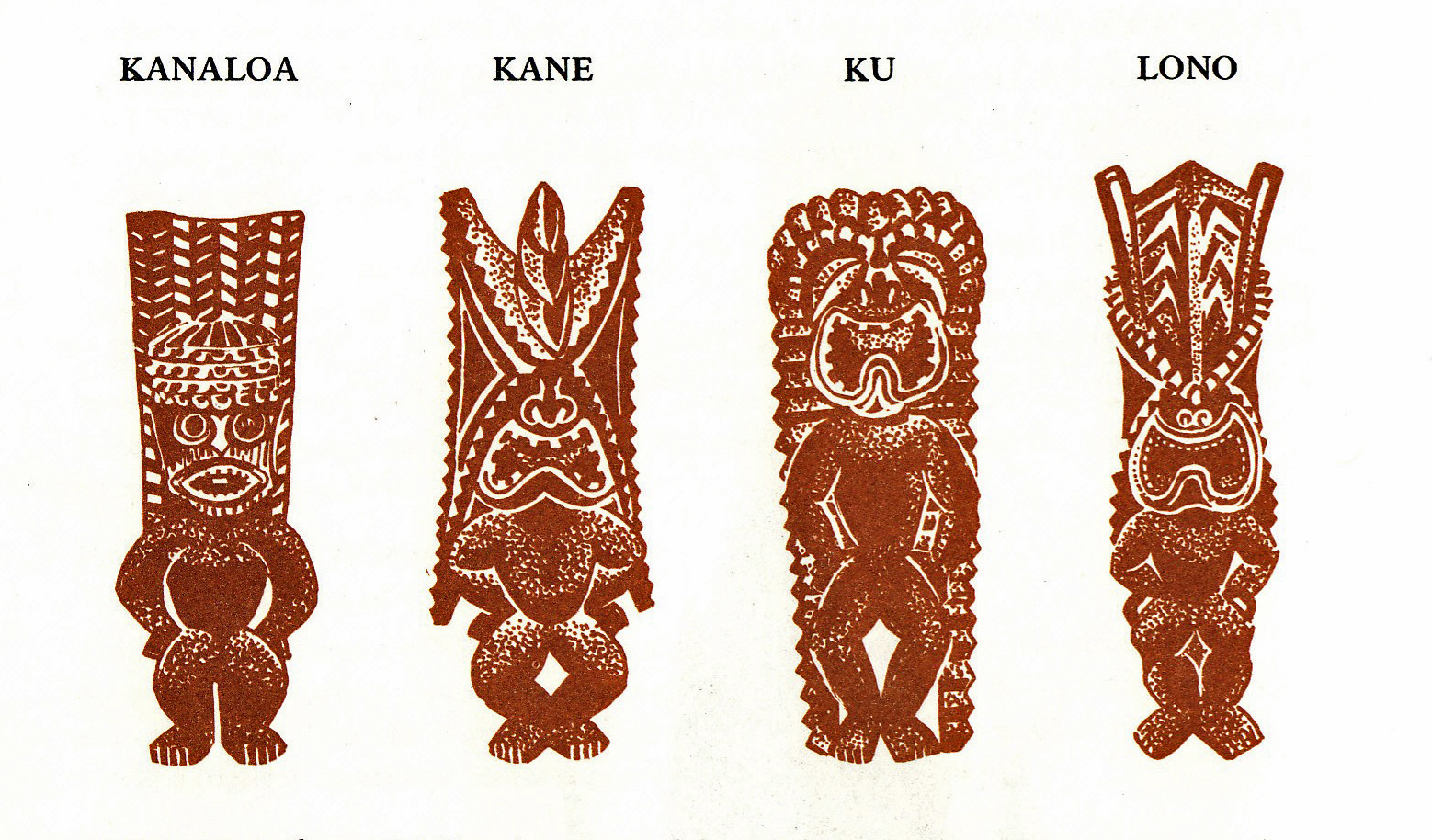
Hawaiians honored a kind of diffused hierarchy of gods, headed by Kanaloa, Kāne, Kū and Lono.  Each has his areas of responsibility or “departments.”  (Kanahele)

Kāne heads the areas of procreation, fresh water, forests, certain plants and animals.   Kū oversees war, politics, certain fish and shrubs, and trees.

Lono is in charge of the peace, agriculture, the weather and healing.  Kanaloa’s responsibilities suggest an important role of the oceans, voyaging and fishing.

In addition to these patron gods, many lesser deities were recognized who had their own responsibilities.  Certain akua watched over certain professions (healers, dancers, canoe makers, tapa makers, astrologers, etc.)

There were also family gods, and gods for individuals.  Each family had its own ʻaumakua (personal god) that watched over and protected them. For some it was the shark, others the pig, and so on. It was thought that spirits could communicate to the living through dreams and often appeared in the form of the family’s ʻaumakua.

Likewise, a vast number of demigods (kupua) that took life forms and represented as part human and part god and often tell of historic and heroic struggles between different kupua.

Kupua stories tend to follow a regular pattern.  The kupua is born in some non-human form, but detected and saved by his grandparents (generally the mother’s side,) who discern the divine nature.  He is won over by some chief and sent to do battle with his rival.  (Beckwith)

Within these various major natural forms, gods, lesser gods, ʻaumakua, kupua and even humans was ‘mana’ – a spiritual energy.  It is therefore an external and internal force within and around us.

“The missionaries found that the conflict between the light of Christianity and the darkness of heathenism was no momentary struggle.”  (Bingham)  The Hawaiians were criticized for believing in a great many spirits, worshipping ‘false gods’ and setting up alters in their honor.

This polytheism (worship or belief in multiple deities) was not and is not unique (although modern Christians may reference it differently.)  This is not to suggest the faiths are the same; there are, however, signs of similarity that should not be ignored.

A recent discussion on cultural beliefs helped me see that even in today’s Christian faith, while one God is ever present – Christian worshippers look to and seek guidance and assistance from others within the religion, beyond God.

Take, for example, the Catholic religion and recent beatification of two saints with Hawaiʻi ties, Saint Damien and Saint Marianne.  Roman Catholic canonization requires evidence of miracles attributed to that person's intercession.  People pray to the religious members for help; multiple miracles may move that member to saintly status.

Catholics pray to God; but within the religion are numerous Saints and Angels who are also looked upon and prayed to; as well as others (as former Father Damien and Mother Marianne, before their elevation to Sainthood.)

During Pope Benedict XVI’s term as Pope (2005-2013) at least 45 new saints were added to the Catholic roles; so, the list of saints continues to grow.

Likewise, look at the monumental edifices erected for worship by other religions, including Christianity.  Houses of worship are not simple structures and each has an alter and other religious representations.

Again, I am not saying they are the same; however, it looks like we may all be more similar than we sometimes think.

The image shows representations of the four primary Hawaiian gods (Kanaloa, Kāne, Kū and Lono.)   In addition, I have added other related images in a folder of like name in the Photos section on my Facebook and Google+ pages.

Follow Peter T Young on Facebook  

Follow Peter T Young on Google+  

© 2013 Hoʻokuleana LLC
Friday, August 2, 2013

Pioneer Mill


The early Polynesians brought sugarcane with them to the Islands.  Kō (sugarcane) was planted as a subsistence crop - with domestic, medicinal and spiritual uses.

In 1802, processed sugar was first made in the islands on the island of Lānaʻi by a native of China, who came here in one of the vessels trading for sandalwood and brought a stone mill and boilers.  After grinding off a small crop and making it into sugar, he went back to China the next year.

It was not until ca. 1823 that several members of the Lāhainā Mission Station began to process sugar from native sugarcanes, for their tables.  By the 1840s, efforts were underway in Lāhainā to develop a means for making sugar as a commodity.  (Maly)

Sugar was being processed in small quantities in Lāhainā throughout the 1840s and 1850s; in 1849, it was reported that the finest sugar in the islands could be found in Lāhainā.  (Maly)

James Campbell, who arrived in Hawaiʻi in 1850 - having served as a carpenter on a whaling ship and then operated a carpentry business in Lāhainā, started a sugar plantation there in 1860. The small mill, together with cane from Campbell's fields, manufactured sugar on shares for small cane growers in the vicinity.

Soon after the establishment of the new plantation, Henry Turton and James Dunbar joined Campbell. Under the name of Campbell & Turton, the company grew cane and manufactured sugar.

The small sugar mill consisted of three wooden rollers set upright, with mules providing the power to turn the heavy rollers. The cane juice ran into a series of boiling kettles that originally had been used on whaling ships.

When the nearby Lāhainā Sugar Company, a small company founded by H Dickenson in 1861, went bankrupt in 1863, its assets were acquired by Campbell and his partners.

In 1865, the plantation became known as Pioneer Mill Company (that year Dunbar left the company.)  By 1874, Campbell and Turton added the West Maui Sugar Company, a venture of Kamehameha V, to the holdings of Pioneer Mill Company.

The Pioneer Mill Company was extremely profitable, enabling Campbell to build a large home in Lāhainā and to acquire parcels of land on Maui and Oʻahu.

Campbell became known by the Hawaiians as “Kimo Ona-Milliona” (James the Millionaire).  Despite his success in sugar, his interests turned to other matters, primarily ranching and real estate.

Over the years, Campbell acquired property in Kahuku, Honouliuli, Kahaualea and elsewhere, amassing the holdings that eventually became 'The Estate of James Campbell.'

In 1877, James Campbell sold his half interest to partner Henry Turton for $500,000 with agents Hackfeld & Company holding a second mortgage of $250,000. The company's charter was dated in 1882, but by 1885, Mr. Turton declared bankruptcy and sold the property back to James Campbell and to Paul Isenberg, who was associated with Hackfeld & Co. Mr. CF Horner was selected to manage the plantation.

With later acquisitions of additional West Maui lands, Pioneer Mill was incorporated on June 29, 1895.  Horner sold his interest to American Factors, formerly Hackfeld & Co., and in 1960, Pioneer Mill Company became a wholly owned subsidiary of Amfac.

Irrigation of Pioneer Mill Company's fields, an area that eventually extended 14-miles long and 1 1/2-miles wide with altitudes between 10 and 700 feet, was accomplished with water drawn from artesian wells and water transported from the West Maui Mountains. The McCandless brothers drilled the first well on Maui for Pioneer Mill Company in 1883.

Pioneer Mill Company was one of the earliest plantations to use a steam tramway for transporting harvested cane from the fields to the mill. Cane from about 1000-acres was flumed directly to the mill cane carrier with the rest coming to the mill by rail.  (The Sugar Cane Train is a remnant of that system.)

In 1937, mechanically harvested cane was bringing so much mud to the factory that Pioneer Mill Company began the development of a cane cleaner.

Between 1948 and 1951, a rock removal program rehabilitated 3,153 acres of Pioneer land to permit mechanical planting, cultivating, and harvesting. In 1952, the railroad was eliminated and a year later new feeder tables were conveying cane directly from cane trucks into the factory.

Lāhainā Light and Power Company, Lāhainā Ice Company, the Lāhainā and Puʻukoliʻi Stores, and the Pioneer Mill Hospital were associated with the plantation, providing services to employees as well to Lahaina residents.

Faced with international competition, Hawaiʻi's sugar industry, including Pioneer Mill Company, found it increasingly difficult to economically survive.

At the industry's peak in the 1930s, Hawaiʻi's sugar plantations employed more than 50,000-workers and produced more than 1-million tons of sugar a year; over 254,500-acres were planted in sugar.  That plummeted to 492,000-tons in 1995.  A majority of the plantations closed in the 1990s.

Seeing hard times ahead, Pioneer Mill Company took 2,000-acres out of cane during the 1960s to develop Kāʻanapali as a visitor resort destination.

By 1986, the plantation had reduced its acreage down to 4,000-acre (which at its height had 14,000-acres planted in cane.)  After years of losing money, in 1999, Pioneer Mill closed its operations.

Recently, the Lāhainā Restoration Foundation and others worked to preserve the Pioneer Mill Smokestack.  It remains tall above the Lāhainā Community as a reminder of the legacy of sugar in the West Maui community.  (Lots of information here from the UH-Manoa, HSPA Plantation Archives.)

The image shows Pioneer Mill (kapolei-com.)   In addition, I have added other related images in a folder of like name in the Photos section on my Facebook and Google+ pages.

Follow Peter T Young on Facebook  

Follow Peter T Young on Google+  

© 2013 Hoʻokuleana LLC

Thursday, August 1, 2013

‘Bloody Monday’


In 1935, as part of the New Deal initiatives, Congress passed the Wagner Act legalizing workers' rights to join and be represented by labor unions.

In Hawaiʻi, business was dominated by the Big Five: Alexander & Baldwin, C. Brewer, Castle & Cooke, AmFac and Theo. Davies.  Nearly everything of significance, from banks to shipping lines and sugar plantations to newspapers, was tightly controlled by the Big Five.

One third of the population of the islands was living on the plantations, with seventy percent of the people directly dependent on plantation economy.

The Hilo Longshoremen's Association was formed on November 22, 1935, when about 30 young longshoremen of almost every ethnic and racial origin common to the territory agreed to join forces and organize all the waterfront workers regardless of race or national origin.

By the summer of 1937, with the help of the longshoremen, Hilo had the following unions: Hilo Laundry Workers' Association, Hilo Longshoremen's Association, Hilo Canec Association, Hilo Clerks' Association, Hilo Railroad Association and the Honuʻapo Longshoremen's Association.

By 1938, during the height of the Great Depression, labor discontent escalated over low pay and poor working conditions.  Negotiations were underway between the unions and employers on two major issues: 1) parity or equity of wages and conditions with the West Coast workers; and 2) the closed or union shop or some kind preferential hiring arrangement.

But Hawai'i employers were committed to fight the issue of wage parity or mainland wage standards in every industry as a matter of principle.

The Hilo Longshoremen’s Association struck against the Inter-Island Steamship Navigation Co.

The Inter-Island Steam Navigation Co., Ltd. had been controlled since 1925 by Matson Navigation and Castle & Cooke, the days before commercial airline transport between the islands.  Its ships carried virtually all passenger and light freight traffic.

After three weeks of striking, the unions had decided to fall back somewhat and draw their line at the return of the two larger ships, the SS Waiʻaleʻale and the SS Hualalai.

Inter-Island scheduled another return of the Waiʻaleʻale to Hilo Harbor.  Expecting confrontation, the night before the scheduled arrival, nearly 70-Police officers and special volunteer deputies began to assemble at the wharf to be sure that the union men would not get there before they did.

They had a small arsenal of 52-riot guns with bayonets, 4-Thompson sub-machine guns, tear gas grenades and an adequate supply of ammunition including both buckshot and birdshot cartridges for the riot guns.

In addition, the Hilo Fire Department was assigned to dispatch a pumping truck and enough firemen as might be needed to repulse the marchers with water hoses.

In addition to the official police force that was assembling, the Inter-Island Navigation Company had also prepared a squad of its own 'specials.'

The Waiʻaleʻale was expected around 9 am on August 1, 1938.  Some of the longshoremen started to gather as early as 6:30 am, and by 8:30 the majority of the unionists began to arrive.

Over two hundred men and women belonging to several different labor unions attempted to peacefully demonstrate against the arrival of the SS Waiʻaleʻale in Hilo.

Without any specific order, the crowd formed up and began to march down singing as they went, "The more we get together, together, together; The more we get together, the better we'll be!" While in the back the women were singing, "Hail, hail the gang's all here."

They were met by a force of police officers who tear gassed, hosed and finally fired their riot guns into the crowd.  In the scuffle, at least 16 rounds of ammunition were fired: seven birdshot and nine buckshot.

When it was over, fifty people, including two women and two children, had been shot; at least one man bayoneted and another's jaw nearly broken for speaking up for his fallen brother.

In the confusion and uncertainty of the moment, the remaining, uninjured unionists left the docks Monday afternoon and the Waiʻaleʻale was unloaded without incident. But that night a rally was held at Moʻoheau Park which was attended by a huge crowd.

Reminiscent of the violence unleashed in the West Coast Strike four years earlier, the Hilo shooting closely paralleled the San Francisco police attack of July 5th that had left two strikers slain and a hundred others wounded.

The West Coast event had been called Bloody Thursday; here, they were already calling August 1st Hilo's Bloody Monday.

The strike was soon settled.

A Grand Jury found: "That evidence is not sufficient to warrant an indictment against any person or group of persons".  The union subsequently filed a lawsuit for damages, which they lost.

Lots of information and images here are from Hawaii-edu and The Hilo Massacre: Hawaii's Bloody Monday, August 1st, 1938 (Honolulu: University of Hawaii, Center for Labor Education & Research, 1988.)

The image shows the gathering of sides at Hilo Harbor.  In addition, I have included other related images in a folder of like name in the Photos section on my Facebook and Google+ pages.

Follow Peter T Young on Facebook  

Follow Peter T Young on Google+  

© 2013 Hoʻokuleana LLC