Friday, March 7, 2014

Kakaʻako Land Fill


In 1898, the US Army built a seawall and filled a submerged coral reef on the ‘Ewa (western) side of Kaʻākaukukui for a gun emplacement at Fort Armstrong to protect the mouth of adjoining Honolulu Harbor.

At the turn of the century, Ala Moana Boulevard was built at what was then the shoreline, and the broad areas on both sides of the future Kapiʻolani Boulevard consisted of rice fields.

The dredging of harbors, offshore areas and the Ala Wai Canal provided fill for the reclamation of the ‘swamps.’  The construction of the Ala Wai stopped the annual flooding of Waikīkī.

At the beginning of the twentieth-century, the stretch of coast makai of Ala Moana Boulevard between Fort Armstrong (Piers 1 & 2 at Honolulu Harbor) and Waikīkī was the site of the Honolulu garbage dump, which burned almost continually.

The residue from burned rubbish was also used to reclaim wetlands.  This residue provided a fill that was quite inert and solid.  Thus, a rubbish dump was considered a cost-free method for a landowner to reclaim swampy land.

Since at least the 1850s, the Hawaiian Monarchy was providing urban public services in Honolulu, including refuse collection and disposal.  Horse-drawn wagons were first used for the collection of refuse; the horses were stabled in Kakaʻako.

Following Annexation and Territorial status (1900,) garbage removal was one of six items listed in the Oʻahu County’s 1905 monthly operating expenses, along with the police and fire departments, the electric light plant, city parks and the Royal Hawaiian Band.  The only direct income for Oʻahu County was its refuse collection fees.

Oʻahu, like many other coastal communities, was ringed with tidelands.  The area was traditionally noted for its fishponds and salt pans, and for the marsh lands where pili grass and other plants could be collected.  About one-third of the coastal plain at Kakaʻako was a wetland.  The entire shoreline was coral rubble bordered by fringing reefs and mudflats.

As time went on, when the fishponds were no longer used, they were more often than not filled with material dredged from the ocean or hauled from nearby areas, garbage and general material from other sources. These reclaimed areas provided valuable new land near the heart of growing urban Honolulu.

The ʻili of Kaʻākaukukui was awarded by land court to Victoria Kamāmalu; Princess Bernice Pauahi Bishop inherited the land, which later became part of the Kamehameha Schools (formerly the Bishop Estate). The Territory of Hawai‘i acquired the land in 1919.

Just as the Army had done at Fort Armstrong, the government built a new seawall, extending east to reclaim more Kaʻākaukukui reef and submerged land.

During the 1920s, the channel and basin on the Waikīkī (eastern) side of the growing Kakaʻako peninsula was dredged as a small boat harbor, called Kewalo Basin, to relieve overcrowding at Honolulu Harbor by the sampan (tuna fishing) fleet.

Hawaiian Dredging Company completed Kewalo Basin’s wharf and channel in 1925, and by 1930 the sampan fishing fleet was relocated to their new base.

In 1930, a garbage incinerator was constructed on Mohala Street (now ʻĀhui Street) near the east end of the Kakaʻako seawall (near Kewalo Basin.)  This moved the open dump fires into a more controlled and contained facility.

In 1931, the City and County of Honolulu dedicated the land on the Waikīkī-side of Kewalo Basin as Moana Park (the name was later changed to Ala Moana (“the path to the sea.”))

After the 1930 incinerator was constructed on ʻĀhui Street, the Star-Bulletin named it "Swillauea" (a play with words associated with the long burning fires of Kīlauea volcano on Hawai‘i Island) and lamented, "… Oh Swillauea-by-the-Sea … a monument to despair, foolishness and ugliness ... all the king's horses and all the king's men couldn't find another place to burn the City's rubbish except in the City's front yard …." (Mason Architects)

In the 1940s, another, larger incinerator was added, as well as a significant new seawall, 500-feet seaward of the old shoreline, enclosing more acreage of tidelands to be filled with the post-combusted ash.   (The large boulders laid in the wall lining Kewalo Channel and around the point came from Punchbowl Crater during the initial development of the National Memorial Cemetery of the Pacific by James W. Glover, Ltd.)

Incinerator Number One was later removed from service after the new incinerator on ʻOhe Street was constructed in 1946-48.  With the completion of the seawall in 1949, filling operations began and by the mid-1950s the shallow reef of Ka’ākaukukui was completely covered over.

And, again, in 1950 another seawall was extended and ash filled areas making more usable acreage.  Following statehood in 1959, government officials met to discuss the near-completion of the fill behind the seawall.   As the height increased, the State expressed concern over the mountain of ash which was growing so rapidly.

The State finally told the City in 1971 to stop placing any more ash to the pile.  Parts of the ash pile were then 25 feet above the top of the seawall.

The incinerator was finally shut down in 1977 because it could not meet the increasingly stringent air pollution standards. Then, in 1992, the State constructed Kakaʻako Waterfront Park on the ash pile (the young and young-at-heart now slide on cardboard down the steep grass-covered incinerator ash hill.)

The second incinerator, on ʻOhe Street, was renovated and is now used as the Children’s Discovery Center.  (The initial incinerator on ʻĀhui Street was used in 1952 by United Fishing Agency as part of their fish auction facility – the fish auction has since relocated to the Commercial Fishing Village at Pier 38.)

(Lots of information here is from the Historic American Buildings Survey for the Kewalo Incinerator and Cultural Surveys.)

The image shows the open dump fires from the Kakaʻako – Ala Moana shoreline (pre-1934;) in addition, I have added other images in a folder of like name in the Photos section.

Follow Peter T Young on Facebook  

Follow Peter T Young on Google+    

© 2014 Hoʻokuleana LLC

Thursday, March 6, 2014

March 6, 1899


"It has been a strange life, really, and a very romantic one."

On October 16, 1875, a child was born to Princess Miriam Likelike (the youngest sister of King Kalākaua) and Archibald Cleghorn.  The child, the only direct descendant of the Kalākaua dynasty, was named Victoria Kawekiu Kaʻiulani Lunalilo Kalaninui Ahilapalapa.

On March 9, 1891, Princess Victoria Kaʻiulani Cleghorn was duly appointed and proclaimed heir apparent to the Hawaiian throne.

Kaʻiulani inherited 10-acres of land in Waikīkī from her godmother, Princess Ruth Keʻelikōlani.  Originally called Auaukai, Princess Likelike (Kaʻiulani's mother) named it ʻĀinahau; Princess Kaʻiulani spent most of her life there.

The stream that flowed through ʻĀinahau and emptied into the ocean between the Moana and Royal Hawaiian Hotels (where the present Outrigger Hotel is located,) was called ʻApuakehau (the middle of three rivers that used to run through Waikīkī.)

The family built a two-story home on the estate.  At first the home was used only as a country estate, but Princess Kaʻiulani's family loved it so much, it soon became their full time residence.

Sadly, Kaʻiulani died, March 6, 1899.

The New York Times obituary (March 18, 1899) read, “Princess Kaʻiulani died March 6 of inflammatory rheumatism contracted several weeks ago while of a visit to the Island of Hawaii.”

“The funeral of the Princess will occur on Sunday, March 12, from the old native church (Kawaiahaʻo,) and will be under the direction for the Government. The ceremonies will be on a scale befitting the rank of the young Princess.”

“The body is lying in state at ʻĀinahau, the Princess’s old home. Thousands of persons, both native and white, have gone out to the place, and the whole town is in mourning. Flags on the Government buildings are at half mast, as are those on the residences of the foreign Consuls.”

Kaʻiulani had gone to the Waimea on the Big Island to visit Helen and Eva Parker, daughters of Samuel “Kamuela” Parker (1853–1920,) grandson of John Parker (founder of the Parker Ranch.)  (When his grandfather died, in 1868, Samuel (at the age of 15) inherited half the Parker Ranch, with his uncle John Palmer Parker II (1827–1891) inheriting the other half.)

While attending a wedding at the ranch, Princess Kaʻiulani and the girls had gone out riding horseback on Parker Ranch; they encountered a rainstorm.  Kaʻiulani became ill; she and her family returned to O‘ahu.

Tragically, after a two-month illness, Kaʻiulani died at ʻĀinahau, at age 23.

Kaʻiulani became a friend of author Robert Louis Stevenson.  He had come to Hawaiʻi due to ill health.  In his writings, Robert Louis Stevenson endearingly recalled that Princess Victoria Kaʻiulani was "...more beautiful than the fairest flower."

He was a frequent guest and used to read passages of poetry to the young Princess under the banyan tree.  Reportedly, the first banyan tree in Hawaiʻi was planted on the grounds of ʻĀinahau.

As many as fifty peacocks, favorites of the young Princess, were allowed to roam freely on the grounds.

Prior to her departure to study abroad, Stevenson wrote a farewell poem to the princess in her autograph book:

“Forth from her land to mine she goes,
The Island maid, the Island rose;
Light of heart and bright of face:
The daughter of a double race.

Her islands here, in Southern sun,
Shall mourn their Kaʻiulani gone,
And I, in her dear banyan shade,
Look vainly for my little maid.

But our Scots islands far away
Shall glitter with unwonted day,
And cast for once their tempests by
To smile in Kaʻiulani’s eye.”

A notation in Stevenson’s poem book further noted, “Written in April in the April of her age; and at Waikīkī, within easy walk of Kaʻiulani’s banyan!  When she comes to my land and her father’s, and the rain beats upon the window (as I fear it will,) let her look at this page; it will be like a weed gathered and pressed at home; and she will remember her own islands, and the shadow of the mighty tree; and she will hear the peacocks screaming in the dusk and the wind blowing in the palms; and she will think of her father sitting there alone.”

It is said that the night Kaʻiulani died, her peacocks screamed so loud that people could hear them miles away and knew that she had died.

The image shows Princess Kaʻiulani in the 1890s.  In addition, I have included other images in a folder of like name in the Photos section on my Facebook and Google+ pages.

Follow Peter T Young on Facebook  

Follow Peter T Young on Google+    

© 2014 Hoʻokuleana LLC

Wednesday, March 5, 2014

William (Will) Joseph Arthur Goodhue


“When we pause to consider that here is a studious and altogether competent observer who has had 18 consecutive years of constant and exclusive leprosy practice among 800 to 500 patients, constituting one of the largest segregated colonies in the world, we begin to realize the value of his accumulated experience and his opinions as a leprologist.” (Report of the Governor of Hawaii, To the Secretary of the Interior, 1914)

William (Will) Joseph Arthur Goodhue was born October 4, 1868 in Quebec, Canada and graduated from Rush and Dartmouth Colleges in medicine. He went to Hawaiʻi in 1902 as an intern practicing on Kauaʻi.

He fell in love with Alice Saburo Hayashi, aged sixteen, and she ran off with him to Honolulu where he had been offered a job, and he set up a home with her in Pālama.  A child (William Goodhue George) was born in 1903; William paid child support, but did not marry Alice.

Dr Goodhue and John D McVeigh assumed the positions of Resident Physician and Superintendent of Kalaupapa.  Goodhue was not only a surgeon in the colony, but spent a great deal of time developing new treatments and improving upon old ones; several of his findings were published in medical journals.

In October 1905, Goodhue married Christina “Tina” Meyer, daughter of Henry and Victoria (Bannister) Meyer.  Tina was grand-daughter of Rudolph Wilhelm Meyer, prior Superintendent of the Kalawao settlement (Kalaupapa) (who served with Father Damien and Mother Marianne Cope.)

Will and Tina had three children, all born at Kalaupapa: William Walter Goodhue, John D. Goodhue and Victoria Goodhue. They were later divorced.

Sister Leopoldina of Kalaupapa said of Goodhue, “We had been in the work nearly fifteen years and until Dr. Goodhue came we had never been assisted by a doctor only a very few times, as they were so much in dread of leprosy.”

“Dr. Goodhue, a true American brave and fearless, plunged into the work with strong will and whole heart doing wonderful work, and it became like a different place.”

The noted author, Jack London, visited the colony, and wrote of his friend, “Dr. Goodhue, the pioneer of leprosy surgery, is a hero who should receive every medal that every individual and every country has awarded for courage and life-saving. … I know of no other place … in the world, where the surgical work is being performed that Dr. Goodhue performs daily.”

“I have seen him take a patient, who in any other settlement or lazar house in the world, would from the complication of the disease die horribly in a week, or two weeks or three - I say, I have seen Dr. Goodhue, many times, operate on such a doomed creature, and give it life, not for weeks, not for months, but for years and years.”

But that is not all.  Goodhue used Alice Ball’s treatment of using chaulmoogra oil at Kalaupapa; and out of the five hundred and twelve patients, one hundred and seventy-five have been taking regular treatment.  (London)

(Ball isolated the ethyl ester of chaulmoogra oil (from the tree native to India) which, when injected, proved extremely effective in relieving some of the symptoms of Hansen’s disease.  Although not a full cure, Ball’s discovery was a significant victory in the fight against a disease.)

Click HERE for a prior story on the research by Alice Ball.

Goodhue, speaking to members of the legislature visiting Kalaupapa in 1921, said, “With two years’ chaulmoogra oil treatment, I believe sixty-five per cent of the chronic cases of leprosy on Molokaʻi can be cured.  And within ten years, all cases should be cured, and Kalaupapa be abandoned as a leper settlement.”

Once known as leprosy, the disease was renamed after Dr. Gerharad Armauer Hansen, a Norwegian physician, when he discovered the causative microorganism in 1873, the same year that Father Damien volunteered to serve at Kalaupapa.

Goodhue retired in 1925.  He had contacted Hansen’s disease and left Hawaiʻi for Shanghai, China, to visit his son who was attending college there (he did not wish to be confined to the leper colony where he had worked all those years on Molokaʻi.)

He lived there on his pension and died of a heart attack on March 17, 1941. He had made the request that if he should not recover to bury him there.  (Lots of info here from NPS.)

The image shows Kalawao, Molokaʻi (Kalaupapa in 1922.)  In addition, I have added other images in a folder of like name in the Photos section on my Facebook and Google+ pages.

Follow Peter T Young on Facebook  

Follow Peter T Young on Google+    

© 2014 Hoʻokuleana LLC

Tuesday, March 4, 2014

Sorrow Without Hope


Amongst the islands of the Hawaiian group is one named Lānaʻi. Beautiful, fertile and productive, its people are orderly and self-governing, but subject to the crown of Hawaiʻi, and loyal subjects of the Kamehameha. Among the natives of this island linger many traditions of the past, both curious and poetical. (Halcombe, 1867)

There's a small island between Hulopo'e and Mānele off the southern coast.  There is a tradition of how this place, and particularly the little island, came to be called Pu‘upehe, that was first recorded in 1867 by Walter M. Gibson, then owner of large portions of Lānaʻi, who reportedly learned the account from the chief, Pi‘ianai‘a, who was on Lānaʻi with Kamehameha I.

Gibson published the account under the title of “The Tomb of Puʻupehe, A Legend of Lānaʻi,” in the island newspaper, the Hawaiian Gazette of March 3, 1867.

Observed from the overhanging bluff that overlooks Puʻupehe, upon the summit of this block or elevated islet, would be noticed a small platform formed by a low stone wall. This is said to be the last resting-place of a Hawaiian girl whose body was buried there by her lover Makakēhau, a warrior of Lānaʻi.

Puʻupehe was the daughter of Uaua, a petty chief, one of the dependents of the king of Maui, and she was won by young Makakēhau as the joint prize of love and war. These two are described in the Kanikau, or Lamentation, of Puʻupehe, as mutually captive, the one to the other.

The maiden was a sweet flower of Hawaiian beauty. Her glossy brown, spotless body “shone like the clear sun rising out of Haleakala.” Her flowing, curly hair, bound by a wreath of lehua blossoms, streamed forth as she ran “like the surf crests scudding before the wind.” And the starry eyes of the beautiful daughter of Uaua blinded the young warrior, so that he was called Makakēhau, or Misty Eyes.

He feared that the beauty of his dear captive would cause her to be coveted by the chiefs of the land. His soul yearned to keep her all to himself. He said: “Let us go to the clear waters of Kalulu. There we will fish together for the kala and the aku, and there I will spear the turtle. I will hide you, my beloved, forever in the cave of Malauea.”

“Or, we will dwell together in the great ravine of Palawai, where we will eat the young of the uwau birds, and we will bake them in ki leaf with the sweet pala fern root. The ohelo berries of the mountains will refresh my love. We will drink of the cool waters of Maunalei. I will thatch a hut in the thicket of Kaohai for our resting-place, and we shall love on till the stars die.”

Makakēhau left his love one day in the cave of Malauea while he went to the mountain spring to fill the water-gourds with sweet water. This cavern yawns at the base of the overhanging bluff that overtops the rock of Puʻupehe. The sea surges far within, but there is an inner space which the expert swimmer can reach, and where Puʻupehe had often rested and baked the honu or sea turtle, for her absent lover.

This was the season for the kona, the terrific storm that comes up from the equator and hurls the ocean in increased volume upon the southern shores of the Hawaiian Islands. Makakēhau beheld from the rock springs of Pulou the vanguard of a great kona,—scuds of rain and thick mist, rushing with a howling wind, across the valley of Palawai.

He knew the storm would fill the cave with the sea and kill his love. He flung aside his calabashes of water and ran down the steep, then across the great valley and beyond its rim he rushed, through the bufferings of the storm, with an agonized heart, down the hill slope to the shore.

The sea was up indeed. The yeasty foam of mad surging waves whitened the shore. The thundering buffet of the charging billows chorused with the howl of the tempest. Ah! where should Misty Eyes find his love in this blinding storm? A rushing mountain of sea filled the mouth of Malauea, and the pent-up air hurled back the invading torrent with bubbling roar, blowing forth great streams of spray.

This was a war of matter, a battle of the elements to thrill with pleasure the hearts of strong men. But with one’s love in the seething gulf of the whirlpool, what would be to him the sublime cataract? What, to see amid the boiling foam the upturned face, and the dear, tender body of one’s own and only poor dear love, all mangled? You might agonize on the brink; but Makakēhau sprang into the dreadful pool and snatched his murdered bride from the jaws of an ocean grave.

The next day, fishermen heard the lamentation of Makakēhau, and the women of the valley came down and wailed over Puʻupehe. They wrapped her in bright new kapa. They placed upon her garlands of the fragrant na-u (gardenia). They prepared her for burial, and were about to place her in the burial ground of Manele, but Makakēhau  prayed that he might be left alone one night more with his lost love. And he was left as he desired.

The next day no corpse nor weeping lover were to be found, till after some search Makakēhau  was seen at work piling up stones on the top of the lone sea tower.

The wondering people of Lānaʻi looked on from the neighboring bluff, and some sailed around the base of the columnar rock in their canoes, still wondering, because they could see no way for him to ascend, for every face of the rock is perpendicular or overhanging. The old belief was, that some akua, kanekoa, or keawe-mauhili (deities), came at the cry of Makakēhau and helped him with the dead girl to the top.

When Makakēhau had finished his labors of placing his lost love in her grave and placed the last stone upon it, he stretched out his arms and wailed for Puʻupehe, thus:

“Where are you O Puʻupehe?
Are you in the cave of Malauea?
Shall I bring you sweet water,
The water of the mountain?
Shall I bring the uwau,
The pala, and the ohelo?
Are you baking the honu
And the red sweet hala?
Shall I pound the kalo of Maui?
Shall we dip in the gourd together?
The bird and the fish are bitter,
And the mountain water is sour.
I shall drink it no more;
I shall drink with ʻAipuhi,
The great shark of Manele.”

Ceasing his sad wail, Makakēhau leaped from the rock into the boiling surge at its base, where his body was crushed in the breakers. The people who beheld the sad scene secured the mangled corpse and buried it with respect in the kupapau of Mānele. (This piece is from the story printed in the Hawaiian Gazette in 1867; Halcombe noted – The Tomb of Puʻupehe – Sorrow Without Hope.)

Cautionary Note: An easy walk of about 1.5-miles round trip may be made to view Pu‘upehe, from Hulopo‘e Beach Park. The trail is visible, and follows the basic alignment of the coast. The trail does pass over some areas of rough rocks, and should be traveled with good footwear and care. Most importantly, the trail takes you along the edge of cliffs ranging in height from 10 feet to 200 feet. Do not approach the cliff side.  (Note the 6-feet wide, 21-feet long and 3-feet high structure at the top.)

The image shows Puʻupehe In addition, I have added other images in a folder of like name in the Photos section on my Facebook and Google+ pages.

Follow Peter T Young on Facebook  

Follow Peter T Young on Google+    

© 2014 Hoʻokuleana LLC

Monday, March 3, 2014

Arakawas


Established over 100 years ago, “old” Waipahu was once a vibrant, multi-ethnic sugar plantation town whose key corporate element was the Oʻahu Sugar Company.  For over 85 years, Waipahu served as a major commercial center outside of Honolulu.    (Waipahu Community Association)

“In the early days of Waipahu, the parking lot behind Bank of Hawaiʻi was a wetland next to Kapakahi stream.  People who lived near the stream grew rice and watercress and had truck gardens.  All of us kids used to swim in the stream and fish for dojo, funa and goby.”  (Goro Arakawa, Clark)

Another Waipahu institution (unfortunately, now gone) was Arakawas.

Zempan Arakawa, patriarch of the Arakawa (born on August 7, 1885,) came to Hawaiʻi from Okinawa in 1905.  First working at the Oʻahu Sugar Plantation, "Arakawa got to know all the workers and what they needed. He ran errands for them. This understanding proved useful when he went into retail a few years later. He knew his customers." (Purcell; Sigall)

The real legacy of the Arakawa family began in 1909, when Zempan and Tsuru (Ruth) Arakawa, opened their first store, Arakawa Shoten on Waipahu Street. (Okinawa Association)

In 1912 he moved the store to Depot Road, where it was in the location later taken over by Big Way market.   (Then, in 1955, he opened the 1 1/2-level store.)  (Star-Bulletin)

From humble beginnings of selling kau-kau bags and sewn tabis to Waipahu plantation workers, they expanded their business and turned Arakawas into Hawaiʻi’s best known “everything” store. If you needed to find something – you would find it at Arakawas. (Okinawa Association)

Learning from his experience working on the plantation, where Zempan took orders for sewing and mending work that he did at night, he soon recognized that the sugar workers needed functional and sturdy work clothing, at a price they could afford.  (Kawakami)

By the 1920s, palaka (typically a white plaid pattern over a dark blue background) became very popular.  The Arakawa store specialized in selling palaka fabrics to plantation workers.  They referred to palaka as gobanji, the Japanese term for a plaid or check design.  Apparently, the early immigrants used palaka only as work jackets; they did not wear palaka shirts.  (Kawakami)

When Zempan retired in 1955 his children; sons Kazuo, Takemi, Shigemi and Goro; daughters Leatrice and Joan and their husbands (Sei Kaneshiro and Horace Taba) took over the running of the store.  (In 1959, Zempan Arakawa was recognized as Father of the Year by the Honolulu Chamber of Commerce.  (Sigall))

From the 1920s to the 1960s, Arakawas was the only clothing supply and general merchandise (including food, household goods, etc) store in the area, serving the general population and Waipahu Sugar Mill workforce.  (Environet)

Eighth child, daughter Joan (who attended Wolfe Fashion Design School,) was Arakawas’ Manager of apparel and accessories. She is known for the use of palaka material and apparel that became symbolic of Arakawa.

Fourth son, Shigemi, started out as the Manager/Buyer of the Import and Gift section of Arakawas, Shigemi was often described as a “creative merchandising genius” by his siblings and wholesalers and manufacturers throughout the Pacific Rim.   (Star Advertiser)

He developed the planned chaos concept of retailing that gave the store its special ambiance and was reflected in every Arakawas’ Sunday newspaper ad.  (Star Advertiser)

Every nook and cranny was crammed with merchandise, from clothing and jewelry to hardware, food and even sporting goods.  (Star-Bulletin)

Goro Arakawa, the youngest son of Zempan and Ruth, received a marketing degree from New York University and returned home to work in the family store.  There, he wrote advertising copy that incorporated the sights and sounds of Waipahu (such as the rooster crowing radio commercials.)  (Filipino Chronicle)

Ads ended with, “Arakawa’s - located on historic Depot Road, just below the Sugar mill.”    Goro also came up with catchy slogans like “If you don’t know what you’re looking for, you’ll find it at Arakawa’s” and “Don’t say you can’t find it until you shop at Arakawa’s.”  (Filipino Chronicle)

The 1 1/2-level store was actually the third incarnation of the small plantation store first opened by Zempan. In fact, the reason for the 1 1/2 levels was the one-half level upstairs occupied by the sporting goods. Going to Arakawa's was like stepping back in time, back to the old sugar plantation days when life in Hawaiʻi seemed simpler and more relaxed.  (Star-Bulletin)

On buying trips around the world, he displayed an uncanny eye for finding things that would catch people’s fancy and sold goods as varied as sculptor Noguchi lamps, tapa-themed dinnerware, mosquito coils, and plastic orchid leis.  (Star Advertiser)

With the gradual decline of the sugar industry, the community’s economic and social vitality slowly began to deteriorate.  The historic town core centered on Waipahu Depot Road was devastated by the closures of the sugar mill and Bigway Market in 1999.  (Waipahu Community Association)

Through the generosity to the communities they served - Arakawas became the symbol of an era in Hawaiʻi’s history that represented hard work, sincerity, honesty and generosity of spirit. (Okinawa Association)

It was a sad day when Arakawas in Waipahu (operating from 1909 to 1995) closed its doors.  Gone was the assortment of colors and sizes of palaka wear, as well as the myriad needs filled by the diversity and depth of the merchandise in the store.

The image shows Arakawas’ crew at their closing (Star-Bulletin.)    In addition, I have included other images in a folder of like name in the Photos section on my Facebook and Google+ pages.

Follow Peter T Young on Facebook  

Follow Peter T Young on Google+    

© 2014 Hoʻokuleana LLC

Sunday, March 2, 2014

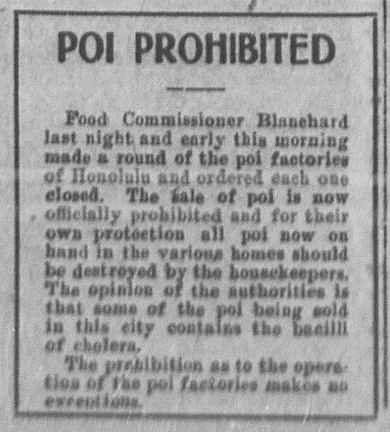
Poi Prohibited


"The sale of poi is now officially prohibited."

Thus was the March 2, 1911 directive of Food Commissioner Blanchard (as noted in an announcement on the front page of the Hawaiian Gazette, March 3, 1911.)  (While not being sold, there was still plenty of poi available to consumption.)

"Over seventy-five hundred pounds of poi is being distributed free every day to Hawaiians in this city by the board of health under a resolution by the legislature appropriating $2000 out of the contingent fund for the expense subject to the approval of the Governor."  (Hawaiian Gazette, March 10, 1911)

"About one ton of poi a day is given out at each of the four stations Kalihi, Palama, Mōʻiliʻili and Kawaiahaʻo Church.  At each place there is a health inspector representing the board of health who is in charge of the operation assisted by deputies of Mr Rath superintendent of the Palama settlement work, who is superintending the poi distribution."  (Hawaiian Gazette, March 10, 1911)

"At first the distribution was in the shape of sacks of poi of about ten pounds each put up at the Kalihi factory but such a great demand was immediately developed that the factory had no time to sack the poi and now it is being sent to the distributing points in barrels."  (Hawaiian Gazette, March 10, 1911)

"A number of bacteriological tests made with poi have convinced the health officers of the territorial and federal government that that staple can transmit and impart the germs of cholera and probably all other disease of similar nature."  (Hawaiian Gazette, March 17, 1911)

"With but two exceptions every case of cholera in the two outbreaks during the past two months has been traced to one source of infection - the Manoa valley taro patches and the poi manufactured from this taro."  (Hawaiian Gazette, April 18, 1911)

"In Manoa valley is a Chinese named Hong Fong who had a taro patch. He carried taro to a shop on Fort street near School. This was made into poi and each day he carried poi from this shop up to Manoa and delivered it to Manana and Mrs Gonsalves who were the first of the Manoa cases."  (Hawaiian Gazette, April 18, 1911)

"Then comes the Perry family cases in Manoa where cholera wiped out almost an entire family. There were four cases of cholera.  They lived on the bank near this taro field.  They raised their own taro but sometimes bought poi from Hong Fong.  They filled their water barrels for drinking purposes from this stream which had been contaminated by Manana when he became sick."  (Hawaiian Gazette, April 18, 1911)

"In this stream Manana's contaminated clothing was washed by members of his family and water from this polluted stream was used to mix with poi.  A Japanese dairyman nearby used this water to dilute the milk product and the children in the Perry family drank milk so diluted and contaminated."  (Hawaiian Gazette, April 18, 1911)

"From February 25, when the first case was reported, to March 14, 1911, the date of the last case, there had been reported a total of 31-cases with 22 deaths.  Twenty four days having elapsed since the occurrence of the last case, Honolulu may properly be considered to no longer harbor the disease."  (Public Health Reports)

The medical conditions led the territorial legislature to enact regulations on the processing of poi.  The "Poi Bill" gave the board of health the authority to close any poi shop which is found to be making poi under filthy and disease-breeding conditions (the first law to regulate poi factories.)

This is not the Islands' last legislative fight over processing poi.

A hundred years later, in 2011, another "Poi Bill" (SB101) was enacted after it made its way through the legislature and onto the Governor's desk.

It exempted paʻi ʻai (traditional "hand-pounded poi") from certain food-processing requirements/permits under certain conditions.  (Up to that passage, the Department of Health deemed paʻi ʻai unsafe.)

(Cholera is an infection of the small intestine caused by the bacteria; the main symptoms are watery diarrhea and vomiting.  It is typically transmitted by either contaminated food or water.   Worldwide, there have been several cholera pandemics, killing millions of people.)

The image shows Food Commissioner's Poi Prohibition proclamation. (Hawaiian Gazette, March 3, 1911)  In addition, I have added other images in a folder of like name in the Photos section on my Facebook and Google+ pages.

Follow Peter T Young on Facebook  

Follow Peter T Young on Google+    

© 2014 Hoʻokuleana LLC

Saturday, March 1, 2014

Placial vs Spatial


In modern land description, the context is ‘spatial’ – we tend to reference things by their location, area and use - 123 Main Street, 10,000-square feet, residential.

Look at any map, GPS orientation or recall how you describe a place, etc, it’s all about space and location; you learn where you are and the physical context of it.

In old Hawaiʻi, it was the nature of ‘place’ that shaped the practical, cultural and spiritual view of the Hawaiian people.

In Hawaiian culture, natural and cultural resources are one and the same.  Traditions describe the formation (literally the birth) of the Hawaiian Islands and the presence of life on, and around them, in the context of genealogical accounts.

All forms of the natural environment, from the skies and mountain peaks, to the watered valleys and lava plains, and to the shore line and ocean depths are believed to be embodiments of Hawaiian gods and deities.  (Maly)

“The ancients gave names to the natural features of the land according to their ideas of fitness. … There were many names used by the ancients to designate appropriately the varieties of rain peculiar to each part of the island coast; the people of each region naming the varieties of rain as they deemed fitting. … The ancients also had names for the different winds.”  (Malo)

Hawaiians named taro patches, rocks, trees, canoe landings, resting places in the forests and the tiniest spots where miraculous events are believed to have taken place.  (hawaii-edu)  There were names for everything, and multiple names for many.

Place names are often descriptive of: (1) the terrain, (2) an event in history, (3) the kind of resources a particular place was noted for or (4) the kind of land use which occurred in the area so named. Sometimes an earlier resident of a given land area was also commemorated by place names.  (Maly)

“Cultural Attachment” embodies the tangible and intangible values of a culture - how a people identify with, and personify the environment around them.

It is the intimate relationship (developed over generations of experiences) that people of a particular culture feel for the sites, features, phenomena and natural resources etc, that surround them - their sense of place. This attachment is deeply rooted in the beliefs, practices, cultural evolution and identity of a people.  (Kent)

In ancient Hawai‘i, most of the common people were farmers, a few were fishermen.  Access to resources was tied to residency and earned as a result of taking responsibility to steward the environment and supply the needs of aliʻi.  Tenants cultivated smaller crops for family consumption, to supply the needs of chiefs and provide tributes.

In this subsistence society, the family farming scale was far different from commercial-purpose agriculture.  In ancient time, when families farmed for themselves, they adapted; products were produced based on need.  The families were disbursed around the Islands.  An orderly delineation became needed.

Māʻilikūkahi is noted for clearly marking and reorganizing land division palena (boundaries) on O‘ahu.  Defined palena brought greater productivity to the lands; lessened conflict and was a means of settling disputes of future aliʻi who would be in control of the bounded lands; protected the commoners from the chiefs; and brought (for the most part) peace and prosperity.  (Beamer, Duarte)

Fornander writes, "He caused the island to be thoroughly surveyed, and boundaries between differing divisions and lands be definitely and permanently marked out, thus obviating future disputes between neighboring chiefs and landholders."

Kamakau tells a similar story, "When the kingdom passed to Māʻilikūkahi, the land divisions were in a state of confusion; the ahupuaʻa, the ku, the ʻili ʻāina, the moʻo ʻāina, the pauku ʻāina, and the kihāpai were not clearly defined.”

“Therefore, Māʻilikūkahi ordered the chiefs, aliʻi, the lesser chiefs, kaukau aliʻi, the warrior chiefs, puʻali aliʻi, and the overseers (luna) to divide all of Oʻahu into moku, ahupuaʻa, ʻili kupono, ʻili ʻaina, and moʻo ʻāina."

What is commonly referred to as the “ahupuaʻa system” is a result of the firm establishment of palena (boundaries.)  This system of land divisions and boundaries enabled a konohiki (land/resource manager) to know the limits and productivity of the resources that he managed.

Ahupuaʻa served as a means of managing people and taking care of the people who support them, as well as an easy form of collection of tributes by the chiefs.  Ultimately, this helped in preserving resources.

A typical ahupuaʻa (what we generally refer to as watersheds, today) was a long strip of land, narrow at its mountain summit top and becoming wider as it ran down a valley into the sea to the outer edge of the reef.  If there was no reef then the sea boundary would be about one and a half miles from the shore.

When the Hawaiians lived on the land as farmers and gatherers they became intimately acquainted with and named countless features and places.

Hawaiian customs and practices demonstrate the belief that all portions of the land and environment are related; the place names given to them tell us that areas are of cultural importance.  (Maly)

This Placial versus Spatial context reflects the relationship of the people to the land.

“Sense of place is about the feeling that emanates from a place as a combination of the physical environment and the social construct of people activity (or absence of) that produces the feeling of a place.  ...  People seek out Hawaiʻi because of the expectation of what its sense of place will be when they get there.”  (Apo)

“Sense of place helps to define the relationships we have as hosts and guests, as well as how we treat one another and our surroundings.”  (Taum)

“In the Hawaiian mind, a sense-of-place was inseparably linked with self-identity and self-esteem.  To have roots in a place meant to have roots in the soil of permanence and continuity.”

"Almost every significant activity of his life was fixed to a place.”

“No genealogical chant was possible without the mention of personal geography; no myth could be conceived without reference to a place of some kind; no family could have any standing in the community unless it had a place; no place of significance, even the smallest, went without a name; and no history could have been made or preserved without reference, directly or indirectly, to a place.”

“So, place had enormous meaning for Hawaiians of old.”   (Kanahele)

The image shows ahupuaʻa on the island of Molokaʻi – each has its own name and reason for delineation (Google Earth/DBEDT.)  In addition, I have included other related images in a folder of like name in the Photos section on my Facebook and Google+ pages.

Follow Peter T Young on Facebook  

Follow Peter T Young on Google+    

© 2014 Hoʻokuleana LLC