Showing posts with label Japanese. Show all posts

Friday, January 23, 2015

Manjirō


Tokugawa Ieyasu (1542-1616) unified Japan by defeating his enemies at the Battle of Sekigahara in 1600. He was made Shōgun in 1603 and set up his headquarters at Edo (modern Tokyo.)  The Edo period is also known as the Tokugawa period; Japan was ruled by the Shōgun of the Tokugawa family.

For reasons of national security, from 1639 the Shōgunate ordered that contacts with the outside world be severely limited. Japan’s only regular contacts were with the Dutch, Chinese and Koreans.  (British Museum)

Fast forward through a couple centuries of Japan isolation to the mid-1850s ... the US hoped Japan would agree to open certain ports so American vessels could begin to trade. In addition to interest in the Japanese market, America needed Japanese ports to replenish coal and supplies for the commercial whaling fleet.

On July 8, 1853, four black ships led by USS Powhatan and commanded by Commodore Matthew Calbraith Perry, anchored at Edo (Tokyo) Bay. The Japanese thought the ships were “giant dragons puffing smoke” (they had not ever seen steam ships with smoke from their stacks.)

“On that great historic event when the Perry Mission from the United States landed at Uraga (Japan) in 1853, Manjirō served as interpreter.  No more suitable person could have been found in all Japan.  Manjirō knew the American spirit and desires."

"Any blunder on his part might have resulted in an international disaster.  As it was, the Perry mission was a great success.  In spite of the powerful conservatism of Japan’s ruling classes at that time, the country was opened to world-wide commerce."  (Japanese Embassy; Millicent Library)

Let’s look back …

Manjirō was born January 23, 1827 in Nakahama, Kochi Torishima prefecture of Japan during the isolation period. He had a tough life as a young man, the death of his father at age 9 forced him to work to support his family.

By age 14 he was part of a five man fishing boat (Manjirō, Jūsuke, Denzō, Goemon and Toraemon.) During one trip in January 1841, they were caught in a storm and stranded on Torishima Island, off the coast of Japan.

Then, the log book of Captain William Whitfield on the ‘John Howland’ noted (June 27, 1841,) “This day light wind from S. E. Isle in sight at 1 P.M. Sent in two boats to see if there was any turtle, found 5 poor distressed people on the isle, took them off, could not understand anything from them more than that they was hungry.”  (Millicent Museum)

After 6-months at sea (arriving in Hawaiʻi,) Whitfield made Manjirō (now called 'John Mung' by the crew) an offer - stay in Hawaiʻi and find a ride home, or come with him to America and receive an education. Manjirō continued to the continent with Whitfield, arriving in New Bedford on May 3, 1843 (reportedly, the first Japanese person to live in the US.)

There, he joined the Whitfield household (the Captain had been a bachelor, but shortly after he married) and Manjirō moved with them to the Whitfield home in Fairhaven (as a foster son, not a servant.)

Not accepted at the Whitfield’s church, the family joined the Unitarian Church; a member of the congregation there was the Delano family (a grandson, Franklin Delano Roosevelt later became US president.)

In the following years the young foreigner became well known to the Fairhaven townspeople as Captain Whitfield treated him like a son. He went to his first school ever (the Old Stone School) after being tutored by Miss Allen, a local teacher and neighbor of the captain. He later learned higher level math, navigation and surveying at the Bartlett School.

Then, an opportunity to go to sea came up; the Captain was away, Mrs Whitfield gave her permission for Manjirō to go back to the Pacific and wrote a letter of introduction to a family friend, chaplain of the Seamen’s Bethel in Honolulu, Reverend Samuel C Damon.

He eventually returned to the Island and was repatriated with his friends (Jūsuke had died prior to Manjirō’s return.)  After three years at sea, he returned to New Bedford in 1849 (never making it back to his home in Japan – though he yearned to return.)

In October 1849, he got gold fever and rushed to California.  After only 70-days in the mines, he earned $600 – about the equivalent of 3-years wages as a whaler.  He then headed for Honolulu to encourage his 3 shipmates to return to Japan with him.

They found a ship (‘Sara Boyd’) headed for Shanghai; with the help of Damon and others, they raised enough funds to buy and provision a small boat (‘Adventure’) that they would store on the Sara Boyd and, when they were close to Japan, use it to make it to the islands.

Damon also obtained for Manjiro a US passport and helped him devise a plan to get safely back to his homeland.  Next they loaded the Adventure onto a larger American vessel which dropped the small boat off in the waters off present-day Okinawa.  (Yamamoto)

On February 3, 1851, 10-years after being shipwrecked, Manjirō, Denzō and Goemon landed on an Okinawan beach (Toraemon did not make the trip, he stayed in Honolulu.)  He eventually saw his mother, again.

The Japan leadership recognized the value Manjirō’s fluency in the English language; in addition, he was the only person in Japan who had extensive knowledge of English and American culture at the time.  Manjirō was raised to lower rank of samurai due to his usefulness to the Government.

Manjirō began to work for the Japan government; he was given a higher rank of samurai and retainer to the Shōgun, and, as such, he earned the right to carry a family name (he chose Nakahama as his surname, after his hometown.)

He became a teacher at the Tosa School, lecturing on American democracy, on freedom and equality, on the independent spirit, and on his travels on the world's seas.  (Keio)

Manjirō tutored senior officers on the geography and history of the US, and the physical and mental characteristics of Americans.  He described American politics and American expectations from Japan and told them how to build and navigate western ships.

With Manjirō’s encouragement, the Shōgunate discarded the 200-years isolation and took the first step toward opening the country in his negotiations with Commodore Perry.  It is impossible to measure the service rendered by Manjirō in enabling Japan to accept the Japan-United States Friendship Treaty.

Manjirō’s contributions to the modernization of Japan were invaluable.  The Japanese relied heavily on his language skills and knowledge of the West.

America’s 30th president, Calvin Coolidge, later said, "When John Manjirō returned to Japan, it was as if America had sent its first ambassador. Our envoy Perry could enjoy so cordial a reception because John Manjirō had made Japan's central authorities understand the true face of America.”  (Manjirō Society)

The Shōgunate sent a delegation to America in 1860 to exchange ratifications of the Japan-US Commercial Treaty. Manjirō boarded the ‘Kanrin-maru’ as instructor and translator.

The success of the Kanrin-maru voyage across the Pacific impressed the US side with the skill and abilities of the Japanese, and became a basis for the success of later bilateral diplomatic negotiations.  (Keio)  Manjiro later taught at Kaiser Gakko, forerunner of Toko Imperial University.  He died in 1898 at the age of 71.

Manjirō’s contributions to the modernization of Japan were invaluable.  He worked hard to establishing good communication between Japanese and Americans.

Both East and West recognized the importance of the friendship and faith Whitfield had in taking the young Manjirō into his home.  In 1987, Fairhaven and Tosashimizu, Japan formalized a sister city agreement (Crown Prince Akihito, now Emperor of Japan, visited Fairhaven at that time.)  (Fairhaven has a ‘Manjiro Trail,’ highlighting some of the sites, there.)

Gifts of samurai swords were given to the City of Fairhaven and Damon.  A short film ‘Friend Ships’ documents the relationship of Manjirō and Whitfield.  (Lots of information from Rosenbach Museum, Millicent Museum and Whitfield-Manjiro.)

The image shows Manjirō as a younger man.  In addition, I have included other related images in a folder of like name in the Photos section on my Facebook and Google+ pages.

Follow Peter T Young on Facebook  

Follow Peter T Young on Google+ 

Follow Peter T Young on LinkedIn   

© 2015 Hoʻokuleana LLC

Thursday, December 18, 2014

Haraguchi Rice Mill


The Royal Hawaiian Agricultural Society was formed in 1850 to develop Hawaiʻi’s agricultural resources.  It was then that rice made its mark in the Hawaiʻi economy. The group purchased land in the Nuʻuanu Valley and rice seed from China and planted in a former taro patch.

At first the Society offered the rice seed to anyone in Hawaiʻi who wanted to plant it. King Kamehameha IV also offered land grants for cultivation of rice.  Because there were no proper milling facilities in Hawaiʻi, it didn’t take off as a viable crop right away.

Then, in 1860, imported rice seed from South Carolina proved very successful and yielded a fair amount of crop.  This, combined with the collapse of the taro industry in 1861-1862 (as the Hawaiian population declined, the demand for taro also declined,) added value to the numerous vacant taro patches and a boom in the rice industry.

In 1899, Hawaiʻi’s rice production had expanded so that it placed third in production of rice behind Louisiana and South Carolina.

The Agricultural Extension Service of the University of Hawaiʻi encouraged rice production, primarily in Hanalei.  As a result the acreage planted in rice on the island rose from 759 acres in 1933 to 1,058 in 1934.

For areas like Hanalei Valley, such efforts, coupled with the valley's general remoteness and absence of competing demands for the land, allowed rice cultivation to continue as a regional activity.

The Hanalei Valley of Kauaʻi led all other single geographic units in the amount of acreage planted in rice. The valley was one of the first areas converted to this use and continued to produce well into the 1960s.

The Commercial Pacific Advertiser noted on October 3, 1861, “Everybody and his wife (including defunct government employees) are into rice - sugar is nowhere and cotton is no longer king. Taro patches are held at fabulous valuations, and among the thoughtful the query is being propounded, where is our taro to come from?”

When the Japanese immigrants arrived in Hawaiʻi, their tastes preferred a shorter grain rice than the Chinese long-grain variety. With the decline of the Chinese population and increase in the Japanese population, more of the Japanese rice was being imported from Japan.

As the Japanese left the plantations, they started their own farms and cultivated their own staple rice.

It was at Hanalei where some Chinese built a rice processing facility; it as later purchased by the Haraguchi family in 1924.  At one time, the Haraguchis cultivated about 75-acres in Hanalei Valley.

Fire destroyed the original wooden mill in March of 1930; a new mill consisted of a 3-foot thick concrete foundation with corrugated iron for its roof and siding.  Interior spaces included engine room, milling area, and storage area for both finished and unprocessed rice.

This main engine operated all the mill machinery by turning a main shaft that connected all the other machines by a pulley system.  The rice in a pit would be delivered up by cups on a belt located on a "triple chute" system. One chute served the belts going downward, another chute for the belts returning upwards and a third to suck the dust up which traveled to the blower.

The cups carried the rice over the wall onto another chute and into the strainer. This strainer would shake the rice and separate any rubbish or stones to prevent it from entering the husking machines.  From the strainer, the rice would proceed to the first husker that removed part of the husk.

About 80% of the husks would be removed by this husker. The husks would travel up the air 'chute to the blower which blew the husks out the back of the mill into a ditch that carried the husks into the river.

The partly husked rice would exit the first husker and was taken up a chute by belted cups and dropped onto another chute into the second husker. The second husker would remove the rest of the husks and the grains would continue up another "triple chute" which would carry it up and over into the polishing machine.

The fine dust from the second husker was collected in a basket under the machine and also taken up the chute into the blower.  Cowhide was used to polish the rice which prevented the grains from cracking which ensured high quality rice.  The rice would exit the polisher and taken up another chute to the grader.

The grading machine constantly shook to move the rice to the three different grades of rice. The whole grain would bypass the grading holes and a trowel was used to push the rice onto a small trough into the rice bag which hung at the end of the funnel.  From there the bags were scaled, sewn by hand and then stacked.

Despite the competition from the California grown rice, the Japanese farmers continued to produce on a smaller scale than the Chinese farmers. By the early 1950s there were about 50 growers cultivating 170 acres of rice on Kauaʻi. Hanalei Valley held 90 acres, 48 acres in Wailua and the rest was split between Hanapepe and Waimea valleys.

In addition to the staple rice, “mochi rice,” used for traditional Japanese cake on New Year’s and other special occasions, was grown.

The mochi rice from Hanalei Valley was noted for its quality throughout the Islands. It was largely a luxury crop and most of it was consumed in the Islands; about 200-bags were shipped to the Mainland.

Some mochi rice was imported from the Mainland but local buyers preferred the local crop since it was said to produce a larger yield of mochi per pound.

In 1959, Hurricane Dot left the mill intact except for an air vent at the roof peak that was torn off and not replaced.  The mill ceased operating in 1960 when Kaua`i's rice industry collapsed. Hurricane Iwa on November 23, 1982 toppled 85% of the building onto the machinery; then came Hurricane Iniki in 1992.

The Haraguchi Rice Mill was the last mill to operate in Hanalei Valley and the only remaining rice mill in the State of Hawaiʻi.  A nonprofit organization was formed to preserve and interpret the mill; the organization is guided by an unpaid Board of Directors (many of them are members of the Haraguchi family.)  The Haraguchi family now farms taro on the adjacent lands that once supported rice.

Today, the Hoʻopulapula Haraguchi Rice Mill is an agrarian museum located in the taro fields of Hanalei Valley.  The Rice Mill Kiosk is open to the public, Monday through Saturday, 11 am – 3 pm.  No Public access into the farm & Rice Mill unless through guided tours, available Wednesdays at 10 am (reservations are required.)  (Lots of information here from NPS.)

The image shows Hanalei and the Haraguchi Rice Mill along the river in distance (HHF.)  In addition, I have added others similar images in a folder of like name in the Photos section on my Facebook and Google+ pages.

Follow Peter T Young on Facebook  

Follow Peter T Young on Google+ 

Follow Peter T Young on LinkedIn  

© 2014 Hoʻokuleana LLC

Sunday, September 14, 2014

Life in the Islands During WWII


Japan's method of declaring war on the US was a four-wave air attack on installations in Hawaiʻi on the morning of December 7, 1941. It was executed in what amounted to five phases.

Phase I: Combined torpedo and dive bomber attack lasting from 7:55 am to 8:25 am; Phase II: Lull in attacks lasting from 8:25 am to 8:40 am; Phase III: Horizontal bomber attacks between 8:45 am to 9:15 am; Phase IV: Dive bomber attacks between 9:15 am and 9:45 am and Phase V: General attack. Raid completed at 9:45.  (Maj Gen Green)

The first order of business was the issuance of orders immediately essential to the internal security of the Hawaiian Islands. The next was providing means for enforcing those orders.  (Maj Gen Green)  Later in the morning, the Army’s commanding officer met with Hawaiʻi’s Territorial Governor.

“General, I have thought it through. I feel that the situation is beyond me and the civil authorities and I think the safety of the Territory and its citizens require me to declare martial law.”  (Governor Joseph Boyd Poindexter to General Walter Campbell Short, December 7, 1941; Green)

“He asked General Short if he concurred in his conclusion and General Short said that he did. The Governor then asked General Short if he would accept the responsibility and General Short replied that he saw no other way out.  Whereupon, the Governor stated that he would declare martial law and inform the President in accordance with Section 67 of the Organic Act.”

The men arose, shook hands and the Governor said, “I wish you luck.”  (Maj Gen Green)

A rush of nationalism surged over the country, and everyone did his or her part to support the war effort. Children collected scrap materials, such as rubber and metal, to help supply the armed forces.  (Taylor)

Tens of thousands of young men from Hawaiʻi enlisted and were shipped out to bases on the US mainland and to fight in Europe and the Pacific. In their absence, over 500,000 soldiers from outside Hawaii were based in the Islands at the height of the war.  (PBS)

Immediately after the attack, Boy Scouts helped to extinguish fires that resulted from the attack, transported supplies and messages, went door to door informing residents of the blackout policy and even stood as sentries on roadways.

Day-to-day life during World War II, whether on the continent or in the Hawaiian Islands, changed.  Hundreds of general orders were issued under the name of the commanding general.

Martial law with its seemingly endless string of rules and regulations dictated minute details of daily life, setting limits on things that were once part of daily life: curfews, registration, blackouts, drills, rationing, air raid sirens, censorship … detention (for some.)

The Army also instituted a 6 pm to 6 am curfew for anyone not on official business and drew up intelligence reports on 450,000-people in Hawaiʻi.  Every citizen over the age of six years was fingerprinted, registered and issued an identification card.

The military ordered a strictly enforced nighttime blackout. Anyone caught with a lit cigarette, pipe or cigar during the blackout was subject to arrest, as was anyone else if the light of their radio dial or kitchen stove burner could be seen through the house windows.

Homes, schools and businesses were directed to prepare bomb shelters. Everyone was issued a protective gas mask and students were trained in their use and conducted drills where an Army officer would fill a classroom with tear gas and have the students walk through to be sure their masks were functioning properly.  (Taylor)

Gasoline was rationed, the possession of arms was prohibited to unauthorized persons, radio transmitting sets and short wave sets were regulated, photo materials were rationed and the local telephone company was taken over to insure the maximum availability of it to the military.    (Maj Gen Green)

Food was rationed; sugar was the first food to be rationed.  Across the country, to prevent hoarding and skyrocketing prices, the Office of Price Administration issued 123-million copies of War Ration Book One, which contained stamps that could be used to purchase sugar.

Because the islands were so isolated, shipping and receiving supplies, and even mail, became a logistical nightmare.  To supplement food needs, Americans planted “victory gardens,” in which they grew their own food.

Transportation between the islands and the mainland was stopped.  Only those needed to fill positions in the islands were allowed to travel.  (Taylor)

All outgoing mail was read by military censors, and letters that could not be edited with black ink or scissors were returned to the sender to be rewritten. Long-distance telephone calls were required to be in English so that military personnel could listen in.  (White & Murphy)

Fearing that Japanese invaders might try to disrupt US currency, the military confiscated and burned more than $200-million in US paper money, and replaced it with bills with HAWAII overprinted on them.

In addition, people in Hawaiʻi were forbidden to make bank withdrawals of more than $200 in cash per month or to carry more than $200 in cash. (White & Murphy)

Japanese in Hawaiʻi had it worst.  Many Japanese Americans were incarcerated in at least eight locations on Hawaiʻi.  They were put in these camps, not because they had been tried and found guilty of something, but because either they or their parents or ancestors were from Japan and, as such, they were deemed a "threat" to national security.

In the Islands, between 1,200 and 1,400 local Japanese were interned, along with about 1,000 family members - 120,000 people were interned on the continent.  (Not a single Japanese American in Hawaiʻi was ever convicted of espionage, treason or sedition.) (NPS)

Although originally it was believed that martial law would last only a short time, it lasted for almost three years. After it was terminated, curfews and blackouts still remained in effect until October 24, 1944.  (Schneider)

To get a glimpse of conditions in the Islands at the time, read and see ‘Under the Blood Red Sun,’ written by Graham (Sandy) Salisbury.  (Nelia reads the book to her 5th grade class each year at Kainalu.)

Here’s a trailer to the movie (It is released today for digital download, September 14, 2014:) https://www.youtube.com/watch?v=3JmKdFNDkpE  (Click here to get to their website: http://underthebloodredsunmovie.com)

© 2014 Hoʻokuleana LLC

Wednesday, July 16, 2014

The “Japanese Problem”


Race, Ethnicity, Nationality, Culture, Heritage, Identity … some have suggested that about 100-years ago, folks used "racial" referring more specifically to nationality rather than ethnicity. In other words, the concern then was that a foreign nation was gradually supplanting parts of another.

Never-the-less, at the time, folks were concerned with the growing numbers of foreign nationals, especially Japanese; racial conflicts were developing and the military feared Japanese expansion.  Growing immigrant population, including those from Japan started to concern some in the Islands, as well as on the continent.

In response, the Commission of Relations with Japan, appointed by the Federal Council of the Churches of Christ in America retained Professor HA Millis of the University of Kansas who authored the “Japanese Problem in the United States” (1915.)

He “believe(d) in restriction in numbers and in keeping the laborers from immigrating to this country.  But once here, the Japanese should not be discriminated against.”  (Millis; New York Times)

However, a later incident in Hawaiʻi (1920) is viewed as a catalyst to actions that resulted in The Japanese Exclusion Act to address what were real, as well as imagined conceptions, misconceptions and opinions.

But we are getting ahead of ourselves; let’s look back.

The early Polynesian settlers to Hawaiʻi brought sugar cane with them and demonstrated that it could be grown successfully.

Since it was a crop that produced a choice food product that could be shipped to distant markets, its culture on a field and commercial scale was started as early as 1800 and it continued to grow.

The first commercially-viable sugar plantation, Ladd and Company, was started at Kōloa on Kaua‘i.  On July 29, 1835, Ladd obtained a 50-year lease on nearly 1,000-acres of land and established a plantation and mill site in Kōloa.

It was to change the face of Hawai‘i forever, launching an entire economy, lifestyle and practice of monocropping that lasted for over a century.  Sugar gradually replaced sandalwood and whaling in the mid-19th century and became the principal industry in the Islands.

Sugar was the dominant economic force in Hawaiʻi for over a century, other plantations soon followed Kōloa.  A century after Captain James Cook's arrival in Hawaiʻi, sugar plantations started to dominate the landscape.

Hawai‘i’s economy turned toward sugar in the decades between 1860 and 1880; these twenty years were pivotal in building the plantation system.  By 1883, more than 50-plantations were producing sugar on five islands.

A shortage of laborers to work in the growing (in size and number) sugar plantations became a challenge; the answer was imported labor.  Starting in the 1850s, when the Hawaiian Legislature passed "An Act for the Governance of Masters and Servants" (providing the legal basis for contract-labor system,) labor shortages were eased by bringing in contract workers from Asia, Europe and North America.

The first to arrive were the Chinese (1852.)   Between 1852 and 1884, the population of Chinese in Hawaiʻi increased from 364 to 18,254, to become almost a quarter of the population of the Kingdom.  The US Chinese Exclusion Law of 1882 (effective in Hawaiʻi in 1902) closed further immigration of persons of Chinese ancestry to Hawai'i, except for the few individuals who could qualify for an exempt status.

In 1868, approximately 150-Japanese came to Hawaiʻi to work on sugar plantations and another 40 to Guam. This unauthorized recruitment and shipment of laborers, known as the gannenmono ("first year men",) marked the beginning of Japanese labor migration overseas.  (JANM)

In March 1881, King Kalākaua visited Japan during which he discussed with Emperor Meiji Hawaiʻi's desire to encourage Japanese nationals to settle in Hawaiʻi; this improved the relationship of the Hawaiian Kingdom with the Japanese government. (Nordyke/Matsumoto)

The first 943-government-sponsored, Kanyaku Imin, Japanese immigrants to Hawaiʻi arrived in Honolulu on February 8, 1885.  Subsequent government approval was given for a second set of 930-immigrants who arrived in Hawaii on June 17, 1885.  More followed.

In 1919, in commemoration of the coronation of Emperor Yoshihito (and a sign of good Japanese-Hawaiian relations,) Japanese in Hawaiʻi offered to construct a modified duplicate of the fountain in Hibiya Park Tokyo in Kapiʻolani Park.

The official presentation of the “Phoenix Fountain” was conducted by Consul General Moroi who announced the fountain was a “testimonial of friendship and equality of the Japanese residing in the Hawaiian Islands.”

One Japanese speaker noted, “We are assembled here to mark a spot of everlasting importance in the annals of the history of the Japanese people of Hawaiʻi.”  (It was later replaced and is now known as the Louise Dillingham Memorial Fountain.

But discord was imminent.

Growing immigrant population, including those from Japan, started to concern some, in the Islands, as well as on the continent.  Many Americans had begun to look at Japan and the Japanese with deep suspicion.

In 1920, demanding increases in pay, Japanese sugar workers on Oʻahu struck the plantations - approximately 6,000 workers, over three quarters of the labor force, walked off the job (only Oʻahu workers walked off, they relied on neighbor island for support.)

Though the strike was on Oʻahu, its impact was felt across the Islands.

At about this time, Olaʻa Sugar Company was established in Puna on the Island of Hawaiʻi; Juzaburo Sakamaki was hired as the company's only regular interpreter.

As interpreter, Sakamaki was the only pipeline between the company and the Japanese immigrants who made up the majority of the labor force at Olaʻa Plantation.  Sakamaki had sided with management during the labor dispute.

Then, a small item in the June 4, 1920 Honolulu Star Bulletin noted, "The home of a Japanese eight miles from Olaa was blown up with giant powder last night." The newspaper did not give the name of the victim, but it reported that the man was in a back bedroom at the time and was not killed, even though the front of the house was destroyed.  (UC Press)

It turns out the attack was on Sakamaki's home.

The Territory of Hawaiʻi charged leaders of the Federation of Japanese Labor with conspiracy to assassinate Sakamaki in order to intimidate opponents of the strike and alleged, further, that the strike was part of a concerted effort to take over the Islands by Japan.

It took the jury less than five hours to reach a verdict on the fifteen defendants.   Judge Banks then sentenced all the defendants to "be imprisoned in Oʻahu prison at hard labor for the term of not less than four years nor more than ten years."  (UC Press)

Some suggest it was the catalyst for legislation restricting immigration into the US.

On December 5, 1923, Rep. Albert Johnson, chairman of the House Committee on Immigration and Naturalization, had submitted to the House a new immigration quota bill. Having heard about the "Japanese conspiracy" over and over from Hawaiian representatives, Johnson finally decided to propose a new law prohibiting the immigration of all Asians.

The subsequent Johnson Reed Immigration Quota Act ((Immigration Act of 1924) limited the annual number of immigrants who could be admitted from any country to 2% of the number of people from that country who were already living in the United States in 1890 (down from the 3% cap set by the Immigration Restriction Act of 1921.)) It passed both houses of Congress with overwhelming majorities: in the House 308 to 58 and in the Senate 69 to 9.

I am reminded of the simple question, “Can we, can we all get along … can we, can we get along?”  (Rodney King)

The image shows Japanese off-loading a ship into Honolulu.  In addition, I have added other images in a folder of like name in the Photos section on my Facebook and Google+ pages.

Follow Peter T Young on Facebook

Follow Peter T Young on Google+  

Follow Peter T Young on LinkedIn   

© 2014 Hoʻokuleana LLC

Monday, June 23, 2014

Shingon Shu Hawaiʻi


Born, reborn and born again,
The beginnings of their births they do not know.
Dying, dying and dying once again,
The end of their deaths they do not know.
(Odaishisama)

The founder of the Shingon Buddhism sect in Japan, Kūkai (more commonly known as Kōbō Daishi or Odaishisama) lived between the years 774 to 835. In Japanese folklore, he has been given mystical powers, ability to create wells and springs for areas stricken by drought, abilities to heal the sick and raise the dead.

Born to an aristocratic family, Kūkai was well educated and charismatic, always able to gain the confidence of the people around him. While travelling to China, Kukai discovered Shingon esotericism and brought this back to Japan.

He convinced the Japanese Emperor to provide land for a temple complex on Mount Kōya, now the world headquarters of the Kōyasan Shingon sect of Japanese Buddhism.

Odaishisama’s Shingon Esoteric view of life is based on the idea of the how things originate with the Six Great-Elements of earth, water, fire, wind, space and consciousness (all of the Six Great-Elements are expressed in the single sanskrit letter "A;" the Shingon view of life lies in the realization that there is no beginning or end to the world of the Buddha.  (shingon-org)

Kūkai was a calligrapher; among the many achievements attributed to him is the invention of the kana, the syllabic Japanese script with which, in combination with Chinese characters (kanji,) the Japanese language is written today.

Having predicted his death the year before, Kūkai died on April 23, 835; it is believed that he remains in spirit.  He was given the name Kōbō Daishi after his death (Odaishisama) and is remembered as a saint, scholar, savior and spiritual healer.

The Issei (first generation) Japanese immigrants that came to Hawaiʻi immigrated to the Islands from 1885 to 1924.  Like the other ethnic immigrant groups, the Issei worked on sugar and pineapple plantations.  The term Issei came into common use and represented the idea of a new beginning and belonging.  When they came, they believed Odaishisama crossed the ocean with them.

On leaving Japan, the young Shingon followers received small portrait scrolls of Odaishisama from their elderly parents, who with tears in their eyes surely told them, "When you go to Hawaii there will be times of hardship and suffering, and also times when you will become sick. At those times, ask Odaishisama for help. Do not forget to say “Namu Daishi Henjo Kongo” (the mantra of Kōbō Daishi, “Homage to the Great Master, the Vajra of all-pervading spiritual radiance”) (NPS)

Shingon Shu Hawaiʻi (Hawai‘i Shingon Mission) was founded March 15, 1915 in Honolulu.  The first temple was built on the site in 1918, completed by Nakagawa Katsutaro, a master builder of Japanese-style temples. In 1929, Hego Fuchino renovated the temple along the lines of the Japanese Design Style.

The temple is a congregational Buddhist school, interested in studying and sharing the faith of Shingon esoteric Buddhism; the temple follows the original tenets established by Kobo Daishi who brought the teachings of esoteric Buddhism to Japan from China in 806 AD.  (ShingunShuHawaii)

The Hawaiʻi Shingon Mission (Shingon Shu Hawaiʻi) is one of seven missions remaining of this type of Japanese Design Style of architecture in Hawaiʻi. As the mother church for the Shingon sect in Hawaii, the Hawaiʻi Shingon Mission on Sheridan Street in Honolulu is one of the most elaborately decorated Buddhist temples in Hawaiʻi.

Although it was altered in 1978 and a major addition was built in 1992, the roof and its original carvings form the framework of its character and the interior furnishings brought from Japan maintain a major part of its significance. The most visible portion of the Hawaii Shingon Mission is its irimoya or steeply sloped-hipped gable roof with elaborate carvings adorning each gable end.

Termed "Japanese Design Style" by Lorraine Minatoishi Palumbo in her dissertation on Japanese temple architecture in Hawaiʻi, it is representative of a time period in Hawaiʻi when the Japanese, proud of their heritage, wanted the familiarity of home.

While this style lasted only 22 years before the Japanese took a decided lean towards a Western influence, the results of this strong connection to a style in Japan makes these buildings stand out in Hawaiʻi.

At the very top of the roof is a depiction of the tomoe, which suggests the yin-yang symbol of China, but represents the circle of life in Japan.

The karahafu-kohai or cusped gable entrance roof with a carving of the Hozo, a phoenix on top of the cusp and within the eyebrow, mark a well-defined entry. The phoenix is widely considered to represent the cycle of life, death, and rebirth. There is also a dragon, representing wisdom, good fortune and power, resting in the clouds.

Culturally, the social history of the Japanese is intertwined in the Buddhist philosophy (which originated in northern India by Prince Siddhartha Gautama, known as Buddha, in 528 BC.) (Lots of information here from NPS.)

The image shows the Shingon Shu Hawaiʻi (Hawai‘i Shingon Mission.)  In addition, I have included other related images in a folder of like name in the Photos section on my Facebook and Google+ pages.

Follow Peter T Young on Facebook  

Follow Peter T Young on Google+    

Follow Peter T Young on LinkedIn   

© 2014 Hoʻokuleana LLC

Friday, March 28, 2014

Go For Broke


On January 28, 1943, the US War Department called for volunteers for a new combat team.  The mainland quota was 3,000 and the Hawaiʻi quota was 1,500.

But wait, we are getting a little ahead of the story.  Let's look back.

On December 7, 1941, Japan's attack on Pearl Harbor forced the US into World War II.  On the day of the bombing and for six weeks after, the Nisei (Hawaiʻi born, 2nd generation Japanese in Hawaiʻi) and other cadets in the University of Hawaiʻi’s ROTC were made part of the Hawaiʻi Territorial Guard and assisted in guarding vital facilities on the island of Oahu.  They served as part of the armed forces defense of the islands for a 7-week period.

However, on January 19, 1942, the Army discharged all the Japanese Americans in the ROTC - and changed their draft status to 4C ... “enemy alien.”  Wanting to serve, one hundred and seventy students petitioned the military governor: “Hawaiʻi is our home; the United States our country. We know but one loyalty and that is to the Stars and Stripes. We wish to do our part as loyal Americans in every way possible, and we hereby offer ourselves for whatever service you may see fit to use us.”  (hawaii-edu)

A year later, the War Department announced that it was forming an all-Nisei combat team - the call for volunteers for the 442nd Regimental Combat Team was made.  The Territory of Hawaiʻi raised a total of 10,000-volunteers and so its quota was increased to 2,900 while the mainland quota was lowered proportionately to 1,500.  

The 442nd Regimental Combat Team was activated on February 1, 1943 at Camp Shelby Mississippi; the Honolulu Chamber of Commerce held a Farewell Ceremony for Hawaiʻi 442nd soldiers on March 28, 1943, at ʻIolani Palace.  By April 1943, the recruits arrived for training at Camp Shelby, Mississippi.

The Hawaiʻi-born Nisei, also known as “Buddhaheads,” made up about two-thirds of the regiment. The remaining third were Nisei from the mainland (they came from the Pacific coast, the Rocky Mountain states, the midwest and the eastern seaboard.)  Immediately, the two factions fought with each other (because of different perspectives based on where they grew up.)  (goforbroke-org)

At the time, Japanese in the US were placed in internment camps; more than 110,000-people of Japanese ancestry (including 60-percent who were American citizens) were forcibly “relocated” from their homes, businesses and farms in the western states (about 1,000 were interned in Hawaiʻi.)

Back at the training camp, the Buddhaheads thought the mainlander Nisei were sullen and snobby, and not confident and friendly. Soon misunderstandings turned into fistfights.  In fact, that was how mainlanders got the name “Katonk.” (They say it was the sound their heads made when they hit the floor.)

The Katonks were fairer skinned, and spoke perfect English. The Buddhaheads were darker skinned and spoke Pidgin - a mixture of Hawaiian, Japanese, Portuguese, Chinese and broken English.  (goforbroke-org)

Money was another big divider between the groups. The Buddhaheads gambled heavily and spent freely using the cash sent by their generous parents who still worked in Hawaiʻi. They thought the Katonks were cheap. They didn’t realize that the Katonks sent most of their meager Army pay to their families imprisoned in the camps.  (goforbroke-org)

The friction between the two groups was so bad that the military high command considered disbanding the 442nd. They thought the men could never fight overseas as a unit. The Army decided to send a group of Buddhaheads to visit the internment camps in Arkansas (the men thought Camp Jerome and Camp Rowher were little towns with Japanese families.)

But when the trucks rolled past the barbed wire fence, past the guard towers armed with machine guns pointed at the camp residents, past the rough barracks where whole families crowded in small compartments with no privacy - suddenly the Buddhaheads understood. Word of the camps spread quickly, and the Buddhaheads gained a whole new respect for the Katonks. Immediately the men in the 442nd became united - "like a clenched fist."

From May 1943 through February 1944, the men trained for combat; they excelled at maneuvers and learned to operate as a team. In March, Chief of Staff General George Marshall inspected the regiment. Following their training, on April 22, 1944, the 442d packed up and were bound for Italy.

The motto of the 442nd Regimental Combat Team was “Go For Broke.” (It’s a gambling term that means risking everything on one great effort to win big.)

The soldiers of the 442nd needed to win big … they did.

The 442nd Regimental Combat Team was the most decorated unit for its size and length of service in the entire history of the US Military.

In total, about 14,000-men served.  Members of this unit earned over 18,000-individual decorations including 9,486 Purple Hearts and 5,200 Bronze Stars. The Combat Team earned five Presidential Citations, the only military unit ever to claim that achievement.

General of the Army George C Marshall praised the team saying, "there were superb: the men of the 100/442d ... showed rare courage and tremendous fighting spirit ... everybody wanted them." General Mark W. Clark (Fifth Army) said, "these are some the best ... fighters in the US Army. If you have more, send them over."  (army-mil)

President Franklin D. Roosevelt wrote, "a combat team ... of loyal American citizens of Japanese descent has my full approval, (and) will add to the ... 5,000 ... already serving in the ... (100th Infantry Battalion, and Military Intelligence Service) ... Americanism is not ... a matter of race or ancestry. A good American is one who is loyal to this country and to our creed of liberty and democracy."

The 442d may be best known for its rescue of the Lost Texas Battalion of the 36th Infantry Division, in the forests of the Vosges Mountains in northeastern France, near Biffontaine and Bruyeres on October 30, 1944.

The 442nd and the 141st Texas Regiment were both part of the 36th Division under the command of Major General John Dahlquist. They were fighting in Eastern France, near the German border.  The 141st Texas Regiment advanced four miles beyond friendly forces - the Germans surrounded them.  More than 200 Texans were stranded on a ridge, they were low on food, water and ammo.

Isolated for six days, the Texans had beaten back five enemy assaults. Deaths and casualties mounted.  During the six days, the 442nd fought to rescue the Lost Battalion.  After 34 days of almost non-stop combat - liberating Bruyeres and Biffontaine, rescuing the 211 Texans, and nine more days of driving the Germans through the forest - the 442nd’s total casualties were 216 men dead and more than 856 wounded.

As part of the Allies' Southern Group of Armies, the 100/442d fought in eight campaigns and made two beachhead assaults in Italy and France, captured a submarine and opened the gates of Dachau concentration camp.

It is ironic that this team liberated Dachau, because some of these Japanese Americans were detained in American camps before being drafted into service, and still had family in those US camps. Nisei were denied their property, freedom to move, live in their own homes, work, and learn in the western US.  (army-mil)

The 442nd Regimental Combat Team included the 522nd Field Artillery Battalion, 232nd Combat Engineer Company, 206th Army Ground Force Band, Antitank Company, Cannon Company, Service Company, medical detachment, headquarters companies, and two infantry battalions. The 1st Infantry Battalion remained on the mainland to train new recruits. The 2nd and 3rd Battalions would join the legendary 100th Battalion, which was already fighting in Italy.

The 442nd Regimental Combat Team was actually composed of two distinct units: the 442nd Regimental Combat Team and the 100th Infantry Battalion.  These two units were formed independently at different times and do not share a common lineage.  The 100th Battalion would eventually become the 442nd's 1st battalion in June 1944.  (the442-org)

Some quotes about the members of the 442:
“You not only fought the enemy … you fought prejudice and won.” President Harry S Truman

“Never in military history did an army know as much about the enemy prior to actual engagement” General Douglas MacArthur, Supreme Commander, Pacific Theater

“My fellow Americans, we gather here today to right a grave wrong ... now let me sign HR 442.” President Ronald Reagan, Civil Liberties Act of 1988

“The Nisei saved countless lives and shortened the war by two years.”  Charles A Willoughby, General MacArthur's Intelligence Officer

Soldiers wear a wide assortment of insignia, ribbons, medals, badges, tabs and patches.  The distinctive unit insignia for the 442d Infantry Regiment, Organized Reserves Corps (Hawaiʻi) was originally approved on May 22, 1952. It was amended to withdraw "Organized Reserves Corps" from the designation on June 30, 1959.  (Pentagon-mil)

The 442d’s insignia is blue and white, the colors for the Infantry. The taro leaf, from the coat of arms of the 100th Infantry Battalion, is identified with Hawaiʻi, and the Mississippi River steam boat symbolizes the place of activation of the 442d Infantry Regiment (Camp Shelby, Mississippi.)  (Pentagon-mil). (Lots of information here from 442-org, goforbroke-org and army-mil.)

The image shows the Honolulu Chamber of Commerce Farewell Ceremony for Hawaiʻi 442d soldiers, March 28, 1943 at ʻIolani Palace.  In addition, I have added others similar images in a folder of like name in the Photos section on my Facebook and Google+ pages.

Follow Peter T Young on Facebook  

Follow Peter T Young on Google+ 

© 2014 Hoʻokuleana LLC

Tuesday, January 28, 2014

Robert Walker Irwin


The early Polynesian settlers to Hawaiʻi brought sugar cane with them and demonstrated that it could be grown successfully.

Sugar cultivation/processing started as early as 1802 and it continued to grow that about a century after Captain James Cook's arrival in Hawaiʻi, it eventually dominated the landscape.

A shortage of laborers to work in the growing (in size and number) sugar plantations became a challenge.  The only answer was imported labor.

Starting in the 1850s, when the Hawaiian Legislature passed "An Act for the Governance of Masters and Servants," a section of which provided the legal basis for contract-labor system, labor shortages were eased by bringing in contract workers from Asia, Europe and North America.

The first to arrive were the Chinese (1852.)  The sugar industry grew, so did the Chinese population in Hawaiʻi.  Between 1852 and 1884, the population of Chinese in Hawai'i increased from 364 to 18,254, to become almost a quarter of the population of the Kingdom (almost 30% of them were living in Honolulu.)  (Young - Nordyke & Lee)

Concerned that the Chinese had secured too strong a representation in the labor market, the government passed laws reducing Chinese immigration.  Further government regulations introduced between 1886 to 1892 virtually ended Chinese contract labor immigration.

In 1868, an American businessman, Eugene M Van Reed, sent a group of approximately 150-Japanese to Hawaiʻi to work on sugar plantations and another 40 to Guam. This unauthorized recruitment and shipment of laborers, known as the gannenmono ("first year men",) marked the beginning of Japanese labor migration overseas.  (JANM)

However, for the next two decades the Meiji government prohibited the departure of "immigrants" due to the slave-like treatment that the first Japanese migrants received in Hawaiʻi and Guam.  (JANM)

About this time (1866,) Robert Walker Irwin, at the age of 22, arrived in Japan to head the Yokohama office of the Pacific Mail Steamship Company. In 1867 the company launched the first regular trans-Pacific steamship service fulfilling a contract with the US government to provide monthly mail service between San Francisco and Hong Kong via Yokohama.

Irwin (January 4, 1844 – January 5, 1925,) great-great grandson of Benjamin Franklin, was born in Copenhagen, Denmark to former Pennsylvania politician (Mayor of Pittsburgh and member of the US House of Representatives) and United States Chargé d'affaires to Denmark William W. Irwin and Sophia Arabella Bache Irwin.

He was later hired to work for the Mitsui business conglomerate and cultivated a number of business and government contacts in Japan becoming acquainted with Japanese Finance Minister Masuda Takashi in 1872.

He also became good friends with Japanese Count Kaoru Inouye, who had toured the United States with Irwin in 1876 and became a major force for modernization within Japan.

Later (1880,) the Hawaiian consul general to Japan, Harlan P Lillibridge, took a leave of absence and Irwin was appointed to replace him; the appointment soon became a permanent one.

In March 1881, King Kalākaua visited Japan during which he discussed with Emperor Meiji Hawaii's desire to encourage Japanese nationals to settle in Hawaiʻi.

As noted in Nupepa-Hawaiʻi, 1881, “His Majesty the King of Hawaiʻi arrived here yesterday morning at 8 am in the Oceanic. As the steamer moved up to her anchorage, the men-of-war in harbour dressed ship and manned yards, the crews of the Russian and Japanese vessels also cheering heartily as the Oceanic passed them. … He subsequently embarked in the Emperor’s State barge.”

Kalākaua’s meeting with Emperor Meiji improved the relationship of the Hawaiian Kingdom with the Japanese government, and an economic depression in Japan served as an impetus for agricultural workers to leave their homeland.  (Nordyke/Matsumoto)

Irwin married Takechi Iki on March 15, 1882. This was the first legal marriage between an American and Japanese citizen and was arranged by Kaoru Inouye, then the Japanese Foreign Minister.  (Irwin had six children. The eldest, Bella, founded the Irwin Gakuen School in Tokyo.)

Focused on Japanese immigration to support Hawaiʻi’s sugar labor needs, and not wanting to repeat the mistakes of the gennenmono episode, Irwin’s friendship and close relationship with Inouye smoothed negotiations; and in 1885 and the first legitimate Japanese immigration to Hawaiʻi occurred.

Irwin arranged for and accompanied the first 943-government-sponsored, Kanyaku Imin, Japanese immigrants to Hawaiʻi who arrived in Honolulu aboard the Pacific Mail Steamship Company City of Tokio on February 8, 1885. After returning to Japan, Irwin received government approval for a second set of 930 immigrants who arrived in Hawaiʻi on June 17, 1885.

The laborers were selected "from the farming class with particular attention given to physical condition, youth, and industrious habits."  They were predominantly unskilled male workers from Hiroshima and Yamaguchi, two neighboring prefectures in the Chugoku district of southwest Japan, and they were accustomed to rural village patterns of early marriage, high birth rates and large families.  (Nordyke/Matsumoto)

With the Japanese government satisfied with treatment of the immigrants, Irwin was able to conclude a formal immigration treaty between Hawaiʻi and Japan on January 28, 1886. The treaty stipulated that the Hawaiʻi government would be held responsible for employers' treatment of Japanese immigrants.

Irwin was the single most important figure in starting the official labor migration from Japan to Hawaiʻi in 1885. The Kanyaku Imin immigration system that Irwin negotiated concluded in June 1894 with 29,339 Japanese nationals having immigrated to Hawaiʻi. This government-sponsored immigration was quickly replaced with private immigration.

He later became a Japanese citizen and received both the "Order of the Rising Sun" and the "Order of the Sacred Treasure." In Japan, he is called the "Father of Japanese Immigration to Hawaiʻi."

In 1891, Irwin purchased a summer home in Ikaho. The residence is a designated Historic Place and is open to the public as a small museum to the Irwin family and Japanese immigration to Hawaiʻi.  Irwin died January 5, 1925 and is buried at Aoyama Cemetery, Tokyo.

The image shows Robert Walker Irwin and wife Iki formally dressed during a visit to the Imperial Palace for an audience with the emperor.  In addition, I have added other related images in a folder of like name in the Photos section on my Facebook and Google+ pages.

Follow Peter T Young on Facebook  

Follow Peter T Young on Google+ 

© 2014 Hoʻokuleana LLC

Wednesday, June 12, 2013

Kapaʻa Japanese Stone Lantern (Ishidoro)


The first Japanese immigrants to the Islands, like the Chinese, appeared not long after Western contact, but the greatest numbers arrived in the mid-1800s to fill the labor needs of the sugar plantations.

The growth of the sugar industry as the base for the Hawaiian economy in the 1850s gave impetus to an increased demand for imported labor.

Japan was not open to Western recruitment until 1868; that year, the first group of 148 Japanese immigrants included 140 men, six women and two children.

In 1872, Politician Walter Murray Gibson declared to the Chamber of Commerce of Hawaiʻi:
“You have considered the races that are desirable, not only to supply your needs of labor but to furnish an increase of population that will assimilate with the Hawaiian. … We must look to races, who whilst being good workers, will not much affect the identity of the Hawaiian, and whose gradual influx will harmonize with, and strengthen, by the infusion of new blood, the native stock. A moderate portion of the Japanese, of the agricultural class, will not conflict with the view that I present, and if they bring their women with them, and settle permanently in the country, they may be counted upon as likely to become desirable Hawaiian subjects.”

King Kalākaua visited Japan for ten days in 1881 while making a global tour. His meeting with Emperor Meiji improved the relationship of the Kingdom with the Japanese government, and an economic depression in Japan served as an impetus for agricultural workers to leave their homeland.

The US Chinese Exclusion Act of 1882 stopped the flow of Chinese workers to the Islands; sugar planters turned to Japan. Farmers and peasants from southern Japan (mostly from the areas of Hiroshima, Yamaguchi and Kumamoto,) having suffered a series of crop failures at home, filled the Hawaiʻi jobs promising comparatively high wages.

The trickle of workers arriving in 1868 turned to a flood by 1886.

Earlier contracts which provided a wage of $4 a month plus food, housing and medical care were replaced with new arrangements for free steerage passage, wages per month of $9 for men and $6 for women, food allowance, lodging, medical care, fuel, no taxes and a required savings account.  (Nordyke/Matsumoto)

While only 116-Japanese were reported as residents in the 1884 census of the Hawaiian Kingdom, the Territory of Hawaiʻi recorded 47,508-men and 13,603-women of the Japanese race in 1900. (Nordyke/Matsumoto)

The Russo-Japanese War (1904 –1905) was "the first great war of the 20th century."  It grew out of rival imperial ambitions of the Russian Empire and the Empire of Japan over Manchuria and Korea.  With Vladivostok only operational during the summer season, Russians sought a warm water port on the Pacific Ocean for their navy, as well as for maritime trade.

Japanese residents on Kauaʻi raised funds to support Japan’s war effort.   After the Japanese victory, in appreciation of the community’s support, Japan sent money to be used to build monuments honoring the Japanese soldiers who had lost their lives in the war.

In 1915, two such monuments were erected, one in Kapaʻa, the other in Līhuʻe. They were also intended to honor Emperor Taishō’s ascension to the throne that year.

Emperor Taishō was the 123rd Emperor of Japan, reigning from 1912, until his death in 1926.  (The Emperor’s personal name was Yoshihito.  He was followed by his son Hirohito.)

(A tasty side note: Emperor Taishō was initially exposed to new foods by the Western diplomatic corps. Through this exposure he created beef fried Taishō Tonkatsu. After World War I, his personal chef released this menu publicly. Today, Taishō Tonkatsu is a very popular dish.)

The Kapaʻa monument was a 15-foot Ishidōrō (stone lantern) placed across the dirt highway from Miura Store.

Over the centuries the Ishidōrō evolved and were adapted for the practical purpose of lighting the grounds of religious sites, and have since become popular by placing them (in varying sizes) in the gardens of tea houses and private residences.

The Kapaʻa project work was accomplished by JS Teraoka, Masanobu Nitta and Mr. Fujiwara; the Ishidōrō was made of concrete, designs etched in redwood were pressed into the wet concrete.  Many plantation workers would stop by after their long work hours to help out.   (Inspiration Journal)

For many, the monument represented the Japanese immigrants’ respect for their culture and homeland, and for others, their intention to return to their families and communities in Japan, after saving up money from plantation work on Kauaʻi.

However, as World War II heated up, anti-Japanese sentiments grew, and community pressure built to remove the monument.  In April 1943, county work crews toppled and buried the massive structure.

According to The Garden Island newspaper, “The monuments were pulled down by the county in response to numerous protests from civilians who felt that they were inappropriate at this time when Russia is considered an ally of the United States.”  A headline from The Garden Island stated, “Reminders of Japanese Victory Removed.”  (Inspiration Journal)

Over the decades, the Ishidōrō was long forgotten.

Then, in 1972, some children playing at Kapaʻa Beach Park noticed a metal rod sticking out of the ground and feared people could get injured.  The County crews working to remove it soon realized that it was part of the old Ishidōrō monument; Kauaʻi Historical Society stepped in and urged it be removed.

It was later re-erected through a community effort led by Mayor Tony Kunimura, the Kaua'i Historical Society and others. For the next 20 years, the damaged and aged lantern stood supported by steel braces.

In 2008, with funding from the Kauaʻi County/HUD Community Development Block Grant Program, the Ishidōrō was fully restored, through the efforts of the Kapaʻa Business Association and others.

Congratulations to the community and coordinators Larry Dill, Pat Pannell and Rayne Regush of the Kapa‘a Business Association, and Leadership Kaua‘i on earning a ‘2009 Leadership in History Award’ from the ‘American Association for State and Local History’ for the Japanese Stone Lantern Restoration, Kapaʻa, Kaua‘i.

The image shows the original Ishidōrō across the road from Miura Store, Kapaʻa, Hawaiʻi.  In addition, I have added other related images in a folder of like name in the Photos section on my Facebook and Google+ pages.

Follow Peter T Young on Facebook  

Follow Peter T Young on Google+  

© 2013 Hoʻokuleana LLC

Saturday, February 23, 2013

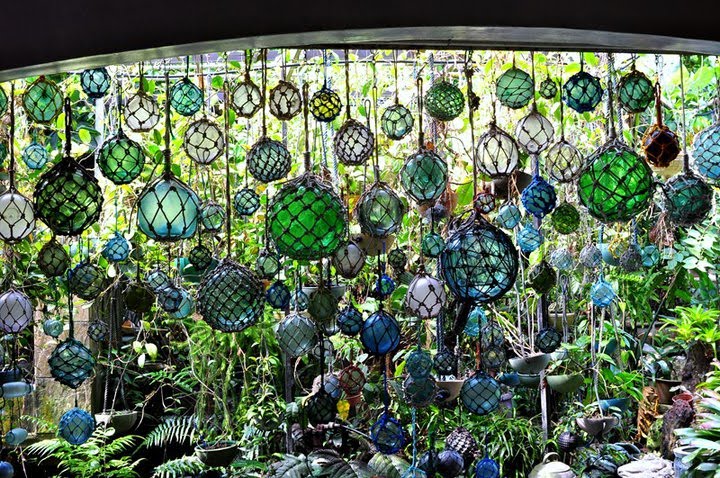
Glass Balls


I suspect many people would believe the occasional glass fishing float found on our shores is strictly a Japanese and Pacific Ocean phenomenon.

Actually, the first glass fishing floats probably came from Norway and were used in the Atlantic.  From 1762 to 1880, a Norwegian glass company was in business and it is believed they were producing glass floats as early as the late-1700s.

The first time these “modern” glass fishing floats are mentioned is in the production registry for Hadelands Glassverk in 1841. The registry shows that this is a new type of production.

However, there might have been some other versions of glass floats in use before that time. In the early 19th-century, the Schimmelmanns Glassverk (1779–1832) produced dark brown and very thick, bottle glass floats.

Aasnaes Glasvaerk, in business from 1813 to 1883, produced 122,493 glass floats just in the year 1875. A glass float with Aasnaes’s mark on the seal button is a collector’s item.

Early evidence of glass floats being used by fishermen comes from Norway in 1844, where small egg-sized floats were used with fishing line and hooks. Around the same time, glass was also used to support fishing nets.

The Japanese started producing small glass floats in the early-1900s and the first Asian floats came ashore along the West Coast just before 1920.

These Japanese floats are part of early recycling efforts – initial Japanese floats we made from recycled sake bottles.  Most floats are shades of green because that is the color of glass from these sake bottles (especially after long exposure to sunlight).

Other brilliant tones such as emerald green, cobalt blue, purple, yellow and orange were primarily made in the 1920s and 1930s. The most prized and rare color is a red or cranberry hue.

To accommodate different fishing styles and nets, the Japanese experimented with many different sizes and shapes of floats, ranging from 2 to 20 inches in diameter. Most were rough spheres, but some were cylindrical or “rolling pin” shaped.

Asahara Glass Company had several factories and made a variety of sizes.  Asahara made baseball- to orange-size floats for tako jigs, salmon gillnetting and seine fishing; grapefruit-size floats for seine and long-line cod fishing; basketball-size for tuna operations, bottom trawls and crab trapping; and the small rolling pin floats were used for tako jigs and troll fishing.

The earliest floats, including most Japanese glass fishing floats, were hand made by a glassblower. Recycled glass, especially old sake bottles, was typically used and air bubbles in the glass are a result of the rapid recycling process.

After being blown, floats were removed from the blowpipe and sealed with a “button” of melted glass before being placed in a cooling oven. This sealing button is sometimes mistakenly identified as a pontil mark (scar where the punt was broken from a work of blown glass.) However, no pontil (or punty) was used in the process of blowing glass floats.

While floats were still hot and soft, marks were often embossed on or near the sealing button to identify the float for trademark. These marks sometimes included kanji symbols.

A later manufacturing method used wooden molds to speed up the float-making process. Glass floats were blown into a mold to more easily achieve a uniform size and shape.

Seams on the outside of floats are a result of this process. Sometimes knife markings where the wooden molds were carved are also visible on the surface of the glass.

By 1939, millions of Japanese glass floats were being used; although Japanese glass fishing floats are no longer being manufactured for fishing, there are thousands still floating in the Pacific Ocean.

By the 1940s, glass had replaced wood or cork throughout much of Europe, Russia, North America and Japan.

Today most of the glass floats remaining in the ocean are stuck in a circular pattern of ocean currents in the North Pacific Gyre.

Off the east coast of Taiwan, the Kuroshio Current starts as a northern branch of the western-flowing North Equatorial Current.  It flows past Japan and meets the arctic waters of the Oyashio Current.

At this junction, the North Pacific Current (or Drift) is formed which travels east across the Pacific before slowing down in the Gulf of Alaska.

As it turns south, the California Current pushes the water into the North Equatorial Current once again, and the cycle continues.

Although the number of glass floats is decreasing steadily, many floats are still drifting on these ocean currents. Occasionally, storms or certain tidal conditions will break some floats from this circular pattern and bring them to ashore.

They most often end up on the beaches of Hawaiʻi, Alaska, Washington or Oregon in the United States, Taiwan or Canada.

Today, most of the remaining glass floats originated in Japan because it had a large deep sea fishing industry which made extensive use of the floats; some were made by Taiwan, Korea and China.

The image shows the mark of an Aasnaes Glasvaerk glass ball made in 1883.  In addition, I have included other images of glass fishing floats from the Atlantic and Pacific Oceans in a folder of like name in the Photos section on my Facebook and Google+ pages.

Follow Peter T Young on Facebook  

Follow Peter T Young on Google+  

© 2013 Hoʻokuleana LLC

Wednesday, September 19, 2012

Japanese Internment


During World War II, Japanese Americans were incarcerated in at least eight locations on Hawaiʻi.

These sites that include Honouliuli Gulch, Sand Island, and the U.S. Immigration Station on Oahu, the Kilauea Military Camp on the Big Island, Haiku Camp and Wailuku County Jail on Maui, and the Kalaheo Stockade and Waialua County Jail on Kauaʻi.

The forced removal of these individuals began a nearly four-year odyssey to a series of camps in Hawaiʻi and on the continental United States.

They were put in these camps, not because they had been tried and found guilty of something, but because either they or their parents or ancestors were from Japan and, as such, they were deemed a "threat" to national security.

In all, between 1,200 and 1,400 local Japanese were interned, along with about 1,000 family members.  The number of Japanese in Hawai‘i who were detained was small relative to the total Japanese population here, less than 1%.

By contrast, Executive Order 9066, signed by President Franklin D. Roosevelt on February 19, 1942, authorized the mass exclusion and detention of all Japanese Americans living in the West Coast states, resulting in the eventual incarceration of 120,000 people.

The detainees were never formally charged and granted only token hearings.  Many of the detainees’ sons served with distinction in the US armed forces, including the legendary 100th Battalion, 442nd Regimental Combat Team and Military Intelligence Service.

During the war, there was a Hawaii Defense Act, Order No. 5 that stated “all aliens were forbidden from possessing weapons, firearms, explosives short-wave radio receiving sets, transmitting sets, cameras, or maps of any United States military or naval installation.”

They could not travel by air, change residence or occupation or move without written permission from the provost marshal.

On December 8, 1941, the first detention camp was set up on Sand Island.  Several factors made Sand Island a logical place for establishment of the first detention camp.  Geographically, it was an island immediately adjacent to the city of Honolulu in the Honolulu Harbor.

The Territorial Quarantine Hospital had been located on Sand Island and it had housing, food prep and administrative facilities.

Within one week of the attack on Pearl Harbor, the FBI detained 370 Japanese, 98 German and 14 Italians.  Almost all of the Japanese detainees were men; of the European detainees, many were women.  The European and Japanese internees were segregated.

The first POW of the war (Ensign Kazuo Sakamaki, of the captured Japanese submarine that beached at Waimanalo) was also interned at Sand Island.

Each compound operated its own mess and maintained its own sanitary and internal administrations.  The detainees supplied their own recreational activities, such as softball and volleyball games.  Each compound had its own spokesman.

While most of the internees were residents of Oʻahu, there were Japanese detained on the Neighbor Islands.

On Kaua‘i internees were crowded into the county jail.  According to Gwen Allen (Hawaii War Years), the December 12, 1941 issue of the Kaua‘i newspaper reported that “the men are building double decker bunks.”  On the Big Island, detainees were interned at Kilauea Military Camp at Volcano.

Restrictions at each were different.  On Kaua‘i, after two days of war, a newspaper announcement invited families to call on detainees any day between 1 pm and 3 pm and they were allowed to take clean laundry and simple Japanese food.

On Maui, each detainee was given a questionnaire asking if they had any animals that needed feeding and other care, and if so, where can they be found.  On the Big Island, there was no public visiting until February 14, 1942.

For some O‘ahu internees, they began their detention at the Immigration Station at Fort Armstrong and were then moved to Sand Island.  Internees at Sand Island lived in tents until wooden barracks were built.  “Until books and other materials were allowed, the internees passed the time by smoothing sea shells for necklaces by rolling them on the concrete floors.”

In March 1942, Sand Island closed.  Some detainees were sent to Honouliuli Internment camp.

Because arrests and detentions continued through the war, the community remained on edge, fearful as to who might be next.  Japanese culture became equated with Japanese political affiliation, and Japanese language clothing and customs suddenly disappeared.

Though some detainees were released after a short imprisonment, the majority were detained for the duration of the war, with most eventually transferred to camps on the continental United States, for a period approaching four years.

Most eventually returned to Hawai‘i after the war.

In 2006, President Bush signed the Camp Preservation Bill (HR 1492), which authorized $38 million in funding for the preservation of former World War II confinement sites.  In part, the intent is that the Honouliuli site become a public historical park where the Hawai‘i internees story can be shared with future generations.

The fact that the internment did happen here in the Hawaiʻi are something to never forget.  Much of the information and images here is from documents attributed to the Japanese Cultural Center of Hawai‘i.  I have also added other images in a folder of like name in the Photos section on my Facebook page.

http://www.facebook.com/peter.t.young.hawaii

© 2012 Hoʻokuleana LLC

Tuesday, August 7, 2012

Buddhism in Hawai‘i


New England Congregationalists first brought Protestant Christianity to the islands in 1820.  Roman Catholic missionaries came to Hawaii in 1827.  Quakers came in 1835 and Mormons in 1850.  Methodists came in 1855, and members of the Church of England arrived in 1862.

Shortage of laborers to work in the growing sugar plantations prompted the Hawaiian Legislature to pass "An Act for the Governance of Masters and Servants," a section of which provided the legal basis for contract-labor system (labor shortages were eased by bringing in contract workers from Asia, Europe and North America.)

Japanese immigration to Hawaiʻi that began in 1868 marked the beginnings of large-scale settlement and, with it, the establishment of a strong religious base of Buddhism.

A large wave of Japanese laborers started arriving in 1885; 29,000 Japanese traveled to Hawai‘i for the next nine years to work on sugar plantations under three-year contracts.

The history of formal Buddhism teachings in Hawai‘i can be traced to the arrival of Soryu Kagahi, a priest of the True Pure Land Sect and a native of Oita Prefecture. 

Upon learning of the extreme hardship, both physical and spiritual, of the Japanese immigrants in Hawaiʻi due to the differences in language and culture, he came to Hawaii to comfort these immigrants and to help in alleviating their hardship.

Kagahi, the first Hongwanji minister, came to Hawai‘i to minister to the religious needs of Japanese immigrants and to share the teachings of Shakamuni Buddha and Shinran Shonin.

Upon arriving in Honolulu on March 2, 1889 (which is presently celebrated as Hawai‘i Kyodan’s “Kaikyo Kinen-bi” or “Hongwanji Day”, the founding day of the mission), Reverend Kagahi rented a house and hung a sign, “The Great Imperial Japan Hongwanji Denomination Hawaii Branch” and used it as a base for his religious activities.

He also traveled to Kauaʻi, Maui and Big Island and conducted religious services.  He visited the Big Island on two occasions and helped the people in Hilo in founding the fukyojo, the forerunner of the present Hilo Betsuin.  (Hilo at that time had a larger Japanese population than did Honolulu.)

In October 1889, Reverend Kagahi returned to Japan to report on the Hawaiʻi situation and to urge establishment of Jodo Shinshu in Hawaii.  He also stressed the need for financial assistance to Hawaiʻi to carry forward these activities.

However, since authorities in Japan initially viewed the Japanese presence in Hawaii as “transient,” they did not see the need for a Hawaiian mission.

That changed in 1897 when the Japanese immigrants petitioned the Honpa Hongwanji headquarters in Japan and requested that Buddhist missionaries be sent to Hawai‘i.

They expressed the urgency and need for “community stability” – a stability achieved through religious institutions and the revival of cultural commonalities among the immigrants.

Leadership in Japan, now aware that the Japanese immigrant had become more than a transient, responded enthusiastically, and more missions were established.

The rise of Buddhism in a predominantly Christian environment was due, in part, to this deeper expression among the Japanese immigrants of their need for a sense of community.

Several of the sugar plantations were sympathetic and supportive of the desire for temples and donated parcels of land near the immigrant camps. 

In 1898, the Rev. Honi Satomi arrived as the first Bishop of Hongwanji and property located off Fort Street at the end of Kukui, in the area called Fort Lane (just above Beretania Street and Central Fire Station) was purchased for the first site of the temple.

Queen Lili'uokalani and Mary Foster (donor of Foster Botanical Garden,) attended a Buddhist service in 1901 to commemorate the birth of founder Shinran Shonin.

In 1918, the Honpa Hongwanji Mission was built in Honolulu, the world’s first reinforced concrete Buddhist temple.

Several Buddhist sects came to Hawai‘i in the late-1800s and early-1900s to fill the needs of the early Japanese: Jodo Shin-shu Honpa Hongwanji Sect, Jodo Sect, Shingon Sect, Nichiren Sect, Jodo Shin Sect and the Higashi Hongwanji Sect.

Over the past 120 years, the Japanese community established 174 temple sites and through the process of building and rebuilding, constructed nearly 300 Buddhist temples throughout the islands, many of which were built in sugar plantation villages by early Japanese immigrants and served tiny congregations.

The image shows the Hilo Hongwanji Temple in 1889.  In addition, I have posted some of the other Buddhist temples across the state in a folder of like name in the Photos section on my Facebook page.

© 2012 Hoʻokuleana LLC